KMC Ward Delimitation | Calcutta High Court Declines Interim Stay On Increase In Number Of Wards Ahead Of Civic Polls
Srinjoy Das
30 Oct 2026 11:42 AM IST
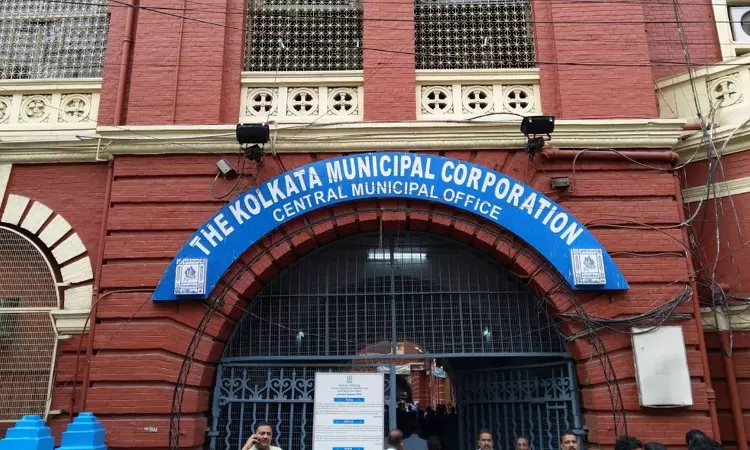
Image Courtesy: The Statesman
The Calcutta High Court has refused to stay the West Bengal government's decision to increase the number of Kolkata Municipal Corporation (KMC) wards from 144 to 209, while considering a challenge alleging that the delimitation exercise was carried out to give an unfair electoral advantage to the ruling party.
Justice Hiranmay Bhattacharyya observed that the petitioner had failed to establish a prima facie case for interim relief, particularly when objections and suggestions had been invited at various stages of the delimitation exercise and the election notification was yet to be issued.
“The balance of convenience and inconvenience is against passing of any interim order in a case of this nature,” the Court observed.
The Court was hearing a writ petition filed by Dipu Das challenging the notification dated September 11, 2026, through which Schedule II of the Kolkata Municipal Corporation Act, 1980, was amended to increase the number of wards from 144 to 209.
The petitioner alleged that the delimitation exercise was based on electoral rolls instead of actual population, thereby excluding a substantial number of residents from consideration. It was further alleged that ward boundaries had been drawn without considering geographical contiguity, compactness and administrative convenience.


The petitioner also alleged that the exercise amounted to gerrymandering, intended to secure partisan advantage for the ruling political party by manipulating constituency boundaries.
Senior Advocate Bikash Ranjan Bhattacharya, appearing for the petitioner, argued that the delimitation exercise lacked a valid foundation as the Kolkata Municipal Corporation had already been dissolved when the recommendation for the exercise was made.
Referring to Sections 117 and 118 of the 1980 Act, he contended that the Municipal Commissioner, being merely an officer of the Corporation, was not competent to make recommendations for delimitation after its dissolution.
Opposing the petition, Advocate General appearing for the KMC argued that the Municipal Commissioner had been appointed as Administrator and vested with all the powers of the Corporation's members. He further submitted that objections and suggestions had been invited at various stages of the delimitation exercise and hearings had been afforded to objectors.
Court's Observations
At the outset, the Court considered the objection regarding the maintainability of the petition under Article 243ZG of the Constitution, which bars judicial interference in matters relating to delimitation of municipal constituencies.
Relying on the Supreme Court's decision in State of Uttar Pradesh v. Pradhan Singh Kshettra Samiti, the Court observed that a delimitation exercise could be challenged only on limited grounds, including where objections were not invited or an opportunity of hearing was not provided.
Since the election notification had not yet been issued, the Court held that it was inclined to entertain the writ petition.
However, on examining the records, the Court found that objections and suggestions had been invited against the proposed delimitation at different stages.
It noted that a notice dated August 5, 2026, had been issued inviting objections and suggestions concerning the preparatory draft of Schedule II. Subsequently, after the Kolkata Municipal Corporation (Amendment) Act, 2026, came into force on August 20, 2026, another opportunity was provided to submit objections against the draft Schedule II between August 22 and September 3, 2026.
The Court also noted that hearings had been conducted on consecutive dates to consider claims and objections.
Importantly, it observed that there was no material to indicate that the petitioner had submitted any objection or suggestion against the draft publication.
“A person having not submitted any objection / suggestion against the draft publication on amendment of Schedule II of the 1980 Act cannot be allowed to take a stand at this point of time that no opportunity of hearing was given to him prior to issuance of the notification dated 11th September, 2026,” the Court observed.
Rejecting the contention that the delimitation exercise had commenced before the amendment to Section 5 of the 1980 Act, the Court held that only preparatory work had been initiated earlier, while the actual delimitation exercise commenced after the amendment came into force.
The Court further held that Section 601 of the 1980 Act empowered the State Government to amend Schedule II and determine the manner in which the municipal wards would be delimited, subject to fulfilment of the statutory conditions.
On the question of the Municipal Commissioner's authority to recommend the delimitation exercise, the Court referred to the order dated June 8, 2026, appointing him as Administrator under Section 118(1)(b) of the Act.
It held that following the dissolution of the Corporation, the Municipal Commissioner, as Administrator, was vested with the powers and duties of the Corporation's members, the Mayor-in-Council and its committees.
The Court, therefore, rejected the petitioner's contention that the Municipal Commissioner was not competent to make a recommendation for delimitation.
Distinguishing the Supreme Court's decision in State of Madhya Pradesh v. Devilal, the Court observed that the said case concerned restructuring of constituencies during an ongoing election process. In the present case, the delimitation exercise had already been completed and the election notification was yet to be issued.
Finding no prima facie case for interim relief, the Court refused to stay the September 11 notification or restrain the authorities from proceeding with the electoral process.
The Court directed the respondents to file their affidavits-in-opposition within three weeks, with the petitioner being permitted to file a reply within one week thereafter. It clarified that its findings were only prima facie observations made for deciding the prayer for interim relief.
Case: Dipu Das v. State of West Bengal & Ors.
Case No.: WPA 31433 of 2026