- Home
- /
- High Courts
- /
- Chhattisgarh High Court
- /
- 'Voice Recording Of Bribe Demand...
'Voice Recording Of Bribe Demand Inadmissible Without S.65B Evidence Act Certificate & Voice Sample Authentication': Chhattisgarh High Court
Saksham Vaishya
29 Jun 2026 6:10 PM IST
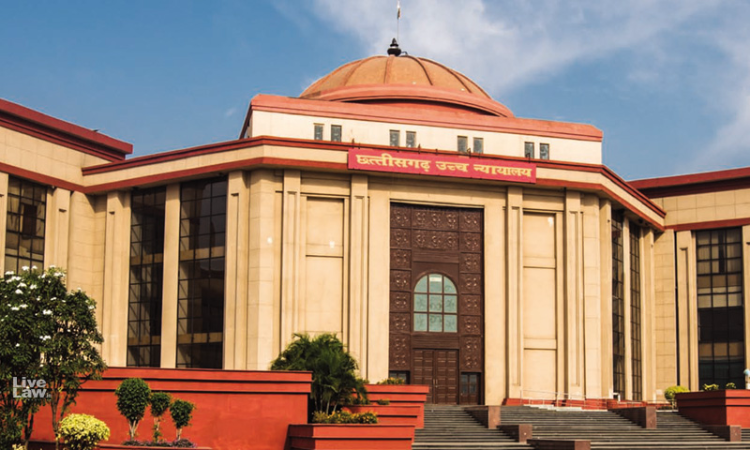
The Chhattisgarh High Court has acquitted two public servants convicted under the Prevention of Corruption Act, 1988, holding that the prosecution failed to prove the demand of illegal gratification beyond a reasonable doubt. The Court observed that in the absence of a certificate under Section 65-B of the Indian Evidence Act, 1872, coupled with the absence of voice samples or any FSL report,...
This is a premium content
Available exclusively to
Our subscribers
Subscribe Premium 
INR 1099+GST
Your support helps us to bring you more content at
an affordable subscription scheme !!!
All payment options available
The Chhattisgarh High Court has acquitted two public servants convicted under the Prevention of Corruption Act, 1988, holding that the prosecution failed to prove the demand of illegal gratification beyond a reasonable doubt. The Court observed that in the absence of a certificate under Section 65-B of the Indian Evidence Act, 1872, coupled with the absence of voice samples or any FSL report, the recorded conversations relied upon by the prosecution could not be relied upon.
[2026 LiveLaw (Chh) 46]
Justice Rajani Dubey was hearing an appeal against the judgment of the Special Judge (Prevention of Corruption Act), convicting the appellants under Sections 7 and 13(1)(d) read with Section 13(2) of the Prevention of Corruption Act, 1988. The prosecution alleged that the complainant, whose wife's salary had been withheld for six months, was asked by appellant No.2 to pay Rs. 5,000 as illegal gratification on behalf of appellant No.1 for the release of the salary. On the instructions of the Anti-Corruption Bureau, the complainant recorded conversations with the accused and, during a trap conducted on 12.10.2010, tainted currency notes were recovered from the pocket of appellant No.1.
The Investigating Officer admitted that no voice samples of either the accused or the complainant had been obtained, while prosecution witnesses also admitted that the recorded conversation was unclear because multiple persons' voices were audible. The Court further observed that no certificate under Section 65-B of the Indian Evidence Act, 1872, had been produced in respect of the electronic record.
“In the absence of a certificate under Section 65-B of the Indian Evidence Act, 1872, and in the absence of any voice sample or FSL report, the voice recording cannot be relied upon,” the Court observed.
Referring to various precedents, the Court noted that proof of demand of illegal gratification is the sine qua non for conviction under the Prevention of Corruption Act and that mere recovery of tainted money is insufficient. The Court also referred to the Delhi High Court's decision in Romesh Sharma v. State [CrL. Rev.P. 646/2004], wherein the conditions governing admissibility of tape-recorded conversations, including proper identification of the speaker's voice, proof of accuracy, exclusion of tampering and compliance with evidentiary requirements, were discussed.
The Court held that the prosecution had failed to prove the demand for a bribe. It observed that the voice recordings were identified solely on the complainant's version, no voice samples had been collected, another person allegedly involved in the conversation had neither been cited nor examined, and the possibility of tampering with the voice recorder could not be ruled out, as it remained with the complainant for several days before seizure.
Accordingly, the Court allowed the appeal, set aside the judgment of conviction and sentence dated 08.09.2017, and acquitted both the appellants of all charges.
Case Title: Anil Markende & Anr. v. State of Chhattisgarh [CRA No. 1423 of 2017].
Click Here To Read/Download Order
Citation: 2026 LiveLaw (Chh) 46
Tags