- Home
- /
- High Courts
- /
- Chhattisgarh High Court
- /
- 'Last Heard' Over Phone Can't Be...
'Last Heard' Over Phone Can't Be Treated As 'Last Seen Together' Evidence: Chhattisgarh High Court Acquits Murder Convict
Saksham Vaishya
22 July 2026 8:40 PM IST
The Chhattisgarh High Court has held that the circumstance of a deceased informing a person during a telephonic conversation that he was in the company of the accused constitutes, at best, a case of "last heard" and cannot be equated with the doctrine of "last seen together". The Court observed that the trial court had erroneously treated evidence of "last heard" as proof of "last...
This is a premium content
Available exclusively to
Our subscribers
Subscribe Premium 
INR 1099+GST
Your support helps us to bring you more content at
an affordable subscription scheme !!!
All payment options available
The Chhattisgarh High Court has held that the circumstance of a deceased informing a person during a telephonic conversation that he was in the company of the accused constitutes, at best, a case of "last heard" and cannot be equated with the doctrine of "last seen together". The Court observed that the trial court had erroneously treated evidence of "last heard" as proof of "last seen together".[2026 LiveLaw (Chh) 77]
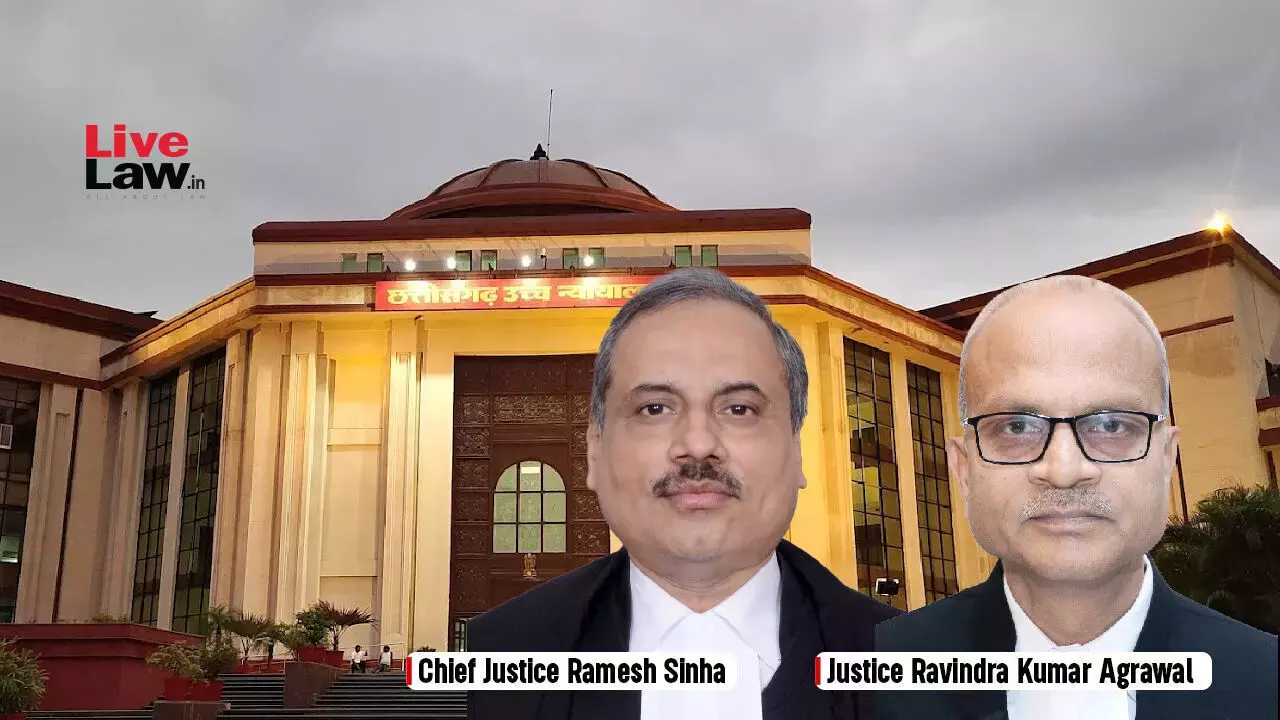
A Division Bench comprising Chief Justice Ramesh Sinha and Justice Ravindra Kumar Agrawal was hearing a criminal appeal filed by the appellant challenging his conviction under Section 302 of the Indian Penal Code and Section 3(2)(v) of the Scheduled Castes and the Scheduled Tribes (Prevention of Atrocities) Act, 1989. The prosecution case was that the deceased had gone to work at the appellant's agricultural field and, during a telephonic conversation with his wife, informed her that he was sitting with the appellant and three other persons and would return shortly. Later, he was found lying unconscious near the appellant's house and was declared dead at the hospital. The trial court convicted the appellant primarily on the basis of the alleged "last seen together" circumstance and the testimony of the deceased's wife regarding gestures allegedly made by the deceased before his death.
The Court observed that the prosecution had successfully established that the death was homicidal through the medical evidence, but held that proof of homicidal death alone was insufficient unless the prosecution also proved beyond reasonable doubt that the appellant was the perpetrator. It observed that no prosecution witness had deposed to having actually seen the deceased alive in the company of the appellant immediately before the occurrence or within such proximity of time as would attract the doctrine of "last seen together".
The Court noted that the prosecution evidence established only that the deceased was "last heard" by his wife during a telephonic conversation stating that he was with the appellant and three other persons. The Court held that such evidence could not, in law, be equated with proof of the circumstance of "last seen together".
“… the prosecution evidence, at its highest, establishes only that the deceased was “last heard” by PW-2 to be in the company of the appellant and certain other persons. Such evidence cannot, in law, be equated with proof of the circumstance of "last seen together," the Court observed.
The Court highlighted that the doctrine of "last seen together" is founded upon direct evidence that the deceased was actually seen alive in the company of the accused at or about the time of the occurrence, and can be invoked only where the time gap is so small that the possibility of any other person being the author of the crime stands effectively excluded.
The Court further observed that even according to the telephonic conversation, the deceased had stated that he was with the appellant as well as three other persons and, therefore, the conversation did not exclusively connect the appellant with the deceased.
Accordingly, the Court allowed the appeal, set aside the judgment of conviction and order of sentence, and acquitted the appellant of all the charges by extending the benefit of doubt.
Case Title: Naresh Kumar Sahu v. State of Chhattisgarh [CRA No. 1599 of 2024]
Click Here To Read/Download Order
Citation: 2026 LiveLaw (Chh) 77
Tags