Police Must Obtain Prior Magistrate's Permission To Investigate Non-Cognizable Offences; Subsequent Approval Can't Cure Illegality: Chhattisgarh High Court
Saksham Vaishya
25 Nov 2026 3:45 PM IST
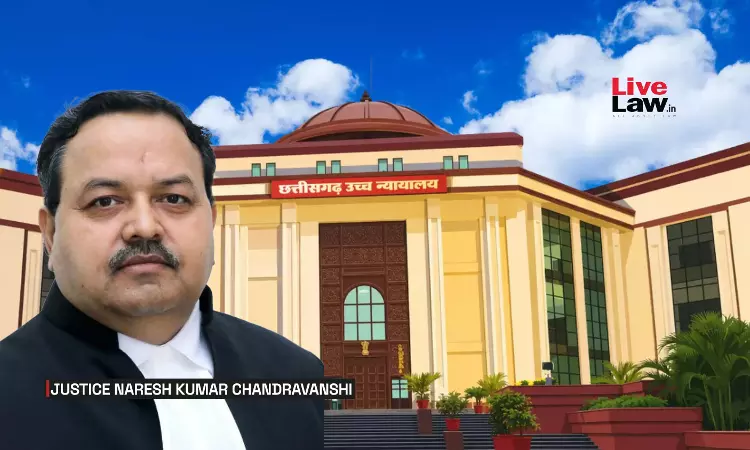
The Chhattisgarh High Court has quashed criminal proceedings against a woman accused of assaulting a minor child, holding that the police could not investigate the non-cognizable offences without obtaining prior permission from the competent court under Section 174 of the Bharatiya Nagarik Suraksha Sanhita (BNSS). The Court ruled that permission obtained after substantive investigative steps had already been completed could not cure the initial illegality.
Justice Naresh Kumar Chandravanshi allowed a criminal revision petition filed under Section 438 r/w Section 442 of the BNSS, challenging the Children Court's rejection of her discharge application in Criminal Case under Section 115(2) of the Bharatiya Nyaya Sanhita (BNS) and Section 75 of the Juvenile Justice (Care and Protection of Children) Act, 2015.
The case arose from allegations that the applicant, who was a distant relative of the 14-year-old victim, had brought the child from Bihar to look after her own child. It was alleged that the applicant assaulted the minor during the intervening night of July 5–6, 2025, following which the child left the house and narrated the incident to a ward councillor and others. Based on a complaint lodged by the councillor, an FIR was registered.


The applicant argued that both offences were non-cognizable on the date of registration of the FIR and that the police had conducted the investigation without obtaining prior permission from the competent court, in violation of Section 174 BNSS. Although the Children Court subsequently granted permission for investigation and arrest on December 8, 2025, the applicant contended that this could not validate investigative steps already undertaken before the permission was obtained.
The Court noted that Section 115(2) BNS was non-cognizable, bailable and triable by a Magistrate. It observed that as per Section 86 of the Juvenile Justice Act, offences punishable with imprisonment of three years or more but not exceeding seven years were classified as non-cognizable and non-bailable.
The Court held that the offence under Section 75 of the Act was also non-cognizable on the relevant date. Consequently, both offences registered against the applicant were non-cognizable.
“Since the aforesaid provision in respect of Section 75 of the Act, 2015 was amended prior to the date of incident of instant case, therefore, at the time of incident of instant case and lodging of the FIR, i.e., 05-06.07.2025, the offence under Section 75 of the Act, 2015 was non-cognizable,” the Court remarked.
Referring to Section 174 BNSS, the Court explained that the police must enter information concerning a non-cognizable offence in the prescribed register and obtain an order from the competent Magistrate before commencing investigation.
On examining the case diary and other documents, the Court found that, before obtaining permission on December 8, 2025, the police had already prepared the spot map, conducted the victim's medical examination and recorded witness statements. These steps constituted substantive parts of the investigation.
The Court held that subsequent permission from the Children Court could not rectify the initial defect, as prior authorisation under Section 174 BNSS was mandatory.
“… all substantive parts of the investigation had already been carried out in respect of the non-cognizable offences registered against the applicant/accused. In such circumstances, obtaining permission from the Children Court, subsequent to the substantive investigation, vide order dated 08.12.2025, cannot rectify the initial defect in the investigation,” the Court observed.
The Court consequently held that the investigation and charge-sheet suffered from grave illegality and that the criminal proceedings could not be sustained. It set aside the Children's Court's order dated April 8, 2026, quashed the charge-sheet and consequential criminal proceedings, and discharged the applicant from the case.
Case Title: Smt. Khushbu Kumari v. State of Chhattisgarh [CRR No. 653 of 2026]