



- Home
- /
- High Courts
- /
- Delhi High Court
- /
- 'What Is The Judicially Manageable...
'What Is The Judicially Manageable Standard?': Delhi High Court Questions PIL Challenging Rajya Sabha Nomination Of C Sadanandan Master
Nupur Thapliyal
25 Feb 2026 1:15 PM IST
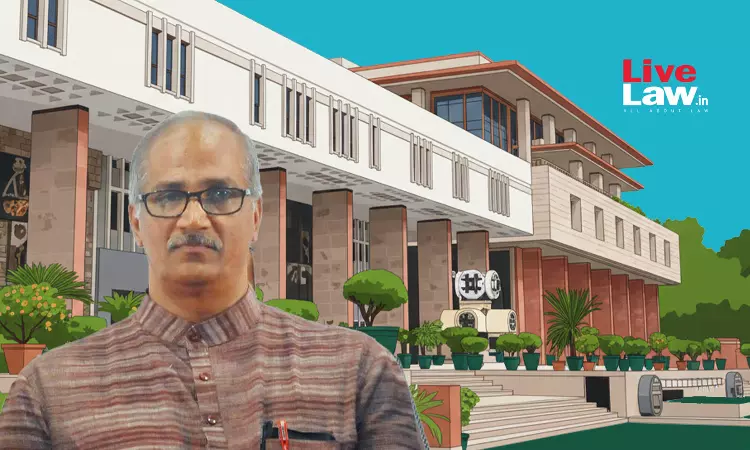
The Delhi High Court on Wednesday questioned a public interest litigation filed against nomination of veteran BJP leader C Sadanandan Master to the Rajya Sabha, alleging that he lacks demonstrable special knowledge or practical experience as required in law. A division bench comprising Chief Justice DK Upadhyaya and Justice Tejas Karia asked if there is any judicially manageable standard...
This is a premium content
Available exclusively to
Our subscribers
Subscribe Premium 
INR 1099+GST
Your support helps us to bring you more content at
an affordable subscription scheme !!!
All payment options available
The Delhi High Court on Wednesday questioned a public interest litigation filed against nomination of veteran BJP leader C Sadanandan Master to the Rajya Sabha, alleging that he lacks demonstrable special knowledge or practical experience as required in law.
A division bench comprising Chief Justice DK Upadhyaya and Justice Tejas Karia asked if there is any judicially manageable standard to adjudicate such an issue.
Master was nominated by the President of India on July 12 last year. Others who were nominated were eminent lawyer Ujjwal Deorao Nikam, former Foreign Secretary Harsh Vardhan Shringla and historian and academician Dr Meenakshi Jain.
The plea has been filed by one Subhash Theekkadan, an advocate by profession, contending that Master's nomination is not based on material presently available in the public domain, any comparable nationally recognized specialization, academic distinction, or substantial contribution within the fields of literature, science, art, or social service as contemplated under Article 80(3) of the Constitution of India.
Advocate MP Raju appearing for the petitioner said that Master did not have any social service expertise to be eligible for nomination and that he was just a former teacher in an ordinary school who later turned politician.
On this, the CJ remarked,
“How to determine this? What is the judicially manageable standard to adjudicate if someone is competent or not? Are we equipped with any such standard to observe if Mr. X is a competent in literature or in arts? Such issues are not appreciable. Filing of petition is fine. We aren't saying that the petition is not maintainable but maintainability of a petition and justiciability is another issue.”
“Whether Sachin Tendulkar was a better player or Vinod Kambli was a better player can be better determined by cricket pandits, not by us. We lack the expertise,” the CJ added.
ASG Chetan Sharma appearing for the Union Government said that there are no judicially manageable standards available to adjudicate such an issue and there are no judicially recognized principles of management to do the same.
“For a politician, the word “social service” used (in the provision) has a direct nexus,” ASG said.
After hearing both sides, the Court said that it will be passing orders if notice has to be issued in the matter to the respondents.
The plea stated that absence of demonstrable material indicating such a qualification raises serious constitutional concerns regarding compliance with the mandatory requirement embedded in Article 80(3).
“There is no publicly known structured mechanism governing the identification, evaluation, or selection of persons possessing special knowledge or practical experience under Article 80(3). It remains unclear whether any objective criteria are applied, whether credentials are independently scrutinized, whether reasons are recorded, or whether any institutional safeguards exist to ensure that the constitutional mandate is meaningfully complied with,” the plea said.
It added that absence of a declared and transparent procedure raises a legitimate apprehension that the nomination process may be “reduced to political discretion rather than merit-based constitutional evaluation.”
“Arbitrary or politically motivated nominations dilute the institutional integrity of the Rajya Sabha, undermine deliberative democracy. and erode the constitutional design envisioned by the framers. The consequences of such constitutional subversion are systemic and affect the citizenry at large, whose right to be governed in accordance with constitutional norms forms part of the democratic basic structure,” the plea said.
Apart from challenging Master's nomination, the plea sought to restrain Master from functioning, acting, or discharging any duties as a nominated Member of the Rajya Sabha.
A direction is sought that political work or party loyalty cannot be equated with social service under Article 80(3) of the Constitution of India.
The plea also sought framing of guidelines for nominations, ensuring that the same are made only on the basis of demonstrable and independent excellence in the specified fields.
The plea has been filed through Advocate Vineeth S Varkalavila.
Title: SUBHASH THEEKKADAN@ SUBHASH TM v. UNION OF INDIA & ORS
Tags

Nupur Thapliyal
Nupur Thapliyal is a Principal Correspondent with LiveLaw, based in New Delhi. She reports from the Delhi High Court and trial courts in the national capital

