



- Home
- /
- High Courts
- /
- Delhi High Court
- /
- Can't Proactively Monitor And...
Can't Proactively Monitor And Remove Unauthorized Videos Of Court Proceedings From Social Media: Meta, Google Tell Delhi High Court
Nupur Thapliyal
7 July 2026 11:49 AM IST
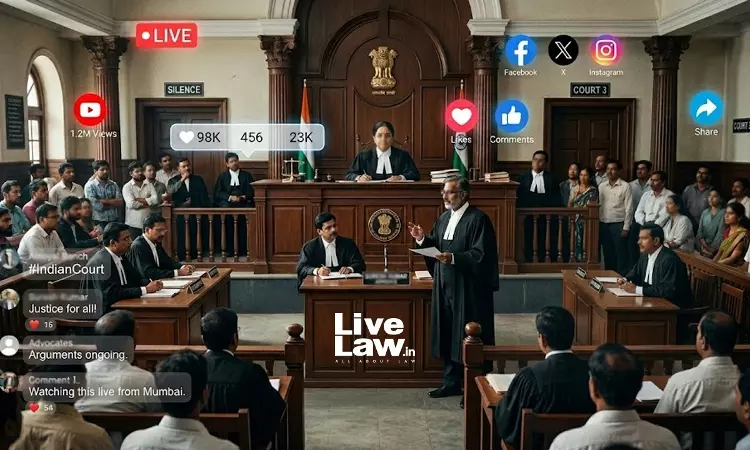
Google LLC and Meta Platforms have told the Delhi High Court that they cannot proactively identify, monitor and remove content related to unauthorized recording of court proceedings circulating on social media. The tech giants have made the submission while opposing the plea filed by one Vaibhav Singh against Arvind Kejriwal and other AAP leaders, alleging that they unauthorizedly recorded...
This is a premium content
Available exclusively to
Our subscribers
Subscribe Premium 
INR 1099+GST
Your support helps us to bring you more content at
an affordable subscription scheme !!!
All payment options available
Google LLC and Meta Platforms have told the Delhi High Court that they cannot proactively identify, monitor and remove content related to unauthorized recording of court proceedings circulating on social media.
The tech giants have made the submission while opposing the plea filed by one Vaibhav Singh against Arvind Kejriwal and other AAP leaders, alleging that they unauthorizedly recorded the court proceedings that happened on April 13 while Kejriwal was appearing in person seeking recusal of Justice Swarana Kanta Sharma from CBI's liquor policy case.
On April 23, the Court had directed taken down of social media posts containing videos of court proceedings.
In its response, Meta has said that it does not have an obligation to proactively monitor content, including the content relating to unauthorised recording of court hearings.
“Petitioner's request to direct Meta to identify and remove the Contested Content from the Facebook Service, if granted, would contravene Section 79 of the IT Act and the Hon'ble Supreme Court's precedent that intermediaries, like Meta, cannot be compelled to proactively monitor their platforms for unlawful / infringing content,” it has said.
The affidavit also adds that while the Court has already issued directions to take down the infringing content, Singh is seeking a broader relief requiring Meta to proactively identify and prevent the dissemination of any future content that may allegedly violate the VC Rules, which is not possible.
Meta has said that such determination cannot be made in the abstract and would necessarily require a case-by-case assessment of the source, context, nature and legality of the content, including whether it constitutes an unauthorised recording or rebroadcast of court proceedings and whether it falls within the scope of judicial directions.
“Accordingly, while Meta remains willing to take appropriate action in relation to specific URLs identified by the Petitioner in terms of the April 23 Order or directed to be actioned by this Hon'ble Court, the broader relief sought by the Petitioner requiring proactive identification of future, previously unidentified content falls outside the scope of the due diligence obligations contemplated under the IT Rules. To hold otherwise would effectively require Meta to undertake an ongoing assessment of the legality of user-generated content prior to any judicial determination regarding such content — a function neither contemplated by the requirement of “reasonable efforts” under Rule 3(1)(b)(xi) nor by the limited technology-based measures contemplated under Rule 4(4),” the affidavit states.
Taking a similar stand, Google in its response has said that it is impossible to proactively monitor the videos uploaded on the YouTube platform.
Google has said that it neither owns, nor controls nor is specifically aware whether the video uploaded by a user is infringing or unlawful or not.
As per Google, it is the uploader alone who has the specific knowledge of the content of the video he or she uploads and Google is a mere intermediary in the whole process.
The affidavit states that Google is neither involved with nor has created or endorsed the impugned content as alleged by Singh anywhere on YouTube.
“Therefore, liability, if any that is to be fastened, can only be against the publisher/uploader of the Contested Content and not against the Answering Respondent. The Contested Content is admittedly "third party content" or "user generated content" that is (i) neither created (ii) nor owned (iii) nor otherwise controlled by the Answering Respondent. The Answering Respondent merely operates the YouTube platform where videos can be uploaded and accessed on the internet on an "as is" basis,” the affidavit states.
The matter came up for hearing before a division bench comprising Justice V Kameswar Rao and Justice Manmeet Pritam Singh Arora which noted that several respondents were not yet served. The matter was therefore adjourned to next month.
Singh has sought removal of the videos from social media, alleging that Kejriwal and others circulated court proceedings during recusal hearing on April 13 and maligned judiciary's image.
It was alleged that there was a conspiracy done by Kejriwal and other politicians to mislead the common people and to show the general public that the judiciary is working on the behest of some political parties and also under the pressure of the Central Government.
Singh had requested the Court to setup a detailed inquiry and take appropriate action against all the political leaders for wilfully and deliberately disobeying the Delhi High Court VC Rules.
The plea contended that till date, no appropriate response has been given by any of the social media platforms nor they have removed the unauthorized recordings of the court proceedings.
The plea names the following as respondents: Kejriwal, Manish Sisodia, Sanjay Singh, Sanjeev Jha, Punardeep Sawhney, Jarnail Singh, Mukesh Ahlawat, Vinayy Mishra as well as INC's Digvijay Singh and journalist Ravish Kumar.
Other respondents are Delhi High Court seeking, Meta platforms, Google LLC and X Corp.
Title: VAIBHAV SINGH v. DELHI HIGH COURT & ORS
Nupur Thapliyal
Nupur Thapliyal is a Principal Correspondent with LiveLaw, based in New Delhi. She reports from the Delhi High Court and trial courts in the national capital

