



- Home
- /
- High Courts
- /
- Delhi High Court
- /
- Delhi High Court Stays DU Student's...
Delhi High Court Stays DU Student's Rustication, Says Imposing Penalty Without Hearing Shows 'Dictatorial' Exercise
Nupur Thapliyal
1 Oct 2026 2:15 PM IST
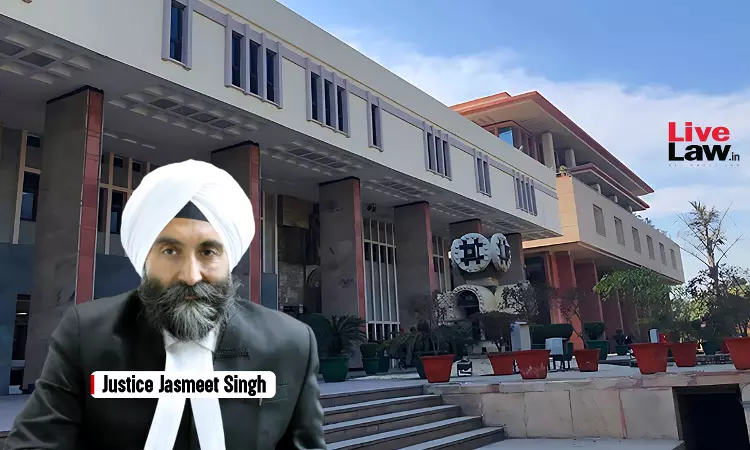
The Delhi High Court has observed that educational institutions cannot invoke their disciplinary authority to deny students the fundamental right to be heard while taking any action against them.Justice Jasmeet Singh emphasised that institutional autonomy does not confer unfettered or arbitrary powers.The Court observed that while educational institutions are entitled to maintain discipline...
This is a premium content
Available exclusively to
Our subscribers
Subscribe Premium 
INR 1099+GST
Your support helps us to bring you more content at
an affordable subscription scheme !!!
All payment options available
The Delhi High Court has observed that educational institutions cannot invoke their disciplinary authority to deny students the fundamental right to be heard while taking any action against them.
Justice Jasmeet Singh emphasised that institutional autonomy does not confer unfettered or arbitrary powers.
The Court observed that while educational institutions are entitled to maintain discipline and take appropriate action against established misconduct, such powers must be exercised within the confines of law and fair procedure.
“The power to discipline must necessarily be exercised within the confines of law and fair procedure. The respondent institution cannot, by invoking its disciplinary authority, dispense with the fundamental requirement of giving the affected student an opportunity to be heard,” the Court said.
Justice Singh made the observations while hearing a plea filed by Priyanka Rawat, a student enrolled in the Certificate Course in Bakery and Confectionery at the University of Delhi's Centre of Innovative Skill Based Courses, challenging her rustication from the course.
Rawat alleged that she was rusticated on September 10, without being issued a show-cause notice or being given an opportunity to explain her position.
She had earlier raised complaints regarding hygiene and food-safety concerns, including a corroded oven, unclean equipment and the use of expired raw materials.
The Court noted that the university's order recorded findings concerning Rawat's alleged conduct, including allegations of loud, rude and disrespectful behaviour, without first putting the allegations to her for a response.
“The impugned order, therefore, prima facie discloses a complete disregard of the foundational principles of natural justice. The manner in which the respondent Nos. 2 and 3 have proceeded is, to say the least, dictatorial,” the Court said.
It observed that the requirement of a prior hearing assumes particular significance when disciplinary action deprives a student of the opportunity to continue their education.
The Court said that the rule of audi alteram partem, which says that no person should be condemned unheard, is of profound importance where the proposed action has the effect of depriving a student of the opportunity to continue her course of study.
“It is difficult to comprehend how an academic institution such as respondent Nos. 2 and 3, which is expected to inculcate discipline, fairness and respect for the rule of law amongst its students, could itself proceed to impose the harshest disciplinary consequence without following the elementary principles of natural justice,” the Court said.
”The very manner in which the power has been exercised, without notice and without hearing, bears the trappings of a dictatorial exercise of authority and cannot be permitted in a society governed by the rule of law,” it added.
During the hearing, counsel for the university authorities acknowledged that the prescribed procedure had not been followed and stated that a fresh inquiry would be conducted in accordance with due process.
Accordingly, the Court stayed the rustication order until the next date of hearing and directed that the student be permitted to continue her course.
It also directed the concerned authorities to file a counter-affidavit explaining the basis for the impugned action.
The matter will next be heard on January 13, 2027.
Tags

Nupur Thapliyal
Nupur Thapliyal is a Principal Correspondent with LiveLaw, based in New Delhi. She reports from the Delhi High Court and trial courts in the national capital

