



- Home
- /
- High Courts
- /
- Delhi High Court
- /
- Judge Who Reserved Judgment Must...
Judge Who Reserved Judgment Must Pronounce Verdict Despite Transfer, Successor Judge Can't Order Rehearing: Delhi High Court
LIVELAW NEWS NETWORK
8 Jan 2026 8:10 PM IST
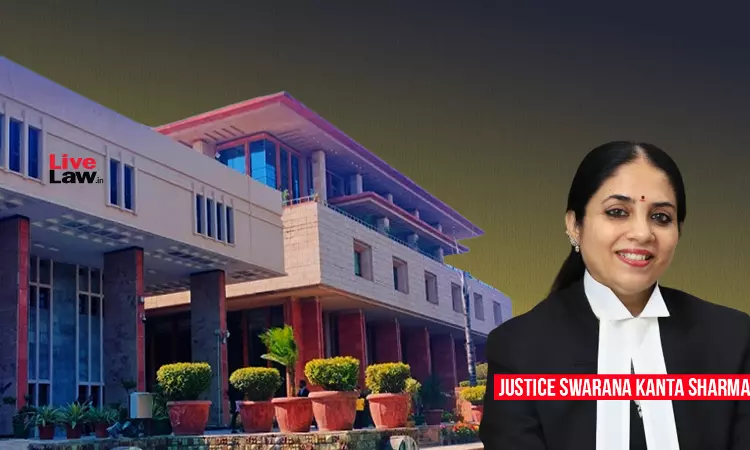
The Delhi High Court has held that once final arguments in a criminal trial are concluded and the matter is reserved for judgment, the judge who heard the case is duty-bound to pronounce the verdict even if he or she is subsequently transferred.Justice Swarana Kanta Sharma relied on Orders dated 18.11.2025 and 26.11.2025, issued by the Registrar General which mandate that all transferred...
This is a premium content
Available exclusively to
Our subscribers
Subscribe Premium 
INR 1099+GST
Your support helps us to bring you more content at
an affordable subscription scheme !!!
All payment options available
The Delhi High Court has held that once final arguments in a criminal trial are concluded and the matter is reserved for judgment, the judge who heard the case is duty-bound to pronounce the verdict even if he or she is subsequently transferred.
Justice Swarana Kanta Sharma relied on Orders dated 18.11.2025 and 26.11.2025, issued by the Registrar General which mandate that all transferred judicial officers shall notify the cases in which judgments or orders had been reserved prior to relinquishing charge and shall pronounce such reserved judgments or orders within a period of two to three weeks from the date of transfer, notwithstanding such posting or transfer.
The bench further clarified that a successor judge cannot order a rehearing of final arguments in the case. It observed,
“Once final arguments had been fully heard, the learned Predecessor Judge was bound to pronounce the judgment. Directing a rehearing of arguments in such circumstances not only defeats the mandate of the transfer orders and the law laid down by this Court, but also results in avoidable delay in adjudication and places an unnecessary burden upon the learned Successor Judge, who is compelled to rehear a matter that has already been fully argued.”
The Court was dealing with a petition filed by an accused under the Maharashtra Control of Organised Crime Act (MCOCA), challenging directions of the successor sessions judge to rehear final arguments after the predecessor judge, who had already reserved judgment, was transferred.
The case arose from a sessions trial in which final arguments had concluded on July 4, 2025 and the matter was repeatedly listed only for pronouncement of judgment.
On November 7, 2025, the predecessor judge was ready to pronounce the verdict but deferred it solely because the accused were appearing through video conferencing and were directed to be produced physically on the next date. Before that date, the judge was transferred.
The case was then placed before the successor judge, who directed a rehearing of final arguments.
Setting aside this order, the High Court held that such a course of action was contrary to binding transfer directions, settled criminal procedure, and the right of the accused to a speedy trial. It observed,
“For an accused, especially one in custody, the period after the judgment gets reserved, each day is spent in anxious anticipation of the outcome. To now compel the accused to undergo another round of final arguments before a new judge would amount to prolonging uncertainty and, in effect, would result in serious prejudice.”
It added, “Courts must remain mindful of the human element inherent in criminal adjudication. While procedural fairness is undoubtedly important, it cannot be carried to an extent that defeats substantive justice. In the present case, directing a rehearing would not further fairness; instead, it would cause avoidable delay and hardship to the accused and undermine the finality of a trial that has already concluded.”
The Court further held that permitting a departure from the Registrar General's directions would dilute their binding nature and open the door to circumvention.
It also emphasised that Section 353 CrPC contemplates pronouncement of judgment without undue delay, and that prolonged withholding of a reserved judgment defeats the principle that justice must be delivered within a reasonable time.
Accordingly, the High Court directed that the case be transferred back to the predecessor judge, for the limited purpose of pronouncing the judgment within two to three weeks.
Appearance: Mr. Avi Kalra, Mr. Prateek Lakra and Ms. Arya Pathak, Advocates for Petitioner; Mr. Manoj Pant, APP for State along with Insp. Ravi Tushir, Special Cell NR
Case title: Parvesh Mann @ Sagar Mann v. State Nct Of Delhi
Citation: 2026 LiveLaw (Del) 57
Case no.: CRL.M.C. 9064/2025


