



- Home
- /
- High Courts
- /
- Delhi High Court
- /
- PIL In Delhi High Court Seeks...
PIL In Delhi High Court Seeks Mandatory Body-Worn Cameras For Police, RAF During Protest-Control Duties
Nupur Thapliyal
6 Oct 2026 4:09 PM IST
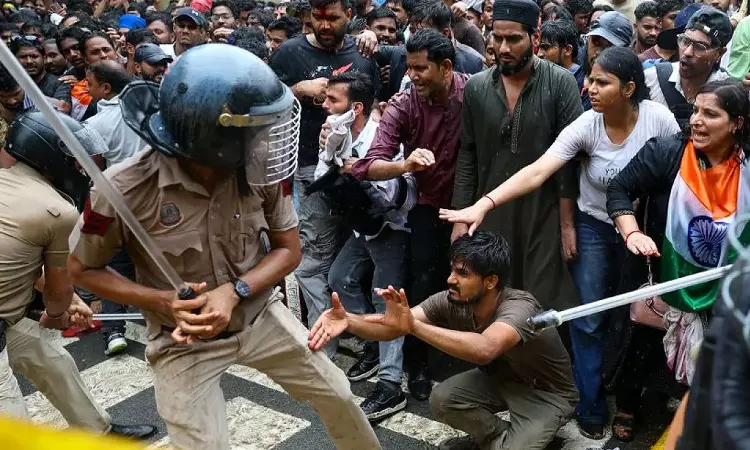
A Public Interest Litigation has been filed before the Delhi High Court seeking directions to the Centre, Delhi Police and Rapid Action Force (RAF) to frame a binding Standard Operating Procedure (SOP) making body-worn cameras (BWCs) compulsory and “always-on” for personnel deployed on crowd-control and protest-management duties.The petition, filed by Advocate Chahat Raghav, also seeks...
This is a premium content
Available exclusively to
Our subscribers
Subscribe Premium 
INR 1099+GST
Your support helps us to bring you more content at
an affordable subscription scheme !!!
All payment options available
A Public Interest Litigation has been filed before the Delhi High Court seeking directions to the Centre, Delhi Police and Rapid Action Force (RAF) to frame a binding Standard Operating Procedure (SOP) making body-worn cameras (BWCs) compulsory and “always-on” for personnel deployed on crowd-control and protest-management duties.
The petition, filed by Advocate Chahat Raghav, also seeks a comprehensive regime governing the storage, integrity, retention and evidentiary use of footage recorded through such cameras.
The plea asserts that the absence of a mandatory BWC framework impacts the fundamental rights guaranteed under Articles 19(1)(a), 19(1)(b) and 21 of the Constitution of India.
The plea has been filed against the backdrop of the July protests at Jantar Mantar involving the Cockroach Janata Party (CJP) and climate activist Sonam Wangchuk.
According to the petition, allegations of excessive use of force by Delhi Police and RAF were accompanied by allegations of stone-pelting, vandalism and attacks on police personnel.
Raghav submits that much of the footage documenting the events came from mobile phones of bystanders rather than an official, authenticated police recording system.
She argues that the said position left accountability for alleged police excesses, as well as evidence against alleged violent protesters, dependent upon “happenstance” citizen videography.
The plea refers to a July 22 order directing preservation of relevant records, including CCTV footage and videography, “if any”. Raghav argues that the reference to videography highlights the absence of a comprehensive and mandatory officer-worn recording mechanism.
According to the plea, contemporaneous footage would also provide authenticated evidence to identify persons in a crowd who engage in stone-pelting, vandalism or attacks on police personnel.
It is therefore argued that a body worn camera regime would “protect both sides of the barricade” by objectively recording police-public interactions.
Raghav further argues that the 2020 advisory was merely recommendatory and did not prescribe mandatory activation, minimum retention, chain-of-custody safeguards or consequences for non-use.
The plea contends that the events at Jantar Mantar demonstrate the inadequacy of an optional body worn camera regime and underline the need for a binding framework.
The plea further alleges that the Standing Order does not prescribe a sufficient regime for retention, integrity, access or chain of custody of the recordings.
It is also contended that the Delhi Police had procured or sought to procure body-worn cameras but had not established a specific regulatory framework governing their deployment during crowd-control operations.
Raghav submits that footage must be generated and preserved through a defined protocol, including safeguards such as hash values, secure server uploads inaccessible for alteration by the officer wearing the camera, an auditable chain of custody and certification under Section 63 of the Bharatiya Sakshya Adhiniyam, 2023.
“….the relief sought is narrowly tailored to crowd control and is protective of and is not destructive of, the right to protest and the right to privacy. It is submitted that the Petitioner does not seek indiscriminate surveillance of protesters,” the plea says.
“The BWC is an accountability record of the police-citizen encounter and not a facial recognition dragnet of the crowd. Indeed, the deployment at J antar Man tar in July 2026 reveals that the priorities of the Respondent are inverted i.e. surveillance facing technology (facial-recognition cameras and 360-degree surveillance vans, BWCs riot control vehicles etc.) were deployed and the footage is now being used to lodge FIRs against the Protestors. It is humbly submitted that the present Petition seeks to correct this inversion,” it adds.
The PIL accordingly seeks a direction on the authorities to establish a binding, enforceable body worn camera regime for police and RAF personnel deployed in crowd-control and protest-management operations.

Nupur Thapliyal
Nupur Thapliyal is a Principal Correspondent with LiveLaw, based in New Delhi. She reports from the Delhi High Court and trial courts in the national capital

