- Home
- /
- High Courts
- /
- Delhi High Court
- /
- Promotion To Equivalent Civil Post...
Promotion To Equivalent Civil Post Doesn't Automatically Confer Substantive Military Rank: Delhi HC
Namdev Singh
20 July 2026 4:39 PM IST
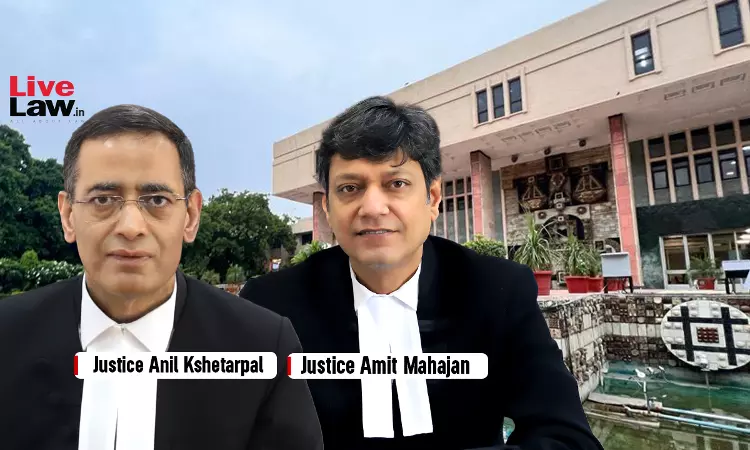
A Division Bench of the Delhi High Court comprising Justice Anil Kshetarpal and Justice Amit Mahajan held that the substantive military rank of Brigadier or Major General is not automatically conferred upon holding an equivalent civil post; it remains subject to satisfaction of Army promotion norms, including medical eligibility. [2026 LiveLaw (Del) 662] Background Facts...
This is a premium content
Available exclusively to
Our subscribers
Subscribe Premium 
INR 1099+GST
Your support helps us to bring you more content at
an affordable subscription scheme !!!
All payment options available
A Division Bench of the Delhi High Court comprising Justice Anil Kshetarpal and Justice Amit Mahajan held that the substantive military rank of Brigadier or Major General is not automatically conferred upon holding an equivalent civil post; it remains subject to satisfaction of Army promotion norms, including medical eligibility. [2026 LiveLaw (Del) 662]
Background Facts
The Respondent was commissioned in the Corps of Engineers of the Indian Army. He was permanently seconded to the Survey of India (SoI) Group 'A' Service. His service conditions were governed by the Survey of India (Group 'A') Service Rules, 1989, which provide for an integrated service comprising Civil and Defence Streams. The Respondent was promoted to the post of Director and later empanelled for promotion to the post of Additional Surveyor General in Level 14.
The respondent completed 23 years of commissioned service on 12.06.2020 and 25 years on 12.06.2022. He claimed entitlement to substantive ranks of Brigadier and Major General under the framework of the 1989 Rules. The SoI authorities addressed communications to Army Headquarters for consideration of grant of corresponding military ranks. However, the Petitioners declined to confer the ranks because the respondent was placed in a low medical category and did not satisfy promotional medical standards.
Aggrieved by the refusal, the respondent approached the Armed Forces Tribunal. The Tribunal passed the Order directing conferment of substantive ranks of Brigadier and Major General with original seniority and consequential benefits.
Aggrieved by the directions of Tribunal, the Union of India filed the Writ Petition before Delhi High Court.
It was argued by the petitioners that conferment of substantive military rank of Brigadier or Major General is not automatic upon holding an equivalent civil post in the SoI. It remains subject to promotion policies, medical standards and eligibility criteria applicable to Army officers. The Respondent belonged to the batch of 1997, whereas officers of the earlier 1994 batch had only recently been considered for promotion to Major General.
It was further argued that grant of substantive rank to the respondent ahead of his batch would disrupt the settled promotion structure. The Defence Service Regulations, 1987 governed substantive promotion and provided for assessment of overall suitability, including medical fitness.
It was further contended that the 1989 Rules provide equivalence for administrative purposes and do not override Army Regulations relating to substantive promotion. It was argued that equivalence of posts cannot be construed as conferring an enforceable right to military promotion. Posts held by DSOs are supernumerary appointments and do not form part of the sanctioned substantive cadre strength of Lt. Colonel and above in the Regular Army.
On the other hand, it was argued by the respondent that upon secondment to the SoI Group 'A' Service, his service became governed by the statutory 1989 Rules. The Rules create an integrated civil service with defined equivalence between civil posts and military ranks. His promotion to Additional Surveyor General was pursuant to approval of the ACC and a Gazette Notification issued in the name of the President of India. It was argued that it is statutory and Presidential in character therefore, it could not be nullified by internal Army policies or administrative letters.
It was further argued that under the equivalence framework contained in the 1989 Rules, if a DSO holds the post of Additional Surveyor General and completes the prescribed commissioned service, then conferment of the equivalent substantive military rank follows as a matter of course. It was further contended that the 1989 Rules do not prescribe any medical fitness requirement. Further, it does not create an absolute bar against promotion of officers placed in SHAPE-2 medical category.
Findings and Observations of the Court:
It was observed by the Division Bench that the 1989 Rules recognised equivalence between specified civil appointments and military ranks for purposes of organisational parity. However, the Rules did not create an independent promotional channel and did not provide that conferment of substantive military rank shall automatically follow the civil promotion.
It was further observed that the distinction between equivalence of post and substantive military promotion is significant as equivalence operates within the administrative domain while substantive rank represents formal placement within the command, responsibility and seniority framework of the Armed Forces.
It was noted by the Division Bench that the DSR governing substantive promotion by selection provides for assessment of overall suitability including medical fitness and comparative evaluation within the promotion stream. The respondent was placed in a low medical category. It was observed that SHAPE-2 may not operate as an absolute bar, but governing regulations provide discretion to military authorities to determine promotability.
It was further observed that the 1989 Rules regulate service conditions within the SoI cadre, whereas Army Regulations administer conferment of military rank. Therefore, both regimes should operate within their respective spheres.
It was noted that the respondent belonged to the 1997 batch, whereas officers of the earlier 1994 batch had only recently entered the zone of consideration for promotion to Major General. Therefore, conferment upon the respondent ahead of seniors would disturb the established promotion hierarchy.
It was further noted that the Tribunal proceeded on the assumption that civil promotion under the 1989 Rules provides entitlement to equivalent substantive military rank. Hence, the Tribunal overlooked the regulatory distinction between administrative equivalence and military promotion.
It was held by the Division Bench that conferment of substantive military rank is inseparable from the statutory promotion framework governing the Army. Therefore, it was concluded that holding an equivalent civil appointment or completion of qualifying service does not create an enforceable right to substantive rank in absence of satisfaction of promotion norms, including medical eligibility and selection requirements.
With the aforesaid observations, the decision of the Tribunal was set aside by the Division Bench. Consequently, the writ petition filed by the Union of India was allowed by the Division Bench.
Case Name : Union Of India & Ors. vs Col Amardeep Singh
Citation: 2026 LiveLaw (Del) 662
Case No. : W.P.(C) 2531/2024
Counsel for the Petitioners : Farman Ali, CGSC with Usha Jamnal, Tanya, Advs. with Col. Sarika, Maj Tarun Pillai, Maj. Anish Muralidhar
Counsel for the Respondent : Aditya Singh Puar, Parthsarthi Hirani, Advs