



- Home
- /
- High Courts
- /
- Delhi High Court
- /
- Section 5(c) Of POCSO Act Not Made...
Section 5(c) Of POCSO Act Not Made Out: Why Delhi High Court Suspended Life Term Of Kuldeep Singh Sengar In Unnao Rape Case
Nupur Thapliyal
24 Dec 2025 11:54 AM IST
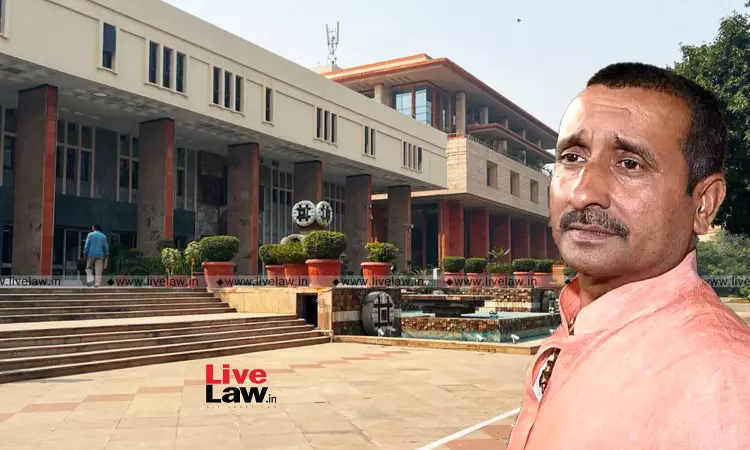
The Delhi High Court has suspended the life sentence awarded to expelled BJP leader Kuldeep Singh Sengar, who was convicted and sentenced to life imprisonment by the trial court in the Unnao rape case.A division bench comprising of Justice Subramonium Prasad and Justice Harish Vaidyanathan Shankar primarily held that the offence under Section 5(c) of the POCSO Act was not made out...
This is a premium content
Available exclusively to
Our subscribers
Subscribe Premium 
INR 1099+GST
Your support helps us to bring you more content at
an affordable subscription scheme !!!
All payment options available
The Delhi High Court has suspended the life sentence awarded to expelled BJP leader Kuldeep Singh Sengar, who was convicted and sentenced to life imprisonment by the trial court in the Unnao rape case.
A division bench comprising of Justice Subramonium Prasad and Justice Harish Vaidyanathan Shankar primarily held that the offence under Section 5(c) of the POCSO Act was not made out against Sengar.
It held that, at a prima facie stage, that the offence did not qualify as aggravated penetrative sexual assault under Section 5 of the Act.
The Court ruled that the appellant, Sengar, could not be categorised as a “public servant” for the purposes of Section 5(c) of the POCSO Act or Section 376(2)(b) of the Indian Penal Code (IPC). The trial court had earlier convicted Sengar for aggravated penetrative sexual assault on the ground that he fell within the definition of a public servant.
Section 5 of the POCSO Act enumerates circumstances in which penetrative sexual assault of a child becomes aggravated, including when the offence is committed by a public servant, police officer, member of the armed forces or security forces, or by hospital or jail staff. Such aggravated offences attract a minimum sentence of 20 years' imprisonment, which may extend to imprisonment for the remainder of the convict's natural life.
Disagreeing with the trial court's view, the High Court held that Sengar did not fall within the scope of Section 5(c). The Bench further observed that he also could not be brought within Section 5(p) of the POCSO Act, which covers persons in a “position of trust or authority”.
“In view of the above, this Court is of the prima facie view that for the purpose of suspension of sentence, the Appellant cannot be brought into the ambit of 'aggravated penetrative sexual assault' under Section 5 of the POCSO Act, punishable under Section 6 of the POCSO Act, or under Section 376(2) of the IPC, which provides for the punishment of imprisonment for remainder of his natural life,” the Court said.
The Bench noted that in the absence of an aggravated offence, the applicable provision would be Section 4 of the POCSO Act, which prescribes a minimum sentence of seven years' imprisonment for penetrative sexual assault. It recorded that Sengar had already undergone about seven years and five months in custody.
“At this stage, being satisfied that (i) offence under Section 5(c) of the POCSO Act is not made out against the Appellant on account of him not falling within the definition of a 'public servant', (ii) only an offence under Section 3 of the POCSO Act would be made out, and (iii) looking at the fact that the Appellant has already undergone more than the minimum sentence under Section 4 of the POCSO Act prior to its amendment in 2019, this Court is inclined to suspend the sentence of the Appellant,” the Bench held.
The Court prima facie observed that for suspension of sentence, Sengar cannot be brought into the ambit of aggravated penetrative sexual assault under Section 5 of the POCSO Act, or under Section 376(2) of the IPC, which provides for the punishment of imprisonment for remainder of his natural life.
“The Appellant was sentenced for the remainder of his life and as on 30.11.2025, he has spent about 7 years and 5 months under incarceration, which is more than the minimum punishment prescribed under Section 4 of the POCSO, as it existed at the time when the offence was committed,” the Court said.
It added: “In the opinion of this Court, once this Court is prima facie of the opinion, for the purpose of the instant Application, that the offence under Section 5 of the POCSO Act is not attracted in the present case, and, therefore, the Appellant cannot be sentenced for the remainder of his life, the contention of the learned Counsel for the Victim/Survivor that investigation was compromised cannot be a ground not to suspend the sentence of the Appellant, more so looking at the period of incarceration already undergone.”
On the victim's counsel emphasis on the issue of her life being in danger, the Court said that Courts cannot keep a person in custody being apprehensive that the police or paramilitary may not do its job properly.
Observing that such an observation or such a thought process would undermine the laudable work of the police forces, the Bench directed the concerned DCP of the area where victim is currently residing to personally ensure and supervise the protection given to her during the pendency of Sengar's Appeal.
“State is also providing for the accommodation of the Victim. The DCW is responsible to ensure that the Victim is provided with sufficient accommodation and such arrangement is directed to be continued till further orders. In any way, the appeal is in this Court and it is always open for the Victim to approach this Court, if required,” the Court said.
While granting bail to Sengar, the Court directed him not to come within a 5 km radius of the place of residence of the Victim and to stay in Delhi during the pendency of his Appeal, to ensure that he is available for completing the remaining part of the sentence in case he is found to be guilty.
Sengar was convicted for raping the victim and for murdering her father in connivance with police officers of Makhi, a village in Unnao district. He has been sentenced to life imprisonment.
The trial in the matter was transferred to Tis Hazari Courts by the Supreme Court in 2019 in the transfer petition moved by the survivor.
The apex court, taking cognisance of the rape survivor's letter written to then Chief Justice of India Ranjan Gogoi, had transferred all five cases registered in connection with the incident from a Lucknow court in Uttar Pradesh to the court in Delhi with directions to hold the trial on a daily basis and completing it within 45 days.
Case Title: Kuldeep Singh Sengar v. CBI
Tags

Nupur Thapliyal
Nupur Thapliyal is a Principal Correspondent with LiveLaw, based in New Delhi. She reports from the Delhi High Court and trial courts in the national capital

