



- Home
- /
- High Courts
- /
- Gauhati High Court
- /
- Forest Department Can't Evict...
Forest Department Can't Evict Alleged Encroachers Without Following Supreme Court Directions In Abdul Khalek: Gauhati High Court
Bhavya Singh
21 Sept 2026 10:10 AM IST
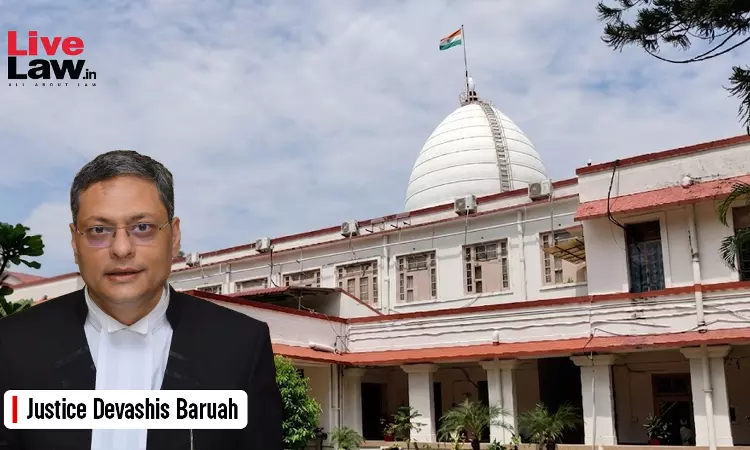
The Gauhati High Court has held that if the Forest Department proposes to take action against alleged occupants of a reserved forest, it must follow the procedure laid down by the Supreme Court in Abdul Khalek v. State of Assam.Justice Devashis Baruah, observed, “...taking into account the directions, which were passed by the Supreme Court in Abdul Khalek (supra), whereby there was a...
This is a premium content
Available exclusively to
Our subscribers
Subscribe Premium 
INR 1099+GST
Your support helps us to bring you more content at
an affordable subscription scheme !!!
All payment options available
The Gauhati High Court has held that if the Forest Department proposes to take action against alleged occupants of a reserved forest, it must follow the procedure laid down by the Supreme Court in Abdul Khalek v. State of Assam.
Justice Devashis Baruah, observed, “...taking into account the directions, which were passed by the Supreme Court in Abdul Khalek (supra), whereby there was a specific manner in which the eviction proceedings were directed to be carried out, it is the opinion of this Court that in the case of the petitioners, if such, steps were not taken, it shall be the requirement of law that in the case of the petitioners such steps in terms with the directions passed by the Supreme Court in Abdul Khalek (supra) should be taken. However, during the pendency of the instant writ petition, if steps already have been taken in consonance with the directions passed in Abdul Khalek (supra), then there shall be no further necessity.”
The observation came in a writ petition filed by 15 petitioners challenging notices issued in July 2025. The notices alleged that the petitioners had entered the South Nambar Reserved Forest under the Naojan Range Forest Office and asked them to vacate the area.
During the pendency of the petition, the Supreme Court in Abdul Khalek & Ors v. State of Assam & Ors prescribed the manner in which removal of alleged encroachments from reserved forests was to be carried out. The South Nambar Reserved Forest was also covered by those proceedings.
The High Court also noted that pursuant to those directions, the Forest Department, in coordination with revenue officials, had taken steps in respect of four reserved forests and passed speaking orders. Those orders were upheld by the High Court in Nekbar Ali @ Nekbor Ali and 88 Ors v. State of Assam & Ors, and the writ appeals against that decision were also dismissed.
The High Court said that in view of the directions in Abdul Khalek, there was a “specific manner” in which the eviction proceedings were required to be carried out.
The Court observed, “taking into account the directions, which were passed by the Supreme Court in Abdul Khalek (supra), whereby there was a specific manner in which the eviction proceedings were directed to be carried out”, the prescribed steps were required to be taken in the case of the petitioners if they had not already been followed.
The Court further clarified that if such steps had already been taken during the pendency of the writ petition in consonance with the directions in Abdul Khalek, there would be no further necessity to repeat the exercise.
Accordingly, the Court held, “The impugned notices, which are enclosed as Annexure 1 to the Writ Petition have become redundant in view of the directions passed by the Supreme Court in the case of Abdul Khalek (supra).”
It further directed, “The Respondent Authorities, more particularly, the Forest Department, if it proposes to take any action against the petitioners, the same shall be done only by following the directions passed by the Supreme Court in the case of Abdul Khalek (supra).”
The writ petition was accordingly disposed of without costs.
Case No.: Yunus Ali & 14 Ors. v. State of Assam & 8 Ors.
Case Title: WP(C)/4258/2025
LL Citation: 2026 LiveLaw (Gau) 175

Bhavya Singh
Reporter

