



- Home
- /
- High Courts
- /
- Gauhati High Court
- /
- Quashing Of Termination For Want Of...
Quashing Of Termination For Want Of Communication Doesn't Cure Defects In Initial Appointment: Gauhati High Court
Bhavya Singh
22 Aug 2026 12:00 PM IST
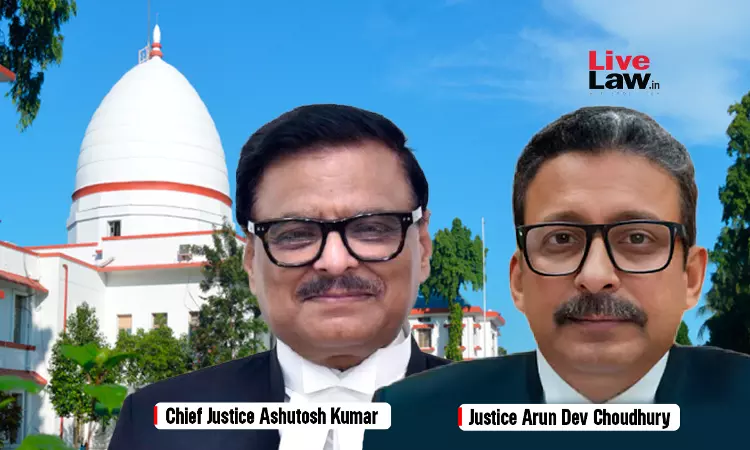
The Gauhati High Court has held that setting aside of a termination order for want of communication to the affected employee does not, by itself, entitle such employee to regular status from the date of the original appointment or to consequential service benefits.A Division Bench of Chief Justice Ashutosh Kumar and Justice Arun Dev Choudhury observed, “Setting aside an ineffective order...
This is a premium content
Available exclusively to
Our subscribers
Subscribe Premium 
INR 1099+GST
Your support helps us to bring you more content at
an affordable subscription scheme !!!
All payment options available
The Gauhati High Court has held that setting aside of a termination order for want of communication to the affected employee does not, by itself, entitle such employee to regular status from the date of the original appointment or to consequential service benefits.
A Division Bench of Chief Justice Ashutosh Kumar and Justice Arun Dev Choudhury observed, “Setting aside an ineffective order of termination does not amount to a declaration that the original appointments were made in accordance with the prescribed recruitment procedure or that the appointee acquired an indefensible right to the post and all statutory benefits attached to a regular appointment.”
The observation came in a writ appeal filed by the State of Assam against a common judgment passed in a writ petition, by which a Single Judge had quashed the termination orders issued against the writ petitioners and directed that they be treated as regular Assistant Teachers for all purposes.
The petitioners had been appointed as Assistant Teachers in different lower primary schools in Dhemaji district in 1989. The State maintained that the appointments were irregular or illegal, including against non-existent or non-sanctioned posts and without following departmental norms and recruitment procedures. It claimed that show-cause notices were issued in March 1992 and termination orders were passed in May 1992. The petitioners, however, maintained that the termination orders had never been served upon them.
The State further relied upon a subsequent screening exercise in which the petitioners participated and the Cabinet decision dated October 7, 2020, pursuant to which they were prospectively accommodated as Tutors. The petitioners had not challenged the screening proceedings, the Cabinet decision or the consequential accommodation orders.
The High Court found that the real dispute was whether the termination orders had been communicated to the petitioners. Since the State failed to place satisfactory material showing service of the orders, the Bench upheld the finding that the termination had not effectively brought their service to an end.
“An order terminating the service of an employee is required to be communicated to the employee so as to become operative. It is a well-settled principle that the mere passing of an order or retaining the same on the file does not, by itself, amount to the communication of the order to the employee,” the Court stated.
However, the Court held that the Single Judge had erred in treating the petitioners as regular Assistant Teachers merely because the termination orders were ineffective.
The Court opined, “the learned Single Judge erred in assuming that, once the termination orders are held to be ineffective for want of communication, the petitioners must necessarily be treated as regular Assistant Teachers from the date of their original appointments and granted all consequential service benefits.”
The Court noted that the subsequent screening process, Cabinet decision and accommodation orders had never been challenged and continued to hold the field.
The Court observed, “In such circumstances, a Court exercising its jurisdiction under Article 226 of the Constitution of India cannot, while deciding the limited question of the effectiveness of the 1992 termination order, grant a consequential declaration that would nullify or render nugatory subsequent unchallenged policy decisions and proceedings.”
The Court further observed, “The fact that a person has worked for a long period, even if such service has been permitted by the authorities, cannot, by itself, create a substantive right to a regular post when the subsequent governmental process has dealt with the appointment in a different manner, and the consequential orders have not been challenged.”
The Court clarified that it was not holding that the petitioners had never rendered service or that salary already paid was liable to be recovered. It also directed the competent State authority to consider extending an appropriate scale of pay to the respondents in their capacity as Tutors in accordance with law.
Accordingly, the Court upheld the setting aside of the May, 1992 termination order for want of proof of communication, but set aside the direction granting the petitioners all consequential benefits as Assistant Teachers and treating them as regular Assistant Teachers for all purposes.
The writ appeal was partly allowed.
Case Title: The State of Assam and 4 Ors. v. Chandreswar Saikia and Ors.
LL Citation: 2026 LiveLaw (Gau) 132
Case No.: WA/35/2026
Tags

Bhavya Singh
Reporter

