



- Home
- /
- High Courts
- /
- Gauhati High Court
- /
- Parked Vehicle Not Liable For...
Parked Vehicle Not Liable For Contributory Negligence Where Driver Had Sufficient Time To Exercise Due Care: Gauhati High Court
Bhavya Singh
19 Sept 2026 2:00 PM IST
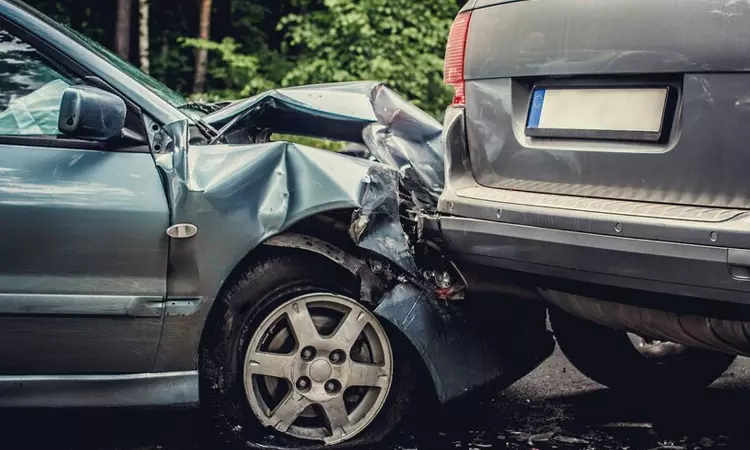
The Gauhati High Court has held that no negligence or contributory negligence could be attributed to an oil tanker parked on the left side of the National Highway when the vehicle which hit it from behind had sufficient time to exercise due care and caution.Justice Manish Choudhury observed, “this Court does not find any negligence on the part of the oil tanker, much less...
This is a premium content
Available exclusively to
Our subscribers
Subscribe Premium 
INR 1099+GST
Your support helps us to bring you more content at
an affordable subscription scheme !!!
All payment options available
The Gauhati High Court has held that no negligence or contributory negligence could be attributed to an oil tanker parked on the left side of the National Highway when the vehicle which hit it from behind had sufficient time to exercise due care and caution.
Justice Manish Choudhury observed, “this Court does not find any negligence on the part of the oil tanker, much less contributory negligence, which was hit from behind on the right side by the defence vehicle driven by P.W.1, whose testimony does not inspire any confidence to accept it as a truthful one.”
The observation came in an appeal under Section 173 of the Motor Vehicles Act, 1988 filed by the Union of India against a judgment of the Additional District and Sessions Judge (FTC), Dibrugarh, dismissing its claim under Section 166 of the Act.
The Union had sought ₹62,100 as compensation for damage caused to a Swaraj Mazda in an accident near the Main Gate of Air Force Station, Chabua, on National Highway No. 37.
The Union's case was that an oil tanker was parked on the left side of the highway without back parking lights and that the defence vehicle hit it from behind while giving side to an oncoming heavy vehicle.
The Tribunal, however, found that the tanker was parked on the left side of the road and that negligence was attributable to the driver of the defence vehicle. It also took note of the Accident Information Report showing that the driver had been charge-sheeted and that one person had died and two others were injured in the accident.
Before the High Court, the Union argued that the driver had exercised due care and caution and that the accident occurred when he tried to avoid an oncoming vehicle with high beam lights. It was also contended that the oil tanker had been parked without back parking lights.
The insurer, on the other hand, submitted that the accident was due to rash and negligent driving on the part of the driver of the defence vehicle.
The High Court examined the testimony of the driver, who was the only eyewitness, along with the Sketch Plan and photographs on record.
The Court found that the Sketch Plan projected a different scenario from the version given by the driver and showed the oil tanker parked on the left side of the National Highway, opposite the Main Gate and Railway lines.
The Court further found that the photographs showed the tanker parked on the extreme left side of the road and the defence vehicle having hit its right corner from behind.
It observed, “This piece of evidence is contrary to the evidence emerging from the documents exhibited as Exhibit - 4 and Exhibit - 5 series. Even if it is accepted that the defence vehicle was on the National Highway and its driver [P.W.1] swerved on the right side, it could not have rammed the oil tanker, which was parked on the left side of the National Highway.”
The High Court also noted that the fact that the driver had been charge-sheeted in connection with the accident had not been traversed by the Union in the appeal.
It further noticed that the claimant had maintained silence regarding the death of one Air Force personnel and the injuries caused to two others, while pursuing the claim for damage to the defence vehicle.
On an overall analysis of the evidence, the Court held, “On a close scrutiny of the evidence on record in its entirety, it is apparent that the version of the driver [P.W.1] is belied by the facts which had emerged from the other evidence on record.”
The Court also found that the driver had sufficient time to exercise due care and caution. It observed, “The driver of the defence vehicle [P.W.1] is found to have got sufficient time to exercise due care and caution to avoid any kind of collision with the vehicle coming from the opposite direction on national highway with high beam lights on.”
It further said, “even if testimony of the driver of the defence vehicle is accepted to be true then he could have exercised due care and caution while turning 90° towards his left, at a slow speed after applying brakes, to avoid any accident.”
The High Court therefore found no negligence or contributory negligence on the part of the oil tanker and dismissed the appeal as being without merit.
Case No.: MAC Appeal No. 147/2014
Case Title: Union of India v. Md. Ismail & Ors.
LL Citation: 2026 LiveLaw (Gau) 172
Tags

Bhavya Singh
Reporter

