



Gauhati High Court Criticises Assam Pollution Board For Reviving Long-Expired Environmental Consent Of Petroleum Unit
Aryan Raj
13 Nov 2026 5:40 PM IST
The Gauhati High Court has quashed an order of the Pollution Control Board, Assam extending the validity of a provisional consent granted to M/s M M Carbon Products Pvt. Ltd. for establishing a Calcined Petroleum Coke (CPC) unit (petroleum processing facility) at Amingaon.
The High Court held that a provisional consent which had expired in 2013 could not have been revived after six years by treating an application for fresh consent as a request for extension.
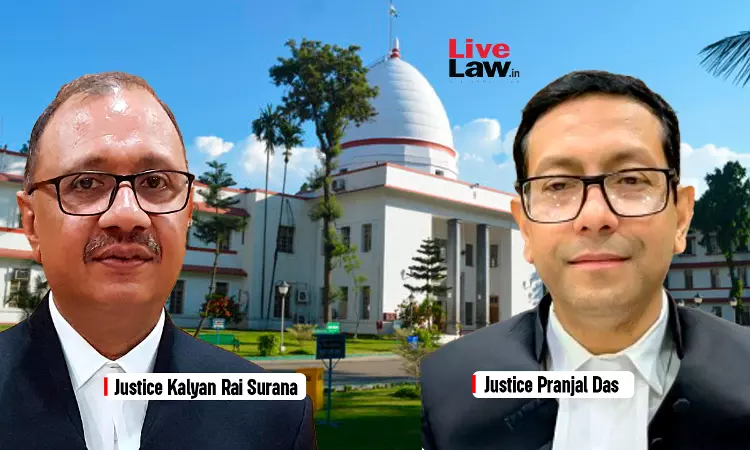
The Division Bench of Justice Kalyan Rai Surana and Justice Pranjal Das observed that the Board had failed to identify any statutory provision authorising it to extend the validity of an expired provisional consent.
The case arose from a PIL filed by NOC Foundation challenging the Pollution control Board order dated December 31, 2022 extending the validity of a Provisional Consent to Establish (PCTE) granted to the company in December 2012 for setting up a CPC unit with an annual capacity of 12,000 metric tonnes.


The permission was valid only until December 9, 2013. However, the company did not commence operations within that period. Although it subsequently applied for fresh consent in 2019 and 2021, the Board treated the application as one seeking an extension of the earlier provisional consent.
The petitioner argued that the original permission had expired and could not be extended after such a long gap particularly when the Board had issued a notification in February 2018 restricting the establishment of new CPC units and further expansion of existing units in Assam due to pollution concerns.
Rejecting the objections to the maintainability of the PIL, the Court also found no basis to dismiss it on the grounds of alleged non disclosure of the source of documents or conflict of interest arising from sponsorship received by the NGO from Indian Oil Corporation.
On the merits, the Court noted that the company's application dated August 28, 2019 was for fresh consent and could not be treated as an application for extending the validity of the 2012 provisional consent. It observed:
“The learned counsel for respondents has not been able to cite any provision of any Act, Rules or notification empowering and/or authorizing the respondent nos. 2 and 3 to suo motu convert and/or treat an application for CTE into/as an application for extending the validity of a PCTE in 2019, the validity of which had expired on 09.10.2013, i.e. after a lapse of about 6 (six) years.”
The Court further questioned the reliability of the Board's online portal noting that it had generated acknowledgements without dates and application identification numbers reflecting earlier years. It described the portal as “totally unreliable and totally untrustworthy” in the specific circumstances of the case.
Holding that the Board had acted beyond its authority, the Court observed that extending the provisional consent after six years of its expiry was “bad in law and not sustainable” under the applicable environmental laws.
Accordingly, the Bench quashed the December 31, 2022 order extending the consent and directed the State Environment and Forest Department and the Pollution Control Board to take consequential steps to give effect to the decision. The Court also imposed costs of Rs. 1 lakh on the Pollution Control Board.
Counsel for the Petitioner: K.N. Choudhury, Senior Advocate, assisted by R.J. Das.
Counsel for the Pollution Control Board (Respondents 2 and 3): S. Baruah.
Counsel for the Private Respondent (Respondent 4): D. Das, Senior Advocate, assisted by T. Chakraborty and A. Atreya.


