



- Home
- /
- High Courts
- /
- Gujarat High Court
- /
- Gujarat High Court Upholds Order...
Gujarat High Court Upholds Order Directing Municipality To Compensate Kin Of Motorcyclist Who Died After Being Struck By Stray Bull
Lovina B Thakkar
2 Jan 2026 1:00 PM IST
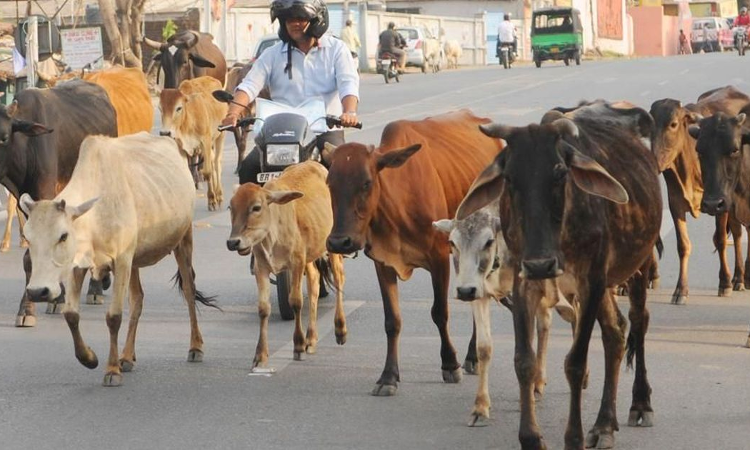
The Gujarat High Court upheld an order directing Vadodara Municipal Corporation to pay ₹4,84,473 with 9% interest per annum as damages to the kin of a motorcyclist who died in 2007 after being struck by a stray bull, holding that the accident occurred due to corporation's negligence in keeping public roads and streets free from stray cattle.Referring to coordinate bench's decision...
This is a premium content
Available exclusively to
Our subscribers
Subscribe Premium 
INR 1099+GST
Your support helps us to bring you more content at
an affordable subscription scheme !!!
All payment options available
The Gujarat High Court upheld an order directing Vadodara Municipal Corporation to pay ₹4,84,473 with 9% interest per annum as damages to the kin of a motorcyclist who died in 2007 after being struck by a stray bull, holding that the accident occurred due to corporation's negligence in keeping public roads and streets free from stray cattle.
Referring to coordinate bench's decision in Faiyazhussain Nazirahmed Ansari vs. Ahmedabad Municipal Corporation, Justice M.K. Thakker in his order invoked the doctrine of res ipsa loquitur and held:
“Considering the aforesaid decision as well as the circumstances of the accident, which speak for itself and narrate the entire incident, it clearly emerges that the stray bull dashed to the deceased while he was riding his motorcycle. The facts on record demonstrate that the accident occurred under the management and control of the appellant Corporation and its servants, and such an accident would not ordinarily occur if those entrusted with such management had exercised due and reasonable care. The doctrine of res ipsa loquitur is, therefore, squarely applicable, as no reasonable explanation has been forthcoming from the appellant regarding the cause of the accident, which was otherwise within the control of the defendant. Had due care been taken, such an unfortunate incident could have been avoided.”
Further, the Court held the 'statutory duty' and 'primary liability' rests with the corporation which 'collects taxes from the public' to maintain public roads and address the menace of stray cattle by taking preventive measures to ensure the safety of pedestrians and riders and to ensure 'the fundamental right of the public to enjoy life and personal safety is duly protected and not jeopardized on account of such hazards.'
It said:
“The inaction on the part of the appellant Corporation in maintaining the public road in a condition safe for its users, including pedestrians and vehicle riders, clearly reflects wilful negligence, carelessness, and remissness in the performance of its statutory duties. Such negligent conduct has resulted in the tragic loss of a valuable human life. In this background, this Court has no hesitation in holding that the appellant Management was negligent in discharging its duties and committed a clear breach thereof.”
The suit was instituted by the legal heirs of the deceased, who met with an accident on 27th September 2007, while riding his motorcycle when a stray bull suddenly rushed onto the road and struck him with its horns, causing him to fall and suffer serious head injuries.
He was then rushed to the hospital where he remained under treatment for 53 days and eventually passed away on 29th November 2007 due to haemorrhage in the left temporal region.
Following his death, an FIR was registered under IPC Sections 279 (Rash or negligent driving on a public way endangering human life or safety), 337 (Causing hurt to any person by an act so rash or negligent as to endanger human life or personal safety) and 338 (Causing grievous hurt to any person by an act so rash or negligent as to endanger human life or personal safety).
Later, the heirs of the deceased filed a suit seeking damages for ₹15,00,000 from the Corporation and the State of Gujarat for medical expenses, loss of life and support, loss of income, mental pain, shock and loss of love and affection.
The trial court in its March 2018 order held the Corporation guilty of contributory negligence of 70% and directed it to pay compensation of ₹4,84,473 with 9% of interest per annum. Against this the corporation moved the high court.
The counsel for the corporation contended the trial court committed a grave error in fastening the liability on the Corporation without any cogent or reliable evidence. It was contended that the accident occurred solely because of the rash and negligent driving of the deceased and that observation attributing 70% contributory negligence is wholly unsustainable. He further argued that the duty to remove stray animals rests with police authorities and not with the Corporation.
The counsel for the legal heirs of the deceased then submitted that the deceased suffered fatal injuries after being struck by a stay bull and falling from his motorcycle. He then relied on newspaper clips stating the accident, the medical records and submitted that the deceased underwent two surgeries and was hospitalized for 53 days before succumbing to his injuries due to haemorrhage in the left Sylvian fissure. The counsel lastly contended that the trail court rightly awarded the compensation by applying the principle of res ipsa loquitur and correctly fastened the liability to the extent of 70% upon the corporation, stating no interference is warranted and the appeal deserves to be dismissed.
The Court after considering the facts and arguments of the parties, referred to Section 63(19) of the Bombay Provincial Municipal Corporations Act, 1949 which casts a statutory duty on the Corporation to remove obstructions from streets and public places.
It said that the trial court order warranted no interference and dismissed the appeal.
It however said that since the amount awarded towards compensation is paid from the public exchequer, the same shall be recovered, after holding a necessary inquiry, from the Market Officer or the concerned erring officer who remained negligent in performing his duties.
Case Title: Vadodara Municipal Corporation vs Mominaben Malbulbhai Ghanivala & Ors.
Case Number: First Appeal No. 519 of 2020
Click Here To Read/Download Order
Citation: 2026 LiveLaw (Guj) 5


