Gujarat High Court Restores Meat Ban Near Somnath Temple Hours After Single Bench Quashed It
LIVELAW NEWS NETWORK
31 Oct 2026 10:24 AM IST
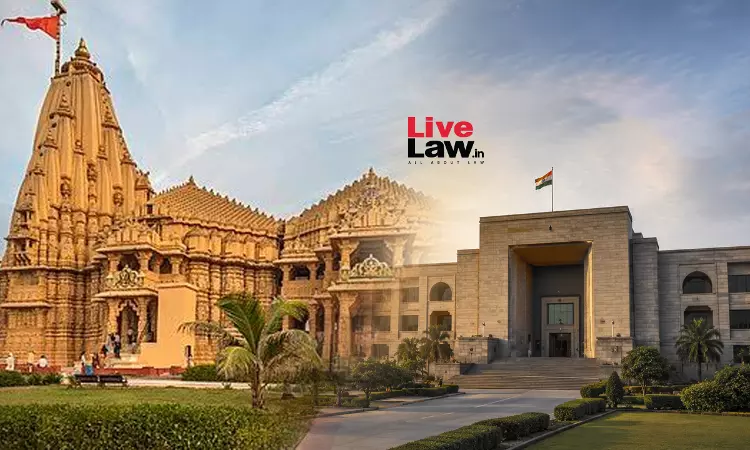
The single bench had found the ban to be disproportionate, and opined that consumption or non-display of meat was not an essential religious practice.
The Gujarat High Court on Friday (October 30) restored a state government notification banning sale of non-veg food in the vicinity of the Somnath Temple, hours after a single judge had struck down the notification issued by the District Magistrate of Gir-Somnath.
For context, earlier on Friday, Justice Nisha M Thakore allowed a writ petition filed by restaurant owners who had challenged the DM's notification issued on August 10 imposing a ban on sale of non-veg items on seven public routes as well as within 500 meter radius of Somnath Temple.
The single judge had held that the notification issued under Section 33(1)(w) of the Gujarat Police Act only regulates places of public entertainment and the DM could not have imposed a complete ban on sale of food, dictating what food is to be served within the premises like an eating house.
Within a few hours, the State moved an urgent appeal before the Division Bench, which held a special sitting at 5.30 PM.


Staying the single bench's judgment, the Division Bench of Acting Chief Justice Manash Ranjan Pathak and Justice Nirzar S Desai noted that the respondents' counsel could not point out a single judgment, whereby a contrary view is taken either by the Supreme Court or by any other High Court.
Further, considering that during Deepavali and the Gujarati New Year a large number of devotees are likely to visit the Somnath Temple, the bench said that the District Magistrate Gir-Somnath's Final Notification dated August 10 shall remain in force till the next date and the single judge's order shall be stayed.
"Issue Notice returnable by 25.11.2026. Appellants shall take steps for service of notice on the respondent No. 7 by speed post within the next five working days, as well as by direct service. The Final Notification dated 10.08.2026 issued by the District Magistrate, Gir Somnath under Section 33(1)(w) of the Gujarat Police Act, 1951 shall remain in force till the returnable date and the order passed by the learned Single Judge in Special Civil Application No. 13977 of 2026 today (30.10.2026) shall remain stayed until further orders," the court said.
The appeal is now listed on November 25.
Background
The District Magistrate of Gir-Somnath issued a Preliminary Notification on July 10 under the Gujarat Police Act prohibiting the preparation, sale and storage of all meat/meat-mutton/fish and non-vegetarian dishes at lorry stalls, shops, restaurants, hotels on both sides of the public roads, specifying the places mentioned therein.
The notification sought objections, if any, from the public to be submitted within 30 days of the publication of the notification. Subsequent to that, the DM issued a Final Notification dated August 10 under sub-section (1) (w) of Section 33 of the Gujarat Police Act whereby the authorities concerned permanently banned preparation, sale and storage of all meat/meat-mutton/fish and non-vegetarian dishes from various places including "All areas within 500 meters of Somnath Temple".
Aggrieved, the respondents filed a writ petition before the single judge. The division bench's order notes that the single judge pronounced the order on Friday in the second half (around 03:00 PM) and allowed the petition.
Even though the judgment was not uploaded, the Division Bench agreed to hear the State's appeal after a special mention was made by GP Mr. Virk.
Advocate General Kamal Trivedi, before the Division Bench, referred to various decisions and said that reasonable restrictions like the August 10 notification are permitted under law. Due to the upcoming Deepavali festival and Gujarati New Year, lakhs and lakhs of devotees are likely to visit Somnath Temple and in its adjoining religious areas.
It was submitted that if people are allowed to take meat/fish and non-vegetarian dishes in those specified areas, it is not only going to "hurt the sentiments of the devotees and believers of Somnath Temple and its adjoining religious areas" but is likely to cause inconvenience and annoyance, risk, danger or damage to the places concerned and its vicinity, the AG argued.
What did the single judge rule
The single judge had ruled that the sole reason assigned by the DM to impose the ban is that the "religious sentiments of sections of society who are against the visual display of non-vegetarian food on street"; the court however said that non-display of non-vegetarian food on the street cannot be read as “essential religious practise” under Article 25.
The court also referred to Chapter 17 (Shraddhatraya-Vibhaga Yoga) of Bhagavad Gita which classifies food into three gunas (qualities): Sattvic (pure/vegetarian), Rajasic (stimulating), and Tamasic (heavy/non-vegetarian), encouraging Sattvic diets for spiritual advancement but not strictly outlawing others.
The court observed that Hinduism is not "monolithic" and the choice or ritual of consuming food varies region-wise.
"Thus, consumption of non-vegetarian food cannot be recognised as an essential feature of religious practice but rather a personal choice. The impugned notification thus does not withstand the test of reasonableness and such imposition is thus held to be arbitrary and ultra vires the fundamental rights guaranteed under Article 19(1)(g) of the Constitution," the court held
The court also referred to various judgments and the Central law–Food Safety and Standards Act, under which the appropriate authority under this law is empowered to regulate the licensing of such activities in premises can impose suitable prohibition.
However, the court found that the documents on record, more particularly the license issued under the Food Safety and Standards Act, did not show any such condition imposed on the restaurant owners.
It further said that alternatively, the respondent authority could have offered some solution to balance between protection of fundamental rights under Article 19(1)(g) and right to religious preferences under Article 25 "by taking least restrictive measures". It said that the restaurant owners had shown their willingness to abide by the regulations strictly and have ensured to not display the food on the streets.
Thus the court said that a permanent ban is not only "disproportionate, excessive and violative of fundamental rights of the petitioners but is without any authority of law".
The court further ruled that Section 33(1)(ii) (w) of Gujarat Police Act, under which the ban was imposed, empowers the licensing Authority or Police to issue rules and regulate the licensing and control of places of public amusement or entertainment, primarily to maintain public order, safety, and health.
It however does not grant the power to legislate dietary restrictions or dictate food preferences, the single judge said. The court found that the term “ any eating house” has been deleted from the definition of the term place of public entertainment in view of Gujarat Act no.8 of 2018 notified on 5th April 2018.
"The learned Magistrate has committed grave error in exercising such powers conferred under Act by treating the religious sentiments of one section of society under 'public order' for regulating establishments like 'hotels'. On the other hand, if the provisions of the Gujarat Provincial Municipal Corporations Act, 1949 are examined, section 2(18) defines the term “ eating house” and section 377 and 381 empowers Municipal Commissioners to issue and regulate licenses for running an “eating house”. Even under the aforesaid provision, it empowers the Commissioner to inspect premises only for the purpose to verify as to whether hygiene, fire safety norms, structural permission adhere and public sanitation is maintained," the court held.
It said that the DM acted de-hors the provision of law as the scope of provisions was in the nature of regulating operations like licensing, to regulate health, safety and traffic but cannot impose an absolute ban on a lawful trade or even dictate the food to be served within the premises like eating house.
Further, a complete ban on running a business under a statute that only grants power to regulate generally violates the fundamental right to carry on trade or business.
The court had however directed the restaurant owners to ensure that the doors of their premises are closed and covered with dark glass top so that no carcasses of animals are visible to the public or passersby on the street. They shall maintain a high standard of hygiene conditions not only in the kitchen but also inside the premises.
The court had also directed that the petitioners, being citizens of this Country, owe a duty as provided under Article 51A of the Constitution to uphold and protect the sovereignty , unity and integrity of India; to promote harmony and the spirit of brotherhood amongst all people of India transcending religious, linguistic and regional or sectional diversities.