- Home
- /
- High Courts
- /
- Gujarat High Court
- /
- S.11(3) Bombay Rents Act | Judicial...
S.11(3) Bombay Rents Act | Judicial Fixation Of Standard Rent Inaplicable To New Construction Built Post 2001 Amendment: Gujarat High Court
Ananya Tangri
4 March 2026 5:15 PM IST
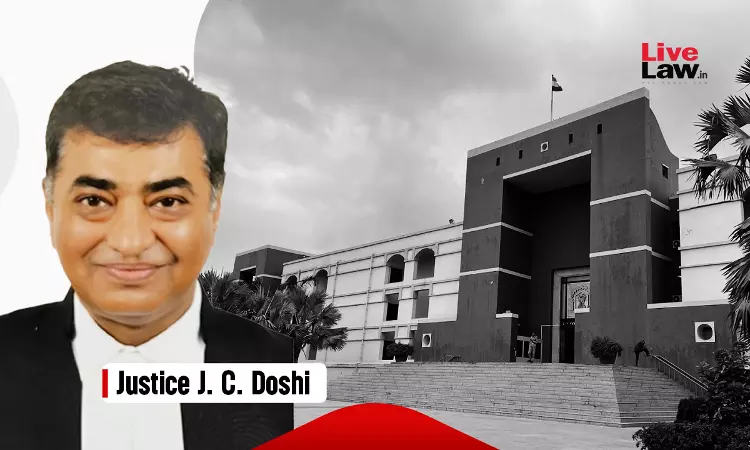
Holding that tenants cannot invoke Section 11(3) of Bombay Rents, Hotel and Lodging House Rates Control Act for fixation of standard rent in respect of premises constructed after the 2001 amendment, the Gujarat High Court dismissed a batch of appeals filed by tenants of Jetpur Swaminarayan Trust.A Single Judge Bench of Justice J.C. Doshi observed:“… it becomes abundantly clear that...
This is a premium content
Available exclusively to
Our subscribers
Subscribe Premium 
INR 1099+GST
Your support helps us to bring you more content at
an affordable subscription scheme !!!
All payment options available
Holding that tenants cannot invoke Section 11(3) of Bombay Rents, Hotel and Lodging House Rates Control Act for fixation of standard rent in respect of premises constructed after the 2001 amendment, the Gujarat High Court dismissed a batch of appeals filed by tenants of Jetpur Swaminarayan Trust.
A Single Judge Bench of Justice J.C. Doshi observed:
“… it becomes abundantly clear that when the appellants instituted an application under Section 11(3) of the Rent Act seeking fixation of standard rent, the very provisions of the Rent Act had ceased to apply to the premises in question. The statutory remedy invoked was, therefore, not available to the appellants in law. The institution of such proceedings, in the absence of a subsisting statutory foundation, amounts to a misconceived invocation of jurisdiction, resulting in an exercise in futility and an unwarranted consumption of judicial time, making it an abuse of process of law. Thus, from all counts makes standard rent application as irreparable suit, which discerned to be nipped at threshold.”
The Court further held that an application under Section 11(3) of the Rent Act, though styled as an “application”, in substance adjudicates adversarial civil rights and is amenable to rejection under Order VII Rule 11 CPC.
Section 11(3) of the Bombay Rents, Hotel and Lodging House Rates Control Act, 1947 (“the Rent Act”) allows a tenant who has received a rent-demand or eviction notice to apply to the Court for judicial fixation of “standard rent,” requiring the Court to determine what amount is reasonably due pending final adjudication.
Accordingly, the appellant tenants had instituted applications under Section 11(3) of the Rent Act seeking fixation of standard rent against Shri Jetpur Swaminarayan Trust, a registered public trust. The premises comprised shops constructed on non-agricultural land which were held by the Trust and let out to various tenants after 2001; in the present matters, the tenancies commenced in 2011–2012.
In 2019, the landlord issued notices seeking permitted increase in rent and terminating tenancy. Within one month, the tenants filed applications under Section 11(3) seeking fixation of standard rent.
The landlord filed applications under Order VII Rule 11 CPC for rejection of the plaint, relying inter alia on the Supreme Court decision in Malpe Vishwanath Acharya, contending that the standard rent regime had become constitutionally untenable and, further, that by virtue of the 2001 Gujarat amendment and Section 4 of the Act, the Rent Act was inapplicable to newly constructed premises.
The Trial Court and the First Appellate Court accepted the landlord's contention. Resultantly, the tenants preferred Second Appeals under Section 100 CPC, which were admitted on a substantial question of law: whether an application for fixation of standard rent falls within Order VII Rule 11 CPC?
Appearing for the tenants, Advocate H.P. Baxi argued that Order VII Rule 11 CPC applies only to plaints and written statements within Order VI, and not to statutory applications such as the one preferred by the tenants. Further, he argued that Malpe Vishwanath Acharya did not efface the concept of standard rent from the statute book. Instead, the Supreme Court refrained from striking down the provisions, leaving the matter to legislative wisdom. Reliance was also placed on Laxman Jiwaba Baherwade to contend that standard rent applications continued to be entertained even after 2001.
Opposing the appeals, Advocate Mrugen Purohit for the Trust submitted that the premises were constructed after 2001 and the tenancies commenced in 2011–2012; therefore, by virtue of Section 4 of the Rent Act as amended, which excludes properties constructed after 2001 from the Act, the Act did not apply.
For context, by virtue of the statutory amendments and the notification issued by the State Government, the operation of the Rent Act, insofar as newly constructed premises are concerned, stood excluded for the relevant period commencing from the year 2001 onwards.
He further relied on Section 141 CPC to submit that proceedings under Section 11(3), though styled as applications, are adversarial in nature and similar to a suit, thus amenable to Order VII Rule 11.
Agreeing with the respondent-landlord, the Court held that Section 141 CPC extends procedural provisions of suits to other civil proceedings. An application under Section 11(3), though labelled as an application, requires the Court to evaluate rival assertions and determine what is “reasonably due”, which “entails a full-fledged consideration of contested civil rights deciding the rival claims.”
Therefore, the submission that such an application does not partake the character of a pleading was termed “hallow and worthless”.
On the constitutional issue, the Court observed that although standard rent provisions remained on the statute book, their enforceability stood “substantially eclipsed” due to the Supreme Court's decision in Malpe Vishwanath, unless amended in conformity with constitutional principles. In light of the amendment to Section 4, the Rent Act did not apply to premises constructed after 2001. Hence, the statutory remedy under Section 11(3) was unavailable to the tenants.
Consequentially, all the Appeals were dismissed with interim relief vacated.
Case Title: Dharmendra Vallabhbhai Ramani v. Jetpur Swaminarayan Trust & Anr.
Case: R/Second Appeal No. 80 of 2023 and allied matters
Appearance: Mr. H.P. Baxi for the Appellants; Mr. Mrugen K. Purohit for Respondent No. 1
Click Here To Read/Download Order
Citation: 2026 LiveLaw (Guj) 74
Tags