



- Home
- /
- High Courts
- /
- Gujarat High Court
- /
- Judicial System Which Disposes...
Judicial System Which Disposes Cases Quickly But Compromises Fairness Not Effective : Supreme Court Justice Vipul Pancholi
Malavika Prasad
4 April 2026 6:35 PM IST
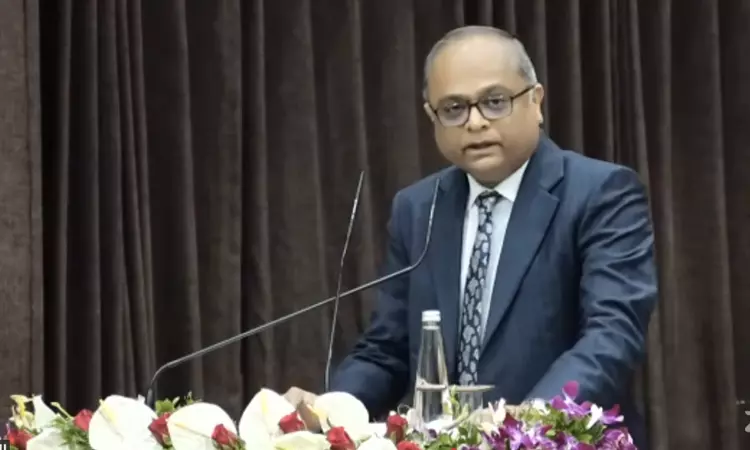
The objective must be to balance efficiency with integrity, Justice Pancholi said.
Supreme Court Justice Vipul M. Pancholi on Saturday (April 4) observed that a judicial system which disposes of cases quickly but compromises on fairness cannot be considered effective; equally, a system that produces flawless judgments after years of delay is also deficient.Justice Pancholi therefore underscored that the objective of the justice delivery system must not be speed at the cost...
This is a premium content
Available exclusively to
Our subscribers
Subscribe Premium 
INR 1099+GST
Your support helps us to bring you more content at
an affordable subscription scheme !!!
All payment options available
Supreme Court Justice Vipul M. Pancholi on Saturday (April 4) observed that a judicial system which disposes of cases quickly but compromises on fairness cannot be considered effective; equally, a system that produces flawless judgments after years of delay is also deficient.
Justice Pancholi therefore underscored that the objective of the justice delivery system must not be speed at the cost of substance, but efficiency with integrity.
The judge was speaking at the inaugural session of a two-day Annual Conference of Judges of the District Judiciary on the theme "Re-shaping Dispensation of Justice: Transcending the Narratives", organized by the High Court in collaboration with the Gujarat State Judicial Academy (GSJA). Supreme Court Justice Vikram Nath attended the event as the Chief Guest, while Supreme Court Justice NV Anjaria was also present.
Addressing the gathering, Justice Pancholi noted that judicial officers function within a structured institutional framework and must recognize the structural tensions inherent in the justice delivery system.
"Cases that are simpler and quicker to dispose of may receive priority. Complex matters requiring detailed evidence, multiple witnesses or intricate legal reasoning may demand time, that is not always adequately accommodated within existing evaluation frameworks," he emphasized.
However, he said, that is not a reflection on the dedication of judicial officers.
"A judicial officer maybe compelled due to systemic incentives to prioritize numbers over complexity. The question before us is therefore is not whether judicial officers are committed. They undoubtedly are. The question is 'Are our systems designed to enable them to deliver meaningful justice?' The theme of this conference urges us to transcend the narrative. But what is this narrative? It is the narrative that pendency is inevitable, delay is unavoidable, and systemic constraints are unmanageable. To transcend this narrative is not to deny reality. It is to redefine it," Justice Pancholi said.
He said that this requires us to shift from management of backlog to management of justice outcomes; from metric-driven efficiency to qualitative effectiveness; and from procedural compliance to substantive justice.
Effective dispensation is not just about speed but also efficiency
"Effective dispensation of justice must be understood not as speed alone, but as a balance of timelines, fairness, accessibility, transparency, and public confidence. A system which disposes of cases quickly but compromises on fairness is not effective. Similarly a system which produces flawless judgments after years of delay is equally deficient. The objective therefore is not speed at cost of substance but efficiency with integrity," he underscored.
He said that the district judiciary occupies a position of foundational importance, as it is at this level that the court directly meets the citizen.
"It is here constitutional promises are translated into tangible outcomes. The district judiciary is where governance becomes reality. Infrastructure has improved; technology has been introduced; case management systems have evolved. Yet the core question remains: 'Has the experience of justice improved commensurately'?" the judge said.
He clarified that this was not a question of criticism, but one of responsibility.
"We must recognize that the perception of justice today is shaped not only by the correctness of judgments, but by three interlinked factors: timelines, accessibility and responsiveness. A judgment delivered after inordinate delay, however legally sound, often fails to inspire confidence. Justice delayed, as we know, is justice diluted," the judge said.
He further observed that there is growing public sensitivity towards pendency of cases, delays in adjudication, and the handling of sensitive matters. Cases involving women, children, and marginalized communities, he noted, carry a heightened sense of urgency and demand a particularly responsive judicial approach.
Similarly, he added that grave offences, whether under special statutes or involving serious crimes, require judicial attention commensurate with their societal impact. At the same time, he pointed to a paradox within the justice delivery system: routine litigation such as cheque dishonour cases, civil disputes, and property matters continues to face prolonged timelines, leading citizens to increasingly question whether formal legal remedies are worth pursuing.
He emphasized:
"District judiciary officers are not merely adjudicators; they are custodians of trust. Every order passed, every adjournment granted, every interaction in the courtroom contributes to shaping public confidence in the judiciary."
Justice Pancholi further underscored three qualities that define effective judicial conduct: sensitivity, discipline, and courage.
Law And Technology
Speaking about technological advancements in the justice delivery system, Justice Pancholi said that the introduction of digital tools, case information systems, virtual hearings, and digitized records has significantly transformed the functioning of courts.
"The launch of an AI policy for the district judiciary marks an important step forward. The introduction of free e-certified copies of orders and judgments is a significant measure that reflects a broader shift towards transparency, accessibility, and citizen-centric service delivery. One of the key areas for reform lies in case management. We must move towards prioritization based on the nature and urgency of cases. Serious offences, vulnerable victims, and high-impact cases must receive considerable attention. At the same time, routine cases must not languish. Balance is the key. We must ensure that judicial officers are empowered and not constrained by the system," he said.
He further noted that the purpose of the conference was to align ideals with practice and to remind stakeholders that justice is not a routine administrative function but a continuing responsibility.
He urged participants to reflect on key institutional questions:
"What are the systemic barriers to effective justice delivery? How can we align institutional incentives with qualitative outcomes? What practical steps can be implemented at the district level?"
Justice Pancholi concluded by urging the participants to move forward with a shared understanding that justice must not be measured merely by the number of cases disposed of, but by the confidence it inspires in the public.
Meanwhile, High Court Chief Justice Sunita Agarwal, in her welcome address, informed the gathering about the launch of a policy on the use of Artificial Intelligence in judicial and court administration in Gujarat, describing it as the "first of its kind by a High Court in India." She stated that the policy aims to harness the power of AI to enhance efficiency and accessibility in the justice delivery system.
The function also witnessed the flagging off of "Access to Justice" vehicles by the dignitaries. Chief Guest, Supreme Court Justice Vikram Nath, also unveiled the "Policy on the Use of Artificial Intelligence" in judicial and court administration.

Malavika Prasad
Malavika Prasad is a Desk Editor with LiveLaw

