




High Court of J & K and Ladakh
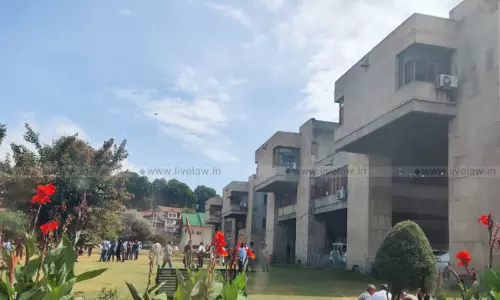
'Penal Liability Doesn't Pass On To Legal Heirs': J&K&L High Court Quashes Suspension Of Employee Over Father's Corruption Case
The Jammu & Kashmir and Ladakh High Court has held that the suspension of a government employee solely on the basis of criminal proceedings pending against his father is impermissible in law, as penal liability cannot be inherited by legal heirs.The Court was hearing a writ petition challenging an order suspending a Class-IV employee of the Jammu and Kashmir Legislative Assembly...
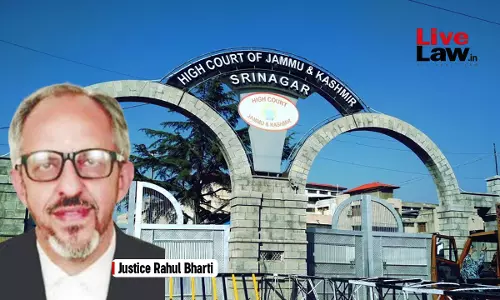
Remedy Lies Before CAT: J&K&L High Court Rejects Over-Age SI Aspirants' Plea; Cites Rigours Of Administrative Tribunals Act
Delineating the limits of judicial review in recruitment matters, the Jammu and Kashmir and Ladakh High Court has dismissed two clubbed writ petitions seeking age relaxation for participation in a fresh recruitment process for the post of Sub-Inspector in the J&K Police. Justice Rahul Bharti held that the writ petitions were "fated to suffer an outright dismissal" as the petitioners...
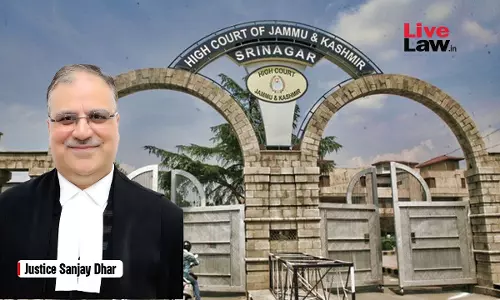
Material Alteration By Cheque Drawer To Defeat Payment Attracts S. 138 NI Act; 'Who Altered' Is A Triable Issue: J&K&L High Court
Emphasising that a material alteration in a cheque does not, by itself, absolve the accused of criminal liability, the Jammu and Kashmir and Ladakh High Court has held that the decisive factor under the Negotiable Instruments Act is not the mere presence of an alteration, but the identity of the person who made it.A bench of Justice Sanjay Dhar ruled that where an alteration is made by the...
S. 309 CrPC | Timeline For Rape Trials Is To Ensure 'Speedy Justice' For Victim, Can't Be Leveraged For Automatic Bail: J&K&L High Court
Emphasizing victim protection over procedural shortcuts for the accused, the High Court of Jammu & Kashmir and Ladakh has held that the timeline mandated under the proviso to Section 309 of the Code of Criminal Procedure (CrPC) is designed to deliver speedy justice to victims and cannot be invoked to grant automatic bail to the accused merely due to a delay in completing the...
Jammu & Kashmir And Ladakh High Court Weekly Round-Up : January 12 To January 18, 2026
Nominal Index:Ghulam Rasool Bhat Vs UT Of J&K 2026 LiveLaw (JKL) 9Nazir Ahmad Bhat Vs Chairman/ Managing Director J&K Bank Corporate Office 2026 LiveLaw (JKL) 10State Of J&K Vs Ahsan-ul-Haq 2026 LiveLaw (JKL) 11Sarwa Zahoor Vs Deputy Director Enforcement Directorate & Anr 2026 LiveLaw (JKL) 12Mehbooba Mufti vs Union of India & Ors 2026 LiveLaw (JKL) 13M/S Ace Enterprises...
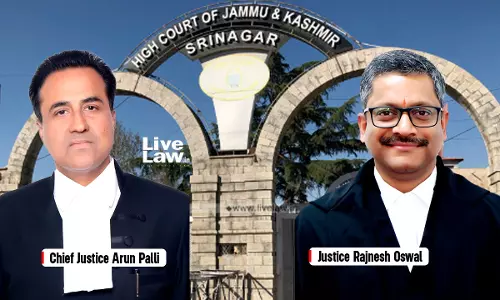
Once An Issue Has Attained Finality, Trial Court Cannot Reopen Or Refer It To HC For Clarification: J&K&L High Court
The Jammu & Kashmir High Court held that once a trial court has finally decided an issue, it lacks jurisdiction to reopen, revisit, or refer the same issue to the High Court, particularly when the order has attained finality and has not been challenged through appropriate legal remedies.A bench of Chief Justice Arun Palli, Justice Rajnesh Oswal observed that permitting re-agitation of...
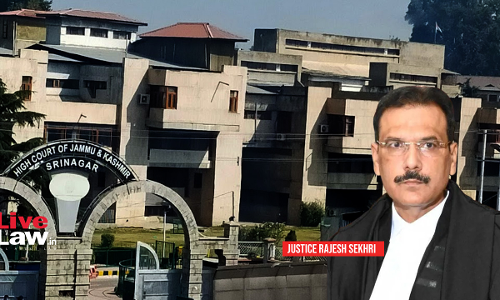
Justice May Be Tempered With Mercy In Exceptional Cases: J&K&L High Court Allows Symbolic Possession In Migrant Property Eviction Dispute
While reaffirming that justice must ordinarily be administered strictly in the manner prescribed by law, the Jammu and Kashmir and Ladakh High Court has underscored that in exceptional factual situations, courts cannot remain indifferent to human consequences.Observing that rigid statutory compliance may, in rare cases, require to be balanced with compassion, the Court held that justice...

Deliberately Appending Mismatched Signature To Prevent Encashment Of Cheque Attracts S.138 NI Act: J&K&L High Court
The Jammu and Kashmir and Ladakh High Court has held that where a drawer of a cheque deliberately appends a signature that does not tally with his specimen signature available with the bank, with the intent to prevent the cheque from being honoured, the offence under Section 138 of the Negotiable Instruments Act, 1881, would stand attracted.A bench of Justice Sanjay Dhar remarked, “.. so...
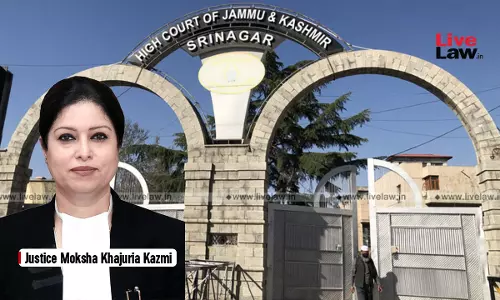
Third Party Using Land With Owner's Consent Cannot Be Prosecuted For Encroachment: J&K&L High Court
The Jammu & Kashmir High Court has held that coercive action cannot be taken against a third party who merely used land with the permission of its recorded owner, especially when the statute invoked is inapplicable.The petitioner had challenged an order directing seizure of his building material and registration of an FIR for alleged encroachment of common land under the J&K Common...
Trial Courts Lack Jurisdiction To Act On Alleged False Affidavits Filed Before Supreme Court: J&K&L High Court
Underscoring the strict procedural safeguards governing prosecution for perjury, the Jammu & Kashmir and Ladakh High Court has held that where an alleged false affidavit or statement is made in proceedings before the Supreme Court, it is the Supreme Court alone which has the jurisdiction to initiate perjury proceedings, and no subordinate court or trial court can assume...
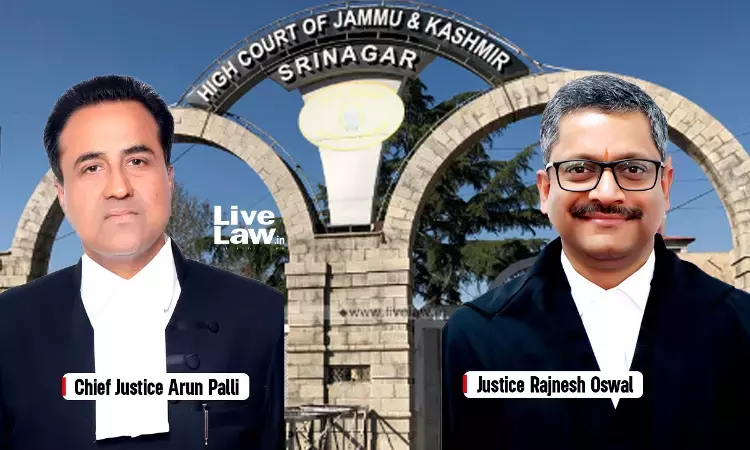
Courts Cannot Be Turned Into Platforms For Political Campaigns: J&K&L High Court Dismisses PIL On Undertrial Transfers
The Jammu & Kashmir High Court dismissed a Public Interest Litigation seeking directions for detention of undertrial prisoners of the Union Territory within prisons located in Jammu & Kashmir, holding that Public Interest Litigation cannot be used as a political platform or as a tool to gain electoral advantage.A Division Bench of Chief Justice Arun Palli, Justice Rajnesh Oswal...
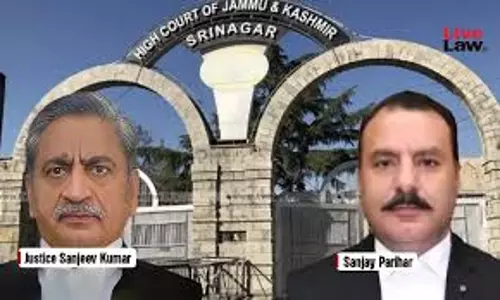
Tribunal Can Remand Cases After Setting Aside Confirmation Order: J&K High Court Clarifies Scope Of Section 26(4) PMLA Act
Clarifying the scope of appellate powers under the Prevention of Money Laundering Act, 2002 (PMLA), the Jammu and Kashmir and Ladakh High Court has held that the Appellate Tribunal's power under Section 26(4) of the Act is of wide amplitude and necessarily includes the power to remand a matter to the Adjudicating Authority as a consequential and ancillary power when an order is...