




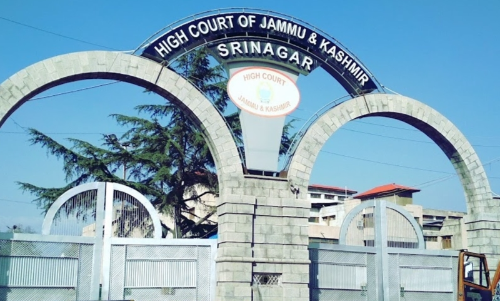
High Court of J & K and Ladakh
J&K Govt Must Prescribe Procedure For Willow Act Confiscations After Forest Act Repeal: High Court
The Jammu & Kashmir and Ladakh High Court has observed that if the Government is serious about effectively enforcing the Jammu & Kashmir Willow (Prohibition of Export and Movement) Act, 2000, it must urgently bridge the legislative vacuum by prescribing a statutory procedure governing seizure and confiscation of willow and vehicles used in alleged violations.Holding that enforcement of...
Jammu & Kashmir And Ladakh High Court Weekly Roundup August 3 - August 9, 2026
Nominal Index:Nisar Ahmad Joo v. UT of J&K & Anr 2026 LiveLaw (JKL) 333Lek Raj Padha v. Union Territory of J&K & Anr 2026 LiveLaw (JKL) 334Nargis Begum v. Union of India & Ors. 2026 LiveLaw (JKL) 335Naveen Jamwal v. High Court of J&K and Ladakh and Others 2026 LiveLaw (JKL) 336State of J&K v. Mohammad Ramzan Mir (connected with Abdul Majeed Beigh v. Mohammad Ramzan...
Public Function Of Imparting Education Alone Does Not Make Army's Op Sadbhavana School Amenable To Writ Jurisdiction J&K&L High Court
The Jammu & Kashmir and Ladakh High Court has held that the mere fact that an educational institution established under the Army's "Operation Sadbhavana" performs the public function of imparting education does not make every dispute concerning its employees amenable to writ jurisdiction under Article 226 of the Constitution.The Court ruled that where the relationship between the...
No Separate Demolition Notice Required For Persons Not Named In Official Records: J&K&L High Court
The Jammu & Kashmir and Ladakh High Court has held that where an administrative authority initiates demolition or encroachment removal proceedings on the basis of contemporaneous official records, it is not obliged to issue notices to persons whose names do not figure in those records merely because they subsequently assert independent private or contractual claims over the property.The...
Srinagar Jail Riot Case: J&K&L High Court Directs Reconsideration Of UAPA Charges, Says Further Probe Can't Reassess Old Material
The Jammu & Kashmir and Ladakh High Court has held that while further investigation under Section 173(8) of the Code of Criminal Procedure (now Section 193(9) BNSS) is legally permissible, a supplementary charge-sheet introducing graver offences must ordinarily be founded on fresh oral or documentary evidence and not merely on a re-evaluation or reassessment of material already...
SC Candidates Availing Domicile-Based Relaxation Eligible For Selection Under Open Merit In BSF Recruitment: J&K&L High Court
The Jammu & Kashmir and Ladakh High Court, while directing the appointment of Scheduled Caste candidates excluded from BSF recruitment despite securing higher marks than selected open merit candidates, has held that candidates who availed physical relaxation based on Jammu and Kashmir domicile cannot be confined to the reserved quota merely because they applied under the Scheduled...
J&K&L High Court Refuses To Quash ₹65 Lakh Cheque Bounce Case, Says Lost Cheque Defence Must Be Tested At Trial
The Jammu & Kashmir and Ladakh High Court, while refusing to quash proceedings in a cheque dishonour complaint involving ₹65.68 lakh, has held that pleas of a cheque being misplaced, prior stop-payment instructions, alleged misuse of cheque and absence of a legally enforceable debt are matters of defence which cannot be conclusively decided in proceedings under Section 528 BNSS.The...
Private Trust Managing Shrine Without Legal Authority Has No Right To Oppose Wakf Takeover: J&K&L High Court
The Jammu & Kashmir and Ladakh High Court has held that a private trust which entered into the management of a shrine without lawful authority or a legally recognisable claim cannot challenge the statutory authorities' action of taking over its management under the Jammu and Kashmir Wakaf Act, 2001.The Court was hearing petitions challenging the Wakaf authorities' decision to take charge...
Victim Accompanied Accused For A Month Without Seeking Help: J&K&L High Court Upholds Acquittal In Kidnapping, Rape Case
The Jammu & Kashmir and Ladakh High Court has refused to overturn the acquittal of a man accused of kidnapping and raping an 18-year-old woman, observing that the prosecution's own evidence indicated that the prosecutrix had voluntarily accompanied the accused, stayed with him for over a month, travelled in public transport without raising any alarm, and failed to seek help despite...
J&K&L High Court Upholds Removal Of Civil Judge Accused Of Taking 7.5 Lakh Bribe, Says Credibility Rests On Character Of Judges
The Jammu & Kashmir and Ladakh High Court, while upholding the removal of a judicial officer accused of taking money on the promise of securing public employment, has held that the credibility of the judicial institution depends not only on the correctness of judicial decisions but also on the character, integrity and rectitude of those who hold judicial office.The Court was hearing a...
J&K&L High Court Upholds CRPF Probationer's Termination, Says Militant Attack Claim To Explain Unauthorised Absence Was Afterthought
The Jammu & Kashmir and Ladakh High Court has upheld the termination of a probationary CRPF Constable, holding that his explanation for remaining absent from duty on the ground that militants had attacked his house was an afterthought unsupported by contemporaneous material.Finding that the documents produced by the petitioner appeared to have been created only after his termination...
Jammu & Kashmir And Ladakh High Court Weekly Roundup July 27 - August 2, 2026
Nominal Index:Arjun Kumar Through His Father Sham Lal v. UT of J&K & Ors 2026 LiveLaw (JKL) 326Inder Krishan Raina v. Union Territory of J&K through SHO Police Station, Nawabad, Jammu 2026 LiveLaw (JKL) 327Javid Ahmad Lone & Ors. v. Union Territory of J&K through SHO, Police Station Karnah, District Kupwara 2026 LiveLaw (JKL) 328Bashir Mohammad Choudhary v. Union...