



Amendment Of Injunction Suit To Seek Possession Of Encroached Land Does Not Change Nature Of Suit: J&K&L High Court
LIVELAW NEWS NETWORK
5 Nov 2026 4:35 PM IST
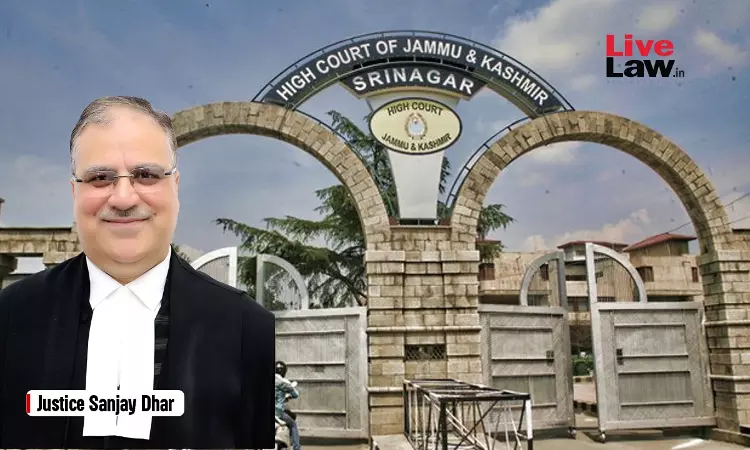
Mere conversion of a suit for permanent prohibitory injunction into one seeking recovery of possession does not fundamentally alter its nature or character when both reliefs arise from the same property dispute, the Jammu & Kashmir and Ladakh High Court has held.
The Court observed that an amendment seeking possession of portions of the very same land allegedly encroached upon during the pendency of the suit cannot be rejected on the ground that it introduces an entirely new cause of action.
The Court was hearing a petition challenging an order of the Sub Judge (Special Mobile Magistrate), Udhampur, which had permitted a plaintiff to amend his plaint to incorporate a claim for recovery of possession of portions of land allegedly encroached upon by the defendant. The amendment was sought after a Local Commissioner, appointed at the instance of the defendant, submitted a report recording encroachment over portions of the disputed property.


Justice Sanjay Dhar dismissed the petition, relying on the Supreme Court's decision in Sampath Kumar v. Ayyakannu, (2002) 7 SCC 559, and observed,
“merely changing the relief from injunction to possession, where said reliefs arise out of the same property dispute, does not fundamentally alter the basic structure or complexion of the suit.”
Background
The dispute concerned land situated at District Udhampur. The respondent, Radhey Krishan, had instituted a suit seeking a decree of permanent prohibitory injunction against the petitioner, Tara Mani, claiming that he was one of the co-owners and co-sharers of the land. He asserted that, pursuant to a private arrangement among the co-sharers, the land had been adjusted and partitioned for use, enjoyment and cultivation, and that he had constructed a residential house on the portion falling to his exclusive share.
According to the plaintiff, the defendant had purchased adjoining land from one of the co-sharers and was attempting to raise a boundary wall in a manner that would cover a portion of the plaintiff's land. The defendant, however, maintained that he had been in lawful ownership and possession of his land for nearly 50 years and had no intention of encroaching upon the plaintiff's share.
During the pendency of the suit, the defendant moved an application seeking appointment of a Local Commissioner for inspection of the disputed site. The trial court allowed the application and appointed the Tehsildar, Udhampur, who conducted the inspection through revenue officials. The Commissioner's report recorded encroachment of 16 marlas out of the said land.
Following the report, the plaintiff sought amendment of the plaint to incorporate a relief for recovery of possession of the allegedly encroached portions. The trial court allowed the application.
Aggrieved, the defendant approached the High Court, contending that the amendment converted a suit based on asserted possession and injunction into one seeking recovery of possession, thereby introducing an entirely different cause of action. It was also argued that the Local Commissioner's report had not properly demarcated the disputed land and could not furnish a fresh cause of action.
Court's Observation
Justice Dhar examined the scope of Order VI Rule 17 of the Code of Civil Procedure, which empowers courts to permit amendment of pleadings where such amendment is necessary for determining the real questions in controversy between the parties.
The Court reiterated that a liberal approach is ordinarily required while considering applications for amendment of pleadings, subject to recognised exceptions. An amendment may be refused where it causes irreparable prejudice to the opposite party, is intended to delay proceedings, seeks to withdraw an admission, introduces a time-barred cause of action or fundamentally alters the basic structure or character of the suit.
The Court also noted that where an amendment is sought after commencement of trial, the applicant must satisfy the requirement of due diligence under the proviso to Order VI Rule 17 CPC by demonstrating that, despite exercising due diligence, the matter could not have been raised before commencement of trial.
Applying these principles, the Court noted that the plaintiff had originally instituted the suit claiming that the disputed land was in his possession and seeking to restrain the defendant from interfering with it. The subsequent report of the Local Commissioner, appointed at the defendant's instance, recorded encroachment over certain portions of the very same property. This prompted the plaintiff to seek recovery of possession of those portions.
The Court then relied upon the Supreme Court's decision in Sampath Kumar v. Ayyakannu, which dealt with the question whether changing the relief from injunction to possession would alter the nature and character of a suit. The Supreme Court had held that where both reliefs arise from the same property dispute, such an amendment does not fundamentally alter the basic structure or complexion of the suit. It had also cautioned that compelling a plaintiff to withdraw the original suit and institute a fresh suit for possession would result in unnecessary delay and wastage of judicial time.
Applying the aforesaid principle, Justice Dhar observed,
“In view of the aforesaid legal position, merely because the plaintiff has sought the relief of recovery of possession in respect of the alleged encroached portions of the suit land, it cannot be said that the proposed amendment alters the basic structure or character of the suit, particularly when the relief sought by way of amendment pertains to the same property, which is the subject matter of the original suit.”
The Court further took note of the fact that the amendment had been sought before commencement of trial and was confined to recovery of possession of the portions allegedly encroached upon. It, therefore, found no reason to interfere with the trial court's exercise of discretion.
Holding that the trial court had correctly appreciated the factual and legal aspects of the matter, the Court observed that its order did not suffer from any perversity or illegality warranting interference under Article 227 of the Constitution.
The Court accordingly concluded that the proposed amendment was permissible and that the petition challenging the trial court's order lacked merit.
Dismissing the petition, the High Court upheld the order dated August 14, 2026, passed by the Sub Judge (Special Mobile Magistrate), Udhampur, permitting Radhey Krishan to amend the plaint and incorporate the relief of recovery of possession in respect of the portions of land allegedly encroached upon by Tara Mani.


