



- Home
- /
- High Courts
- /
- High Court of J & K and Ladakh
- /
- Co-Operative Bank Performing Public...
Co-Operative Bank Performing Public Functions Amenable To Writ Jurisdiction Despite Not Being 'State' Under Article 12: J&K&L High Court
LIVELAW NEWS NETWORK
21 July 2026 9:35 PM IST
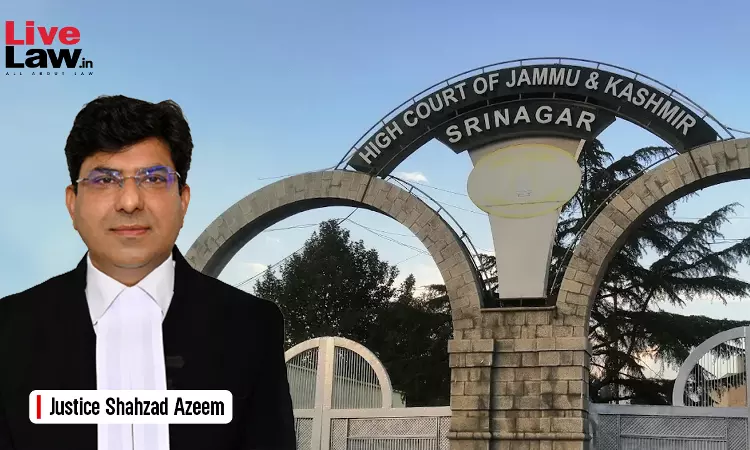
Expanding the contours of judicial review under Article 226 of the Constitution, the High Court of Jammu & Kashmir and Ladakh has held that the maintainability of a writ petition no longer depends solely upon whether the respondent is a 'State' under Article 12.The Court Observing that the touchstone for invoking Article 226 is the presence of a public law element, not the formal status...
This is a premium content
Available exclusively to
Our subscribers
Subscribe Premium 
INR 1099+GST
Your support helps us to bring you more content at
an affordable subscription scheme !!!
All payment options available
Expanding the contours of judicial review under Article 226 of the Constitution, the High Court of Jammu & Kashmir and Ladakh has held that the maintainability of a writ petition no longer depends solely upon whether the respondent is a 'State' under Article 12.
The Court Observing that the touchstone for invoking Article 226 is the presence of a public law element, not the formal status of the body against whom relief is sought the court emphasised that where a Cooperative Bank carries on banking business by accepting deposits from the public under RBI regulation, it performs a public function and becomes amenable to writ jurisdiction as "any person or authority", notwithstanding its private character.
A bench of Justice Shahzad Azeem made these observations while dismissing a writ petition filed by a former General Manager/Chief Executive Officer of the Urban Cooperative Bank, Anantnag, who had challenged orders relieving him from service and withholding his retirement benefits after the authorities held that his extension beyond the age of superannuation was without legal sanction.
Although the petitioner had attained the prescribed superannuation age on 31 March 2021, the erstwhile Board of Management granted him successive extensions, thereby prolonging his tenure until 31 March 2026. However, upon the Registrar of Cooperative Societies superseding the Board and appointing a Board of Administrators, the latter issued directions for the petitioner's immediate relief from service. This action was premised on the ground that the initial extensions were fundamentally contrary to the applicable statutory service rules.
Aggrieved, the petitioner approached the High Court contending that the action was illegal, violated principles of natural justice and was taken without mandatory approval of the Reserve Bank of India.
Court's Observations:
Before examining the merits, the Court addressed the preliminary objection that the writ petition itself was not maintainable because the Urban Cooperative Bank was not "State" within the meaning of Article 12 of the Constitution.
Rejecting the objection, Justice Azeem held that constitutional jurisprudence on Article 226 has undergone a significant transformation. Quoting the recent Supreme Court decision in Ajay Vijh v. Indian Banks Association, the Court observed,
"The focus has gradually shifted from the formal character of the body against whom relief is sought to the nature of the function performed, the source of power exercised, and the effect of the impugned action on legally protected rights."
The Court emphasised that Article 226 extends to "any person or authority" performing public duties and is not confined to statutory authorities or instrumentalities of the State. Justice Azeem observed,
"..For maintaining of a Writ Petition under Article 226... the existence of a public law element and the effect of the impugned action on the rights of the affected person are the decisive factors."
Examining the nature of Urban Cooperative Banks, the Court noted that they accept public deposits, advance loans, operate under RBI regulatory supervision and deal with public money. Such activities, the Court held, transcend the realm of private contractual relationships and carry a distinct public duty component. The Court remarked,
"The business involves public money, depositor protection and financial system stability. RBI regulations impose public duties on the Bank. This supports amenability to writ jurisdiction under Article 226 as 'any person or authority' performing public functions."
The Court further distinguished the earlier judgment in Ghulam Rasool Dar v. J&K State Cooperative Bank Ltd., observing that while a purely contractual service dispute governed exclusively by non-statutory bye-laws may not be amenable to writ jurisdiction, the present case involved statutory service rules framed under SRO 233 of 1988, thereby introducing a clear public law element warranting judicial review.
Having held the writ petition to be maintainable, the Court proceeded to examine the legality of the petitioner's continuation in service. Referring to Rule 13 of SRO 233 of 1988, the Court held that employees of Cooperative Societies retire upon attaining the age of 58 years, and any enhancement of the retirement age or extension beyond that age can only be brought about through statutory amendment by the Government.
Relying upon the Division Bench judgment in Mohammad Yousuf Mir v. Union Territory of J&K, the Court reiterated that the Board of Management possessed no authority to extend the service of employees beyond the statutory retirement age.
Justice Azeem held that the resolution granting the petitioner extension till 2026 was non est in the eyes of law, observing that the Board lacked any statutory competence to grant such extension. Consequently, the petitioner's continuation after 31 March 2021 had no legal foundation.
The Court further declined to examine the petitioner's challenge to the appointment of the Board of Administrators, holding that disputes relating to the constitution and management of a Cooperative Society fall within the exclusive mechanism provided under Section 70 of the Jammu & Kashmir Cooperative Societies Act, 1989, and therefore could not be adjudicated in writ proceedings.
Holding that the petitioner's extension beyond the statutory age of retirement was void ab initio and that the relieving orders merely recognised the correct legal position, the Court thus dismissed the writ petition.
Case Title: Mohammad Shafi Reshi v. Union Territory of J&K & Ors.
Citation: 2026 LiveLaw (JKL) 312


