



- Home
- /
- High Courts
- /
- High Court of J & K and Ladakh
- /
- Contractual Professionals Not...
Contractual Professionals Not Entitled To Remuneration Beyond Contract Period Without Proof Of Work Performed: J&K&L High Court
LIVELAW NEWS NETWORK
4 Jun 2026 6:30 PM IST
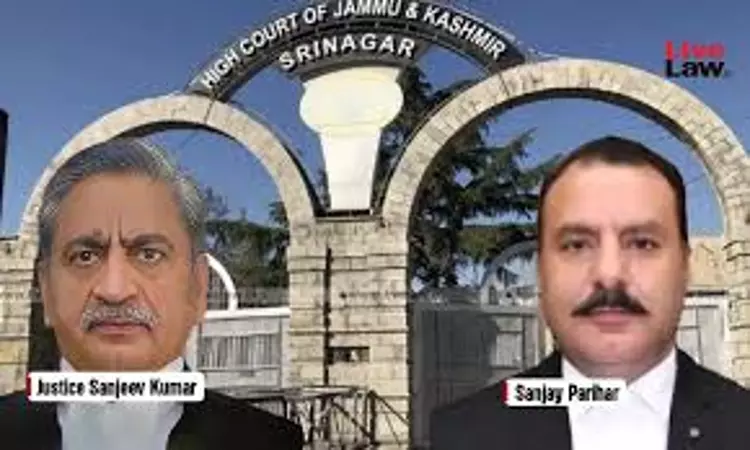
The High Court of Jammu & Kashmir and Ladakh has set aside a writ Court order directing payment of remuneration to contractual professionals engaged for preparation of zonal plans, holding that the respondents miserably failed to demonstrate that they performed any duties beyond the period of their contract.The Court observed that the experience certificates were issued by the very...
This is a premium content
Available exclusively to
Our subscribers
Subscribe Premium 
INR 1099+GST
Your support helps us to bring you more content at
an affordable subscription scheme !!!
All payment options available
The High Court of Jammu & Kashmir and Ladakh has set aside a writ Court order directing payment of remuneration to contractual professionals engaged for preparation of zonal plans, holding that the respondents miserably failed to demonstrate that they performed any duties beyond the period of their contract.
The Court observed that the experience certificates were issued by the very officer who had dispensed with their services, and that a concerted effort was made to defraud the public exchequer.
The Court was hearing an intra-Court appeal filed by the Union Territory of Jammu & Kashmir against a common judgment passed by a learned Single Judge in two writ petitions, whereby the writ Court had directed release of remuneration to the respondents up to March 20, 2020.
A Division Bench of Justice Sanjeev Kumar and Justice Sanjay Parihar, while observing that “the experience certificates are, on the face of it, managed in connivance with the CTPK only with a view to defraud the public exchequer,” held that the writ Court had ignored the circulars which clearly disengaged the respondents' services, and that there was no documentary evidence of any extension or of actual work performed beyond the contractual period.
The genesis of the case could be tracked to an. Advertisement issued by Srinagar Development Authority in 2017 whereby it invited applications for hiring professionals on contractual basis for preparation of zonal plans of Srinagar city for a period of 12 months.
Similarly, the Chief Town Planner, Town Planning Organization, Kashmir issued an Advertisement Notification on May 4, 2017 for hiring subject specialists for preparation of Master Plan/Zonal Plans of Anantnag city. The respondents were selected and appointed.
The appointment orders provided that the services were hired for a period of 12 months or till completion of the zonal plans, whichever was earlier. The contract for Srinagar professionals was extended for six months up to August 31, 2019. The Anantnag professionals were engaged from July 2018 to June 2019.
The then Chief Town Planner, Kashmir, issued a circular informing all concerned including the respondents that their hired professional services would be deemed disengaged w.e.f. September 1, 2019, calling upon them to hand over all data and equipment. Another circular dated June 18, 2019 was issued for Anantnag professionals disengaging them w.e.f. July 1, 2019.
The respondents filed writ petitions claiming that they continued to perform duties beyond the contract period and were not paid remuneration. The writ Court, relying on a communication from the CTPK to the Principal Secretary, Housing and Urban Development Department stating that the circulars were not served on the professionals and that they continued up to March 20, 2020, along with experience certificates issued on June 8, 2020, allowed the writ petitions.
Court's Observation
The Division Bench noted that facts were not much in dispute as the respondents services were governed by written contracts which were not extended beyond August 31, 2019 (Srinagar professionals) and June 30, 2019 (Anantnag professionals). The competent authority did not extend the term of their contract, instead, the CTPK issued two separate circulars dispensing with their services and directing them to submit data and equipment.
The Court found it intriguing that the respondents claimed to have continued performing duties despite these circulars. The Court also took judicial notice of the situation in the valley post-abrogation of Article 370 of the Constitution of India on August 5, 2019, followed by the COVID-19 pandemic, making it difficult to believe that the respondents continued to work under verbal orders beyond the contract period.
“We are not persuaded to believe that the respondents, who were working directly under the Chief Town Planner Kashmir, were not served with or were not aware of the circulars dispensing with their services after the expiry of their contractual period,” the Court observed.
The Court noted that the writ Court had placed strong reliance on a communication dated August 27, 2021 written by the then CTPK, Iftikhar Ahmad Hakim, and the experience certificates issued by the earlier CTPK, Fayaz Ahmad Khan. The Court found this paradoxical,
“Be it noted that it is the same Fayaz Ahmad Khan, Chief Town Planner, Kashmir, who vide the two circulars (supra) dispensed with the services of the respondents.”
The Court held that the experience certificates were clearly managed in connivance with the CTPK to defraud the public exchequer. “We fail to understand as to how Mr. Fayaz Ahmad Khan, the CTPK, who had issued the twin circulars discharging the respondents from the contractual services, could issue certificates in their favour certifying that they were performing their duties beyond the period of their tenure and after the order of their discharge,” the Court observed.
The Court further noted that despite repeated queries, the respondents could not produce any order issued by the competent authority permitting them to perform duties beyond the contract period. Rather, the documentary evidence on record showed that their contract was formally terminated.
“It is, thus, clear that a concerted effort was made to give the respondents the benefit of submitting the data and the equipment much after the termination of their contract,” the Court held. “Who would believe that the respondents, who were working directly under the CTPK, were not aware of the circulars issued by it, more particularly when the circulars pertained to them and were with respect to the discharge of their services.”
The Division Bench thus held that the judgment passed by the writ Court was not factually correct. The respondents had miserably failed to demonstrate that they performed any duties beyond the period of their contract. Accordingly, the appeal was allowed, the order of the writ Court was set aside, and the writ petitions were dismissed.
Case Title: UT of Jammu and Kashmir & Ors. v. Mohd. Shafi Yatoo & Ors.
Citation: 2026 LiveLaw (JKL) 250


