



Denial Of Wages For Work Actually Performed Violates Article 23: J&K&L High Court Orders Payment To Doctor Despite Retrospective Cancellation Of Engagement
LIVELAW NEWS NETWORK
22 Oct 2026 4:55 PM IST
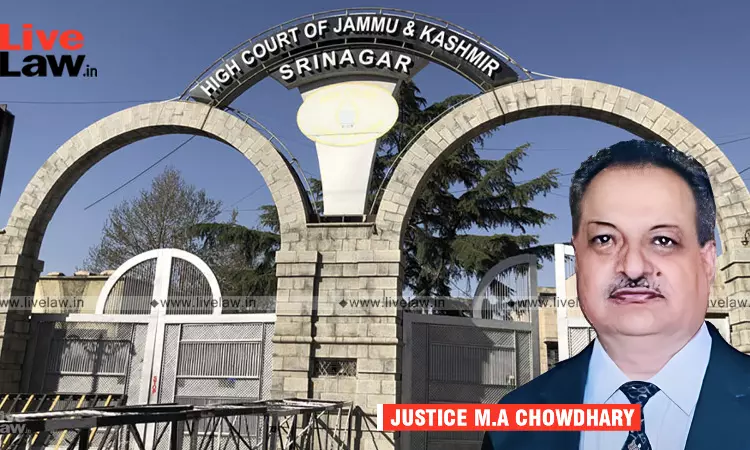
The Jammu & Kashmir and Ladakh High Court has held that withholding remuneration for work actually performed violates Article 23 of the Constitution of India, even where an employee's engagement is subsequently cancelled ab initio on account of an adverse character verification report.
The Court ruled that a condition in an engagement order disentitling an appointee to wages for the period during which she actually worked cannot be enforced, even if the employee furnished an undertaking accepting that condition.
The Court accordingly directed the authorities to release the legitimately unpaid salary of Dr. Saima Kabir, who had worked as a Stipendiary Senior Resident at Sher-i-Kashmir Institute of Medical Sciences (SKIMS), Srinagar.
The Court was hearing a writ petition filed by Dr. Kabir seeking release of her unpaid salary, issuance of an experience certificate and refund of a security deposit of ₹55,000. The respondents had cancelled her engagement ab initio after receiving an adverse report regarding her character and antecedents, relying on a condition in the engagement order and an undertaking furnished by her.


Justice M. A. Chowdhary, while partially allowing the petition, observed,
“Withholding and denial of payment of the remuneration for the period the petitioner had worked, would be violative of Article 23 of the Constitution of India. The condition in the engagement order which disentitles an appointee to wages/salary for the period for which she has worked, is in teeth of Article 23 of the Constitution and even on filing of an undertaking, cannot be enforced.”
Background
Dr. Kabir was provisionally engaged as a Stipendiary Senior Resident in the Department of Anaesthesia at SKIMS, Soura, Srinagar, for one year under Government Order. She claimed that she discharged her duties throughout the engagement period but received salary for only one month, amounting to ₹1,27,772, on April 4, 2024. The salary for the remaining eleven months allegedly remained unpaid.
The engagement order stipulated that if an adverse report concerning her character or antecedents was received from the CID Department, she would have no claim to the engagement, which would be deemed cancelled ab initio. Dr. Kabir had also furnished an affidavit undertaking not to claim engagement in such circumstances.
Following receipt of an adverse report, the authorities issued an order, cancelling her engagement ab initio. She did not challenge that cancellation order in the present proceedings.
The respondents argued that Dr. Kabir had accepted the conditions governing her provisional engagement and could not subsequently seek relief contrary to those conditions. They also disputed her claim that she had deposited ₹55,000 as security, stating that no documentary proof of the deposit had been produced.
Court's Observations
The High Court first examined the conditional nature of Dr. Kabir's engagement. It held that she could not seek continuation or recognition of her engagement contrary to the terms she had accepted, particularly when the cancellation order had not been challenged.
Relying on Kerala State Electricity Board v. Kurien E. Kalathil (2000) 6 SCC 293 and State of U.P. v. Neeraj Awasthi (2006) 1 SCC 667, the Court reiterated that contractual and temporary engagements are governed by their terms and that courts ordinarily cannot rewrite the conditions accepted by the parties.
However, the Court distinguished the question of continuation in service from the right to receive remuneration for work already performed.
It observed that the subsequent cancellation of an engagement did not, by itself, resolve whether salary had accrued for services rendered before cancellation. The respondents' contention that cancellation ab initio, coupled with the petitioner's undertaking, disentitled her to all relief was therefore not sustainable insofar as payment of wages was concerned, the court maintained.
The Court held that the authorities could not deny payment for the period during which Dr. Kabir had actually worked. It found support for this conclusion in a decision rendered by a Coordinate Bench which involved an identical factual background. The Court clarified that this relief would not disturb the cancellation order itself.
The Court separately considered Dr. Kabir's request for an experience certificate. It observed that such a certificate records the fact and duration of service rendered, but could not be used to declare her engagement valid notwithstanding its cancellation ab initio.
Nevertheless, the Court found no justification for withholding a factual certificate if the official record established that she had actually performed duties during a particular period. It therefore directed the authorities to consider issuing a certificate recording the period of actual service, without certifying any period after the cancellation order.
As regards the claimed security deposit of ₹55,000, counsel for Dr. Kabir did not press the relief, acknowledging the absence of documentary proof and the respondents' denial of the deposit.
Partially allowing the petition, the High Court directed the respondents to release Dr. Kabir's legitimately unpaid earned salary for the period during which she actually worked, preferably within eight weeks of receiving a copy of the order.
The Court further directed that, in the event of default, the outstanding salary would carry simple interest at 6% per annum from April 15, 2026, the date of filing of the petition, until realisation. The authorities were also directed to consider issuing a factual certificate recording the period of actual service, without disturbing the cancellation order.


