



Disability Not Recorded At Enrolment Presumed To Have Arisen During Service Unless Rebutted By Cogent Medical Evidence: J&K&L High Court
LIVELAW NEWS NETWORK
20 Oct 2026 12:40 PM IST
The Jammu & Kashmir and Ladakh High Court has upheld an Armed Forces Tribunal order granting disability pension to an Ex-Lance Naik, holding that a disability not recorded at the time of enrolment is presumed to have arisen during service unless the presumption is rebutted by cogent medical evidence.
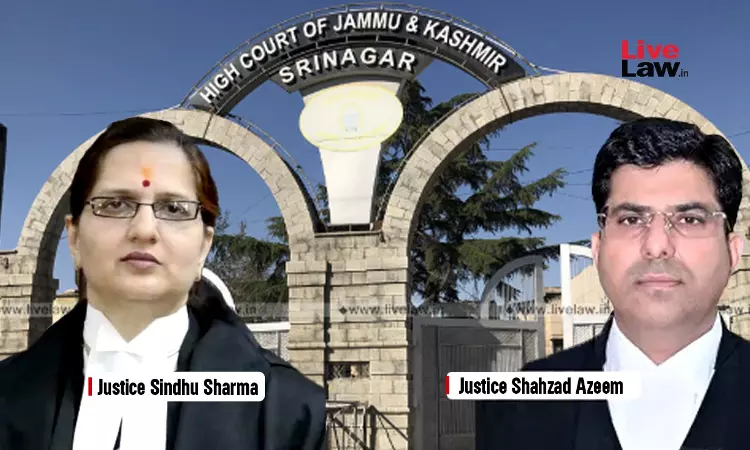
A Division Bench of Justice Sindhu Sharma and Justice Shahzad Azeem dismissed a writ petition filed by the Union of India challenging the grant of disability pension to former Defence Security Corps personnel Babu Ram, who had been assessed with 15–19% disability due to bilateral cataract.
The Court observed that the Release Medical Board had assigned no reasons for concluding that the disability was neither attributable to nor aggravated by military service, leaving the statutory presumption in favour of the personnel unrebutted.
“The Medical Board undoubtedly deserves due weight, [but] the same is not conclusive and is always subject to judicial scrutiny,” the Bench observed.
Background


Babu Ram was initially enrolled in the Indian Army on December 7, 1971, and discharged on December 31, 1995, after rendering 24 years of qualifying service. He was subsequently re-enrolled in the Defence Security Corps on March 16, 1998, and discharged on March 31, 2008.
Before his discharge, a Release Medical Board assessed his disability, described as “Bilateral Cataract (Optd) with Pseudophakia ICD,” at 15–19%. The Board opined that the disability was neither attributable to nor aggravated by military service. His claim for disability pension, as well as his first and second appeals, was rejected.
Aggrieved, Babu Ram approached the Armed Forces Tribunal, which allowed his application and held him entitled to disability pension at 50% after rounding off, subject to verification. The Tribunal restricted arrears to three years preceding the institution of the original application and directed their release within three months, failing which interest at 8% would be payable.
The Union of India challenged the Tribunal's order before the High Court, contending that the disability was assessed below 20%, was not attributable to military service and that the findings of the expert Medical Board could not have been interfered with.
Opposing the plea, Babu Ram argued that no disability had been recorded either at his initial enrolment or at the time of his re-enrolment in the Defence Security Corps. He further submitted that the disability manifested during service and that the Medical Board had provided no reasons for its conclusion.
Court's Observations:
The Bench examined the principles governing disability pension and relied upon the Supreme Court's decision in Dharamvir Singh v. Union of India, which emphasised that where no disability or disease is recorded at the time of enrolment, and the medical authorities fail to explain why it could not have been detected earlier, the disability is presumed to have arisen during service.
The Court also referred to Union of India v. Rajbir Singh, wherein the Supreme Court laid down that personnel are presumed to have been in sound physical and mental condition upon entering service, except for disabilities recorded at the time of entry. A disease leading to discharge is ordinarily deemed to have arisen during service if no note of it was made at the time of acceptance into service.
Applying these principles, the Bench noted that it was undisputed that Babu Ram had no recorded disability either when he initially joined the Army or when he was re-enrolled in the Defence Security Corps. His disability had manifested during the course of service.
Significantly, the Court found that the Release Medical Board had not assigned any reasons for its opinion that the disability was neither attributable to nor aggravated by military service.
“In the absence of any reasons, the statutory presumption operating in favour of the respondent remains unrebutted,” the Bench observed.
The Court further noted that Regulation 179 of the Pension Regulations for the Army, 1961, read with Regulation 266 applicable to Defence Security Corps personnel, had been considered by the Tribunal while examining the respondent's entitlement to disability pension.
The Bench also relied upon the Supreme Court's decision in Sukhvinder Singh v. Union of India, which held that once an individual is found entitled to disability pension, the benefit cannot be denied merely because the disability assessed by the Medical Board is below 20%.
Quoting the Supreme Court, the Bench reiterated,
“The benefit of doubt is rightly extended in favour of the member of the Armed Forces.”
Rejecting the Union's contention that the Medical Board's opinion should be treated as final, the Court held that although such an opinion deserves due weight, it is not conclusive and remains subject to judicial scrutiny. Where the Board records a conclusion without reasons and disregards settled principles governing disability pension, the Court is justified in declining to accept it.
The Bench also emphasised the beneficial nature of disability pension provisions, observing that they are intended to provide financial security to Armed Forces personnel who suffer disability during service and must be interpreted liberally in their favour, particularly where no disability was recorded at the time of entry.
Finding no infirmity, illegality or perversity in the Armed Forces Tribunal's order the High Court dismissed the Union of India's writ petition along with the connected applications.


