



False Age Certificate Issued By Medical Board Not 'Forgery' Unless It Qualifies As A False Document: J&K&L High Court
LIVELAW NEWS NETWORK
19 Nov 2026 3:20 PM IST
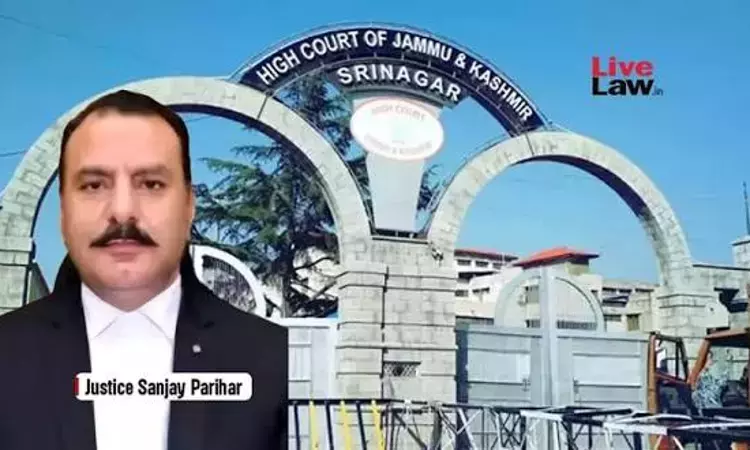
The Jammu and Kashmir and Ladakh High Court has held that merely issuing an official document containing an allegedly false or deliberately manipulated statement does not, by itself, amount to forgery unless the document satisfies the statutory definition of a “false document” under Section 464 of the Ranbir Penal Code (RPC).
Applying this principle, the Court quashed charges of forgery against two doctors accused of issuing a false age certificate to facilitate the regularisation of a government employee, while allowing proceedings for cheating, criminal conspiracy and criminal misconduct under the Prevention of Corruption Act to continue.
The Court emphasised that “a distinction must be maintained between the authenticity of the execution of a document and the truthfulness of its contents.” It held that where a certificate is issued by officials authorised to issue it, an allegedly incorrect assessment recorded in that certificate does not automatically constitute making a false document.
Justice Sanjay Parihar also rejected the contention that the Crime Branch Kashmir lacked jurisdiction to investigate the matter merely because allegations under the Jammu and Kashmir Prevention of Corruption Act, Svt. 2006, had emerged during the investigation. The Court held that the Act does not confer exclusive investigative jurisdiction upon the Vigilance Organisation (now Anti-Corruption Bureau), and that police officers of the prescribed rank can investigate corruption offences subject to compliance with the statutory requirements.


The Court was hearing a petition filed by Dr. Gulzar Ahmad Bhat and Dr. Abdul Lateef Salik, who were members of a Medical Board accused of deliberately manipulating the age assessment of a beneficiary to enable him to secure regularisation and service benefits in the Public Health Engineering Department.
Background
The prosecution case was that Ghulam Hassan Bhat had allegedly procured and used a false age certificate to secure regularisation and permanent employment in the Public Health Engineering Department.
During a preliminary inquiry, it allegedly emerged that the beneficiary, in conspiracy with members of the then Medical Board, Srinagar, including the petitioners and Dr. Abdul Samad Sheikh, the then Chief Medical Officer, had obtained an age certificate dated December 16, 1999.
The Medical Board had assessed Ghulam Hassan Bhat's age as 32 years on that date, which would place his approximate year of birth in 1967. However, verification of the service and school records of his son, Mohammad Shafi Bhat, revealed that the latter's date of birth was February 25, 1966.
The prosecution alleged that the age assessment was demonstrably inconsistent because it would make the father younger than his biological son. It further alleged that the certificate had been deliberately issued to enable the beneficiary to obtain regularisation and permanent employment, resulting in wrongful gain to him and corresponding loss to the State exchequer.
On the basis of the material collected, offences under Sections 420, 467, 468, 471 and 120-B RPC, read with Section 5(2) of the Jammu and Kashmir Prevention of Corruption Act, were alleged against the petitioners.
The doctors approached the High Court challenging the jurisdiction of the Crime Branch to investigate offences under the Prevention of Corruption Act. They contended that such investigation fell exclusively within the domain of the Vigilance Organisation and that SRO 202 dated June 3, 1999, could not confer upon the Crime Branch powers overriding the special statute.
They also argued that the age certificate could not be treated as a forged document because it had admittedly been issued by the members of the Medical Board who were authorised to conduct the assessment. The prosecution had not alleged that their signatures or the official seal were forged, or that the certificate had been issued by impersonating any competent authority.
Opposing the petition, Senior Additional Advocate General Mohsin Qadri submitted that the FIRs had initially been registered for offences under the RPC and that the allegations under the Prevention of Corruption Act had surfaced only during a lawful investigation. He maintained that the Crime Branch was competent to investigate the offences falling within its jurisdiction and collect evidence concerning the entire transaction.
Court's Observation
Examining the jurisdictional objection, Justice Parihar observed that the Prevention of Corruption Act contains specific provisions regulating investigations into corruption offences and prescribing the ranks and authorisations required for investigating officers.
However, it rejected the argument that the Vigilance Organisation alone could investigate every allegation involving the conduct of a public servant.
Justice Parihar held that Section 3 of the Act does not confer exclusive jurisdiction upon the Vigilance Organisation. Rather, it recognises the competence of police officers of the prescribed rank to investigate offences under the Act, subject to the statutory conditions.
The Court observed,
“Section 3 does not confer exclusive jurisdiction upon the Vigilance Organization to investigate offences under the Act, nor does it impose an absolute prohibition upon the regular Police or Crime Branch from investigating such offences.”
It explained that a police officer not below the rank of Deputy Superintendent of Police is competent to investigate offences under the Act without obtaining prior permission from the Magistrate. An officer below that rank may investigate only upon obtaining the requisite order of a Magistrate of the First Class. The Act also provides a separate mechanism for authorised officers of the Vigilance Organisation.
The Court, however, clarified that SRO 202 could not be interpreted in a manner that overrides the statutory restrictions under the Prevention of Corruption Act.
It held,
“A notification issued in exercise of powers under the Code of Criminal Procedure cannot override the substantive requirements of a special statute.”
Thus, while the Crime Branch could investigate offences under the RPC and collect evidence concerning the conduct of public servants, any investigation into an offence specifically punishable under the Prevention of Corruption Act had to comply with Section 3 of that enactment.
The Court also rejected reliance upon Circular Order No. 12261-64/GB dated September 3, 1999, observing that an administrative circular regulating the distribution of investigative work between agencies could neither enlarge nor curtail jurisdiction conferred by statute.
Holding that the subsequent disclosure of a corruption offence did not invalidate an investigation lawfully commenced for offences under the RPC, the Court overruled the preliminary objection to the Crime Branch's jurisdiction, subject to compliance with the statutory requirements.
Incorrect contents of an authentic document do not automatically constitute forgery
Turning to the allegations of forgery, the Court examined Section 464 RPC, which defines the circumstances in which a person can be said to have made a false document.
The petitioners argued that the certificate had been issued by the very officials authorised to assess the beneficiary's age. There was no allegation that they had forged signatures, fabricated the official seal, impersonated another authority or materially altered an existing document without lawful authority.
Relying upon the Supreme Court's decision in Mohammed Ibrahim and Others v. State of Bihar and Another, (2009) 8 SCC 751, the Court reiterated that merely executing a document containing an incorrect assertion does not necessarily amount to making a false document.
It noted that Section 464 RPC contemplates specific categories of conduct, including dishonestly or fraudulently making a document so that it is believed to have been executed by another person or under another person's authority, materially altering a document without lawful authority, or procuring its execution through the circumstances specified in the provision.
Applying these requirements to the age certificate, the Court observed,
“Tested on the touchstone of the aforesaid statutory requirements, the certificate dated 16.12.1999 does not appear to fall within any of the three categories.”
The Court noted that the prosecution did not allege that the petitioners lacked authority to issue an age assessment certificate in their capacity as members of the Medical Board. Nor was it alleged that they had impersonated another person, forged signatures or seals, or materially altered an existing certificate.
It further referred to Mir Nagvi Askari v. Central Bureau of Investigation, AIR 2010 SC 528, reiterating that the prosecution must establish the foundational requirement of making a false document before criminal liability for forgery can be fastened upon an accused. The Bench made a distinction between an allegedly false assessment and the legal character of the document containing that assessment.
It observed,
“The falsity of a statement contained in a document is not, by itself, sufficient to constitute forgery.”
The Court added that the prosecution's case was essentially that the petitioners had exercised their lawful authority to assess the beneficiary's age but deliberately recorded an incorrect assessment to confer an undue advantage upon him.
Such allegations, if established, could attract criminal liability for cheating, conspiracy and criminal misconduct. They did not, however, automatically satisfy the statutory definition of making a false document.
Consequently, the Court held that the foundational ingredients of forgery were not disclosed and that offences under Sections 467, 468 and 471 RPC were not prima facie attracted against the petitioners.
The Court clarified that its conclusion regarding forgery did not resolve the question whether the allegations disclosed the ingredients of cheating, criminal conspiracy and criminal misconduct.
It noted that the prosecution case was not confined to an erroneous assessment of age. The allegation was that the petitioners had knowingly furnished an incorrect assessment in concert with the beneficiary, intending to induce the Department to grant him regularisation and other pecuniary benefits to which he was allegedly not entitled.
The Court held that whether the assessment had been deliberately manipulated, whether the petitioners acted in concert with the beneficiary and whether the requisite dishonest intention existed were matters requiring appreciation of evidence.
It observed,
“At the present stage, however, the allegations and the material collected during investigation furnish a prima facie basis for examining the petitioners' liability under Sections 420 and 120-B RPC.”
The Court further held that the allegations disclosed the essential foundation of criminal misconduct under Section 5(2) of the Prevention of Corruption Act, as the petitioners were public servants allegedly accused of abusing their official position to secure a pecuniary advantage for another person.
Partly allowing the petition, the High Court quashed the impugned FIR and consequential proceedings against the petitioners insofar as they related to offences under Sections 467, 468 and 471 RPC. However, it refused to interfere with the proceedings concerning offences under Sections 420 and 120-B RPC, read with Section 5(2) of the Jammu and Kashmir Prevention of Corruption Act, Svt. 2006.


