



Further Investigation Into Ancillary Terror Links Does Not Render Chargesheet Incomplete For Default Bail Claim: J&K&L High Court
LIVELAW NEWS NETWORK
23 Oct 2026 2:00 PM IST
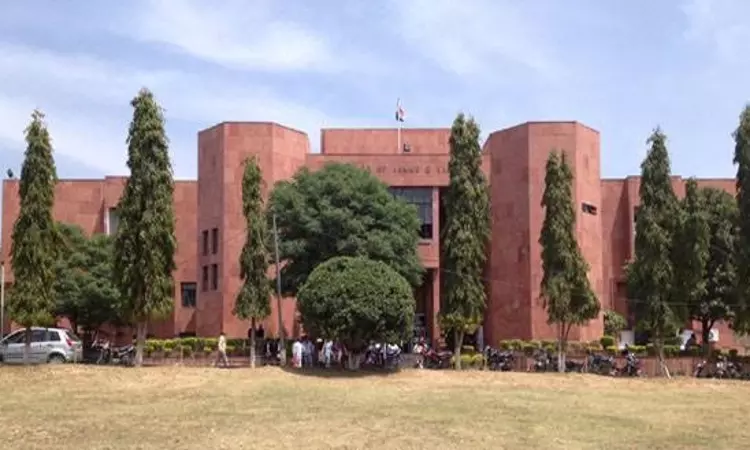
The Jammu & Kashmir and Ladakh High Court has upheld the denial of default bail to three accused facing prosecution under the Unlawful Activities (Prevention) Act, 1967 (UAPA), holding that the investigating agency's continued efforts to establish their links with slain or absconding terrorists did not, by itself, render the chargesheet incomplete.
A Division Bench comprising Justice Sanjeev Kumar and Justice Yash Paul Bourney held that the investigation into the accused persons' alleged involvement in the offences had been completed on the basis of the material collected, including witness statements, electronic and forensic evidence, and call detail records.
The Court concluded that the mere prospect of a supplementary chargesheet concerning their alleged links with terrorist agencies did not entitle them to default bail.
The Court was hearing an appeal under Section 21 of the National Investigation Agency Act, 2008, challenging an order passed by the 3rd Additional Sessions Judge, Jammu, designated as the Special Court under the NIA Act. The trial court had rejected the appellants' application for default bail in FIR registered under various provisions of the UAPA, the Bharatiya Nyaya Sanhita (BNS), the Explosive Substances Act and the Arms Act.


In a judgment authored by Justice Yash Paul Bourney, the Bench observed that the trial court had correctly concluded that the chargesheet was complete regarding the appellants' alleged involvement in the offences, notwithstanding the ongoing investigation into their links with other terrorists.
Background
An FIR was registered on March 28, 2025, invoking Sections 13, 16, 18, 23, 38 and 39 of the UAPA, along with provisions of the BNS, the Explosive Substances Act and the Arms Act. The three appellants, Raiz, aged 24 years, Younis, aged 21 years and Meema, aged 60 years were arrested on April 28, 2025. The chargesheet was filed on October 25, 2025.
The appellants sought default bail on the ground that the investigation had not been completed within the statutory period. They relied on a paragraph of the chargesheet, which stated that the investigation into certain aspects was continuing, including efforts to establish their links with slain or absconding terrorists and their possible involvement in earlier terror-related incidents in Kathua.
Contending that the chargesheet was incomplete, the appellants argued that its filing was intended to deprive them of their indefeasible right to default bail.
The Special Court rejected the plea, observing that paragraph 18.4 of the chargesheet recorded that offences under Sections 13 and 19 of the UAPA stood established against the appellants.
It held that the prospect of a supplementary chargesheet concerning their alleged links with terrorist agencies operating across the border did not make the chargesheet already filed incomplete. The appellants' plea for bail on merits was also rejected.
Court's Observations
The High Court examined the appellants' reliance on Ritu Chhabaria v. Union of India (2023), in which the Supreme Court held that an investigating agency cannot file a chargesheet without completing the investigation merely to deprive an arrested accused of default bail. The Supreme Court had also recognised that default bail is a fundamental right flowing from Article 21 of the Constitution.
The bench reproduced the Supreme Court's observation,
“Without completing the investigation of a case, a charge-sheet or prosecution complaint cannot be filed by an investigating agency only to deprive an arrested accused of his right to default bail under Section 167(2) of the CrPC.”
The Bench also noted the subsequent clarification by the Supreme Court in Directorate of Enforcement v. Manpreet Singh Talwar, wherein it was made clear that courts could consider applications for default bail independently of, and without relying upon, the decision in Ritu Chhabaria.
Applying the legal position to the case, the High Court examined the chargesheet, the supporting material, witness statements recorded under Sections 161 and 164 CrPC, and the order passed by the Special Court. It agreed with the trial court that the investigation concerning the appellants' alleged commission of the offences had been completed on the basis of the material collected.
The Bench observed,
“Mere mentioning that investigating agency was still investigating and trying to establish the links between the appellants and the slain/absconding terrorists does not make out a case to project that investigation was incomplete as argued by the learned counsel for the appellants.”
The Court thus distinguished between the investigation into the offences allegedly committed by the appellants and the continuing efforts to establish additional links with other terrorists. It found that the latter, without more, did not invalidate the chargesheet or establish an entitlement to default bail.
The Bench further held that the appellants were not entitled to bail on merits. After considering the material available against them, it found no justification to interfere with the trial court's assessment on that aspect.
Dismissing the appeal, the High Court upheld the Special Court's order rejecting the appellants' application for default bail. It directed that a copy of the judgment be forwarded to the trial court to proceed with the trial expeditiously.


