



Hotels Hired For Protected Persons Entitled To Full Room Rent Even If Unoccupied: J&K&L High Court
LIVELAW NEWS NETWORK
21 Nov 2026 9:16 AM IST
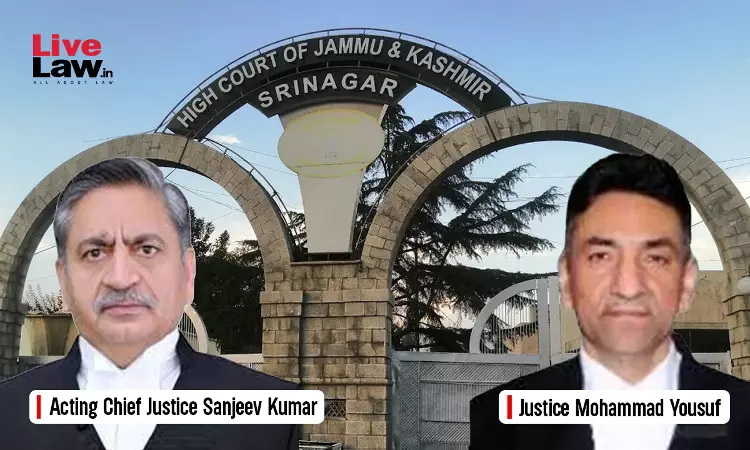
The Jammu & Kashmir and Ladakh High Court has held that a hotel owner is entitled to receive rental charges for all rooms hired by the Government to accommodate protected persons, irrespective of whether those rooms were actually occupied.
The Court ruled that once the rooms are hired and the hotel is required to keep them available for the designated persons, the Government cannot reduce the agreed rental merely because some of the rooms remained vacant.
A Division Bench comprising Justice Sanjeev Kumar and Justice Mohd Yousuf Wani, however, clarified that catering charges would be payable only for the number of persons who actually availed food services at the hotel.
The Bench thus partly allowed an appeal filed by the Union Territory of Jammu and Kashmir and other officials against a Single Judge's order directing payment of the hotel owner's outstanding boarding and lodging claims.


The Court observed that in the absence of any stipulation in the hiring order linking room rent to actual occupancy, the hotel owner was required to keep all the hired rooms un-booked and ready for the protected persons. It described as “highly unjustified and rather ridiculous” the Government's contention that rental charges should be restricted to rooms actually occupied.
Background
The dispute arose from the hiring of Hotel New Metro for accommodating Sarpanches, Panches, PRI members, Municipal Councillors and other protected persons. Initially, the hotel was hired pursuant to an order issued by the Divisional Commissioner, Kashmir, with effect from November 15, 2020.
The hotel was de-hired with effect from October 5, 2021. Subsequently, the Deputy Commissioner, Srinagar, hired 19 rooms of the hotel through a communication dated October 27, 2021. Those rooms remained under the occupation of various protected persons accommodated by the authorities until October 25, 2022. The second hiring was also governed by the rates and conditions previously fixed by the Divisional Commissioner.
After the hotel was vacated, its proprietor submitted boarding and lodging bills to the Deputy Commissioner. Instead of clearing the bills on the basis of the 19 rooms hired, the Deputy Commissioner constituted a committee under the chairmanship of the Sub-Divisional Magistrate (East Srinagar) to verify the claims of hotel owners.
The committee examined the records, including the daily entry and exit registers of protected persons, and recommended payment on the basis of actual occupancy. Consequently, the authorities cleared the bills only for the rooms actually occupied.
Aggrieved by the reduction, Hotel New Metro approached the High Court seeking quashing of the order, the committee's constitution, and its subsequent report. It also sought release of the outstanding hiring and catering charges.
A Single Judge allowed the writ petition on February 11, 2026, quashed the committee's order and report, and directed the authorities to liquidate the hotel's claims for the period from November 15, 2020, to October 25, 2022.
The Union Territory challenged that decision in the present Letters Patent Appeal, arguing, among other things, that the Single Judge had granted relief for a period that was not part of the original writ petition and that the hotel was not entitled to rent for rooms that remained unoccupied.
Court's Observation
The Division Bench first examined the Single Judge's direction to release payment for the initial hiring period, from November 15, 2020, to October 5, 2021.
It found that the hotel owner had not actually sought such relief in the original writ petition. The petition had stated that part payment for that period had already been released by the office of the Divisional Commissioner and that the remaining amount was under process. The Divisional Commissioner, who was the authority responsible for the payment, had also not been impleaded as a respondent.
The Court noted that the claim for the initial hiring period had been introduced only through a supplementary affidavit, without formally amending the writ petition or impleading the competent authority. The Division Bench held that the Single Judge had committed an error by allowing that claim without giving the Divisional Commissioner an opportunity to contest it.
“The direction of the writ Court, insofar as it pertains to liquidation of the liability of the respondent for the aforesaid period is concerned, is certainly beyond the scope of the writ petition and is otherwise in breach of the principles of natural justice,” the Bench observed.
Turning to the second period of hiring, the Court examined the Deputy Commissioner's order dated October 27, 2021, under which 19 rooms had been hired. It found that the order did not contain any condition stipulating that rental charges would be payable only for rooms actually occupied by protected persons.
The Bench emphasised that the hotel owner was required to keep all 19 rooms available for accommodating the 38 protected persons named in the allotment order. The authorities had not contended that the owner was free to let out the unoccupied rooms to other guests during the period of hiring.
In these circumstances, the Court held that the committee's decision to calculate room rent only on the basis of actual occupancy was unsustainable.
“In the absence of any such clear stipulation in the hiring order dated 27th October, 2021, passed by the Deputy Commissioner, Srinagar, the respondent was under an obligation to keep all the 19 rooms un-booked and ready for accommodating all the 38 protected persons named in the order itself,” the bench stated.
The Bench further observed that it would be unjustified to deny the hotel owner rent for rooms which had been reserved and kept available for the Government's use merely because some of the protected persons did not actually occupy them.
The Court, however, drew a distinction between room rent and catering charges. It held that catering charges were payable on a per-head, per-day basis, as specified in the applicable circular of the Divisional Commissioner dated November 7, 2020.
Since food was prepared keeping in view the number of persons actually staying at the hotel, the owner could not claim catering charges for all 38 persons merely because their accommodation had been allotted, the court opined.
“Rather, these charges would be payable on a per head per day basis and as per the actual number of protected persons availing themselves of the food services in the hotel,” the Bench held.
Partly allowing the appeal, the Division Bench modified the Single Judge's judgment and issued separate directions for the two periods of hiring.
The Court set aside the direction to release payment for the initial period from November 15, 2020, to October 5, 2021. It granted the hotel owner liberty to submit a representation to the Divisional Commissioner, Kashmir, for any outstanding amount relating to that period. The competent authority was directed to consider the representation on its merits and release any amount found payable without further delay. If dissatisfied, the hotel owner would be at liberty to file a fresh writ petition.
For the subsequent period, from October 27, 2021, to October 25, 2022, the Court held that the hotel owner was entitled to room rental charges for all 19 rooms hired by the Deputy Commissioner, irrespective of actual occupancy, after deducting any amount already paid.
Catering charges for the same period, however, were directed to be calculated only on the basis of the actual number of persons who availed the hotel's catering services.


