



- Home
- /
- High Courts
- /
- High Court of J & K and Ladakh
- /
- Bail Cannot Be Denied Under UAPA On...
Bail Cannot Be Denied Under UAPA On Uncorroborated Approver Testimony & Telephonic Links: J&K&L High Court
LIVELAW NEWS NETWORK
8 April 2026 7:15 PM IST
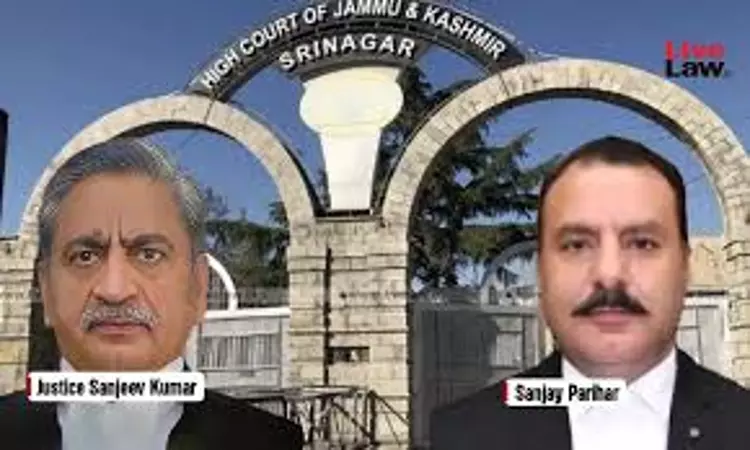
The High Court of Jammu & Kashmir and Ladakh has held that bail under the Unlawful Activities (Prevention) Act cannot be refused where the prosecution relies primarily on approver statements and uncorroborated telephonic contacts, in the absence of recovery or material establishing prima facie involvement.The Court was hearing an appeal under Section 21 of the NIA Act challenging the order...
This is a premium content
Available exclusively to
Our subscribers
Subscribe Premium 
INR 1099+GST
Your support helps us to bring you more content at
an affordable subscription scheme !!!
All payment options available
The High Court of Jammu & Kashmir and Ladakh has held that bail under the Unlawful Activities (Prevention) Act cannot be refused where the prosecution relies primarily on approver statements and uncorroborated telephonic contacts, in the absence of recovery or material establishing prima facie involvement.
The Court was hearing an appeal under Section 21 of the NIA Act challenging the order of the Special Judge, NIA, Jammu, whereby the appellant's application for bail in a case registered under Section 120-B IPC, Sections 8/21 of the NDPS Act and Sections 17, 18 and 20 of the UAPA had been rejected.
A Division Bench comprising Justice Sanjeev Kumar and Justice Sanjay Parihar, while examining the material placed on the record observed that “no recovery has been effected from the appellant, nor is there any material to demonstrate his conscious possession, direct participation, or involvement in any transaction leading to the recovery of narcotic substances from other co-accused, … the entire case against him rests upon the statement of an approver and alleged telephonic contacts, without any corroborative evidence such as financial transactions, recovery, or overt acts attributable to him”.
The Bench accordingly held that “even if the prosecution material is taken at its face value, the same does not satisfy the threshold laid down in Watali, as there are no reasonable grounds to believe that the accusations against the appellant are prima facie true”.
The prosecution's case alleges that the appellant was engaged in smuggling and transportation of narcotic substances over a prolonged period and that the proceeds generated therefrom were utilised for providing logistical support to militant activities. It is further alleged that he remained in contact with several co-accused and had facilitated certain transactions, including the arrangement of a vehicle allegedly used for the transportation of contraband.
According to the charge-sheet, the case against the appellant rests primarily on the statement of an approver and confessional statements of co-accused, along with alleged telephonic contacts. It is not in dispute that no recovery of narcotic substances has been effected from the appellant in connection with the present case.
The appellant contended that apart from a prior NDPS case in which he had already been granted bail, there was no incriminating material against him. It was further submitted that despite being in custody since March 2021, the evidence recorded thus far does not establish any direct involvement or nexus with the alleged offences.
The prosecution, on the other hand, relied upon voice clips, chats and statements of co-accused to contend that the appellant was part of a broader conspiracy involving narcotic smuggling and utilisation of proceeds for unlawful activities.
The High Court, at the outset, reiterated the settled legal position governing the grant of bail under the UAPA. It was observed that in National Investigation Agency v. Zahoor Ahmad Shah Watali (2019), the Supreme Court held that at the stage of bail, the Court must examine whether there exist reasonable grounds for believing that the accusations are prima facie true based on the material placed on record.
At the same time, the Court noted that the rigour of Section 43-D(5) is not absolute and referred to Union of India v. K.A. Najeeb (2021), holding that constitutional courts retain the power to grant bail where prolonged incarceration renders continued detention unjustified.
The Court further relied upon Vernon v. State of Maharashtra (2023) and emphasised that the Court is not expected to act as a mere post office of the prosecution but must assess the probative value of the material. It also referred to Asif Iqbal Tanha v. State (NCT of Delhi) (2023), reiterating that mere association or contact, in the absence of specific acts constituting terrorist activity, cannot justify denial of bail.
On the requirement of criminal conspiracy, the Court referred to State (NCT of Delhi) v. Navjot Sandhu (2005) and Kehar Singh v. State (Delhi Administration) (1988), holding that conspiracy requires a clear meeting of minds and cannot be inferred merely from suspicion or association.
Upon examining the material on record, the Court found that no recovery had been effected from the appellant and that there was no material to demonstrate his conscious possession, direct participation or involvement in any transaction leading to recovery of narcotic substances from other co-accused. It was observed that the entire case against the appellant rested upon the statement of an approver and alleged telephonic contacts, without any corroborative evidence such as financial transactions, recovery, or overt acts attributable to him.
Addressing the evidentiary value of the material relied upon by the prosecution, the Court reiterated that confessional statements of co-accused constitute weak evidence and cannot independently sustain the prosecution's case, observing that “even the role attributed to the appellant, as borne out from the charge-sheet, appears to be peripheral and inferential in nature.”
The Court also examined the alleged telephonic contacts and found that the material, at best, indicated limited interaction, including facilitation of a transaction relating to the sale of a vehicle, and did not disclose any direct nexus with narcotic trafficking or terrorist activities.
In light of these findings, the Court held that the material on record does not meet the threshold laid down in Watali. It further held that “the continued incarceration of the appellant, particularly in the backdrop of prolonged custody, would be inconsistent with the mandate of Article 21 of the Constitution, as recognised in K.A. Najeeb”.
Accordingly, the Court set aside the order passed by the Special Judge, NIA, Jammu and directed that the appellant be released on bail subject to conditions, including furnishing of a personal bond of ₹1,00,000 with two sureties of the like amount, appearance before the trial court on each date of hearing, restriction on leaving the territorial jurisdiction without permission, and a direction not to indulge in similar offences.
The appeal was disposed of with a direction to notify the trial court of compliance.
Case Title: Amin Allaie v. National Investigation Agency
Citation: 2026 LiveLaw (JKL) 140


