



- Home
- /
- High Courts
- /
- High Court of J & K and Ladakh
- /
- Bank Can Dismiss Employee Even...
Bank Can Dismiss Employee Even After Retirement If Departmental Enquiry Began During Service: J&K&L High Court
LIVELAW NEWS NETWORK
24 May 2026 2:10 PM IST
The High Court of Jammu & Kashmir and Ladakh has held that disciplinary proceedings initiated against a bank employee during service can lawfully continue after his retirement and culminate in an order of dismissal if the governing service regulations so permit.The Court also reiterated that judicial review in disciplinary matters is confined to examining the fairness of the...
This is a premium content
Available exclusively to
Our subscribers
Subscribe Premium 
INR 1099+GST
Your support helps us to bring you more content at
an affordable subscription scheme !!!
All payment options available
The High Court of Jammu & Kashmir and Ladakh has held that disciplinary proceedings initiated against a bank employee during service can lawfully continue after his retirement and culminate in an order of dismissal if the governing service regulations so permit.
The Court also reiterated that judicial review in disciplinary matters is confined to examining the fairness of the decision-making process and does not extend to re-appreciation of evidence or reassessment of findings recorded by enquiry officers.
The Court was hearing an intra-court appeal filed by Jammu and Kashmir Bank challenging a judgment of a Single Judge which had quashed the dismissal of a former Branch Head, Naseer Ahmad Sheikh, and directed restoration of his service benefits. The disciplinary action stemmed from allegations that the officer had sanctioned temporary overdrafts (TODs) beyond his delegated authority and in violation of banking norms during his tenure at the Barzulla and Rangreth branches.
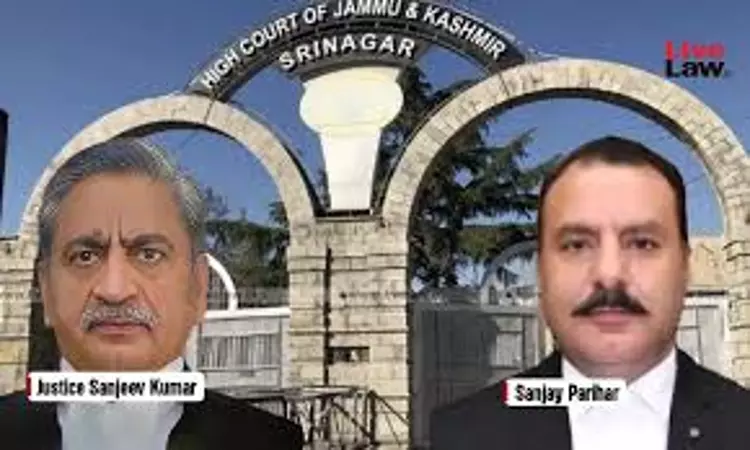
A Division Bench of Justice Sanjeev Kumar and Justice Sanjay Parihar allowed the appeal and restored the order of dismissal. In a significant observation, the Court held,
“... If the extant service Rules/Regulations permit continuance of the disciplinary proceedings, initiated against an officer/employee before he had attained the age of superannuation, those can be continued and brought to its logical conclusion even after he had attained the age of superannuation.”
Background:
The respondent retired from Jammu and Kashmir Bank as a Branch Head upon attaining the age of superannuation on June 30, 2021. Before his retirement, however, the bank had placed him under suspension on March 17, 2021 and initiated disciplinary proceedings in relation to alleged acts of omission and commission committed during his tenure at the Barzulla and Rangreth branches.
Following preliminary investigations, the bank issued two separate charge sheets alleging serious financial irregularities, including unauthorized sanctioning of temporary overdrafts beyond his delegated powers. Separate enquiry officers were appointed to conduct departmental enquiries into the charges.
The enquiries continued even after the respondent attained superannuation. Upon completion of the proceedings, the enquiry officers found most of the charges proved. A composite show-cause notice was thereafter issued by the disciplinary authority, to which the respondent submitted a reply and was also granted a personal hearing.
After considering the enquiry reports, documentary evidence and the employee's defence, the disciplinary authority passed an order dated April 1, 2022 dismissing him from service with effect from the date of his retirement. The appellate authority subsequently upheld the punishment.
The employee challenged the dismissal before the writ court, which allowed the petition and held that the charges were not sufficiently established and that the employee had acted under verbal instructions of superior officers. Aggrieved by that decision, the bank preferred the present Letters Patent Appeal.
Court's Observation:
The Division Bench first examined whether a disciplinary enquiry initiated before retirement could legally continue after an employee had superannuated. Referring to Rule 259 of the Officers Service Manual, 2000, the Court held that the service regulations expressly permit continuation of disciplinary proceedings even after retirement and authorize the bank to impose any penalty, including dismissal, upon conclusion of such proceedings.
The Court relied upon the recent Supreme Court decision in Virinder Pal Singh v. Punjab and Sind Bank and held that where service rules authorize continuation of disciplinary proceedings after retirement, the delinquent employee is deemed to remain in service for the limited purpose of conclusion of such proceedings.
Turning to the scope of judicial review, the Bench emphasized that constitutional courts do not sit as appellate forums over departmental enquiries. The Court observed that once an enquiry has been conducted in accordance with law and findings are supported by evidence, the adequacy or sufficiency of that evidence cannot be re-evaluated by a writ court.
Quoting law, the Court reiterated that “The courts do not sit in judgment on merits of the decision of the disciplinary authority.” It further held that interference is permissible only where findings are based on no evidence, are perverse, or where the enquiry suffers from violation of statutory provisions or principles of natural justice.
After examining the entire enquiry record, the Division Bench found that the respondent had been afforded full opportunity to defend himself and that there was ample documentary evidence substantiating the charges.
The Court noted that the respondent never disputed granting temporary overdrafts beyond his authorized limits. His defence was that he had acted under verbal directions of superior officers and had subsequently sought post-facto approvals. However, the enquiry record revealed that no such post-facto approval requests had been received by the concerned zonal office.
The Court rejected the finding of the writ court that the employee had been denied an opportunity to cross-examine a senior executive of the bank. It held that the official had never been examined as a witness and had merely responded to an official communication based on available records. Consequently, no question of cross-examination arose.
Addressing Rule 337(C) of the Officers Service Manual, which had heavily weighed with the writ court, the Division Bench held that the provision had been incorrectly interpreted. The rule requires an employee acting under oral directions of a superior officer to obtain written confirmation at the earliest possible opportunity. The Court found that the respondent failed to establish that he ever obtained such written confirmation.
The Court also underscored the heightened responsibilities of bank officials entrusted with public funds. Relying upon the Supreme Court's decision in Disciplinary Authority-cum-Regional Manager v. Nikunja Bihari Patnaik and the recent judgment in Virinder Pal Singh v. Punjab and Sind Bank, the Bench observed that sanctioning loans beyond one's authority constitutes financial irregularity exposing the bank to serious financial risks and can attract disciplinary action even where no actual financial loss is ultimately suffered.
The High Court thus concluded that the departmental enquiries were conducted strictly in accordance with the bank's regulations. Accordingly the bench set aside the judgment of the Single Judge and restored the disciplinary action taken by the bank.
Case Title: Jammu and Kashmir Bank Ltd. & Ors. v. Naseer Ahmad Sheikh
Citation: 2026 LiveLaw (JKL) 229
Appearances
For the Appellants: Mr. Shafqat Nazir, Advocate with Ms. Heena Baqal, Advocate
For the Respondent: Mr. Shuja-ul-Haq, Advocate


