



- Home
- /
- High Courts
- /
- High Court of J & K and Ladakh
- /
- BSF Rules | Court Of Inquiry Is...
BSF Rules | Court Of Inquiry Is Preliminary Fact Finding Exercise, Not Disciplinary Trial Which Can Cause Prejudice: J&K&L High Court
LIVELAW NEWS NETWORK
16 Dec 2025 7:25 PM IST
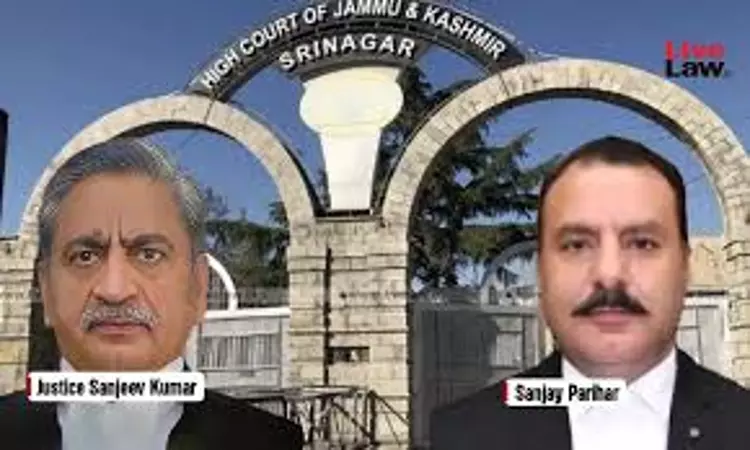
The Jammu & Kashmir and Ladakh High Court has held that such an inquiry is only a fact-finding mechanism intended to assist authorities in deciding the future course of action and does not amount to initiation of departmental proceedings.The Division Bench of Justice Sanjeev Kumar and Justice Sanjay Parihar underscored that the findings returned by the Court of Inquiry shall be in the...
This is a premium content
Available exclusively to
Our subscribers
Subscribe Premium 
INR 1099+GST
Your support helps us to bring you more content at
an affordable subscription scheme !!!
All payment options available
The Jammu & Kashmir and Ladakh High Court has held that such an inquiry is only a fact-finding mechanism intended to assist authorities in deciding the future course of action and does not amount to initiation of departmental proceedings.
The Division Bench of Justice Sanjeev Kumar and Justice Sanjay Parihar underscored that the findings returned by the Court of Inquiry shall be in the nature of a preliminary report” and that merely ordering such an inquiry or asking the officer concerned to appear and record his statement would not prejudice him in any manner.
“… At the stage of Court of Inquiry, there is no departmental proceeding initiated or commenced against the delinquent, though the finding of such Court of Inquiry may form the basis of taking a decision by the competent authority about future course of action. It is thus evident that by ordering the court of inquiry or even asking the appellant to appear and record his statement would not prejudice him in any manner”, the court remarked.
The observations came while dismissing two intra-court appeals filed by Akhand Prakash Shahi, an Assistant Commandant in the BSF, challenging the initiation of a Court of Inquiry and the continuation of his suspension, respectively. The appeals arose from orders of a Single Judge dismissing his writ petitions.
Background of the case
The case traced its origin to a complaint lodged by a lady Assistant Sub-Inspector (Ministerial) of the BSF against the appellant, who was then posted as Assistant Commandant at STC Airport, Humhama, Srinagar. Acting on the complaint, FIR was registered at Police Station Dwarka (North), New Delhi, for offences under Section 376 IPC. After completion of investigation, a charge-sheet was filed before the competent criminal court, charges were framed, and the appellant was granted bail but currently facing trial.
Considering the gravity of the allegations, the BSF authorities placed the appellant under suspension in exercise of powers under Rule 40A(1) of the BSF Rules, which suspension was later confirmed. Simultaneously, the authorities ordered a Court of Inquiry to examine the allegations. This led the appellant to approach the High Court, contending that parallel proceedings would seriously prejudice his defence in the criminal trial.
Before the Writ Court, the appellant assailed the initiation of the Court of Inquiry and the rejection of his representation, arguing that when a criminal trial on identical charges was already pending, the respondents could not lawfully proceed with disciplinary action. The Single Judge, however, rejected these submissions, holding that there was no statutory bar to simultaneous criminal and departmental proceedings and that no complicated questions of fact or law were involved.
Division Bench Findings
Affirming the Single Judge's view, the Division Bench held that the appellant's challenge was fundamentally misconceived. The Court clarified that no departmental proceedings had been initiated at all, and what was ordered under Rule 173 of the BSF Rules was merely a Court of Inquiry. The Bench categorically observed,
“strictly speaking, we do not find it a case where respondents are pursuing the criminal prosecution and the disciplinary proceedings simultaneously” .
Elaborating on the nature of a Court of Inquiry, the Bench observed that under the BSF Rules, it is a fact-finding inquiry meant to collect material so as to enable the competent authority to decide whether disciplinary proceedings are warranted. The Court emphasized that at this stage, there is no departmental proceeding initiated or commenced against the delinquent, and even though the findings may form the basis of a future decision, they remain purely preliminary in character .
The Bench further highlighted that participation in such an inquiry does not prejudice the delinquent officer, noting that he cannot be compelled to make any self-incriminating statement and even has the option to remain silent. The apprehension that disclosure during the inquiry would undermine the defence in the criminal trial was thus held to be without any substance .
Delving deep into Rules 170, 173, and 174 of the BSF Rules, 1969, the bench noted that Rule 174 expressly permits a Court of Inquiry to be held to investigate into “any disciplinary matter or any other matter of importance.” Given the seriousness of the allegations, the Bench found it entirely justified for the authorities to first order a Court of Inquiry before deciding whether to initiate formal disciplinary proceedings. Such an inquiry, the Court observed, actually affords an opportunity to the officer concerned to place his explanation on record and possibly persuade the authorities against initiating disciplinary action.
Suspension appeal also dismissed
In the connected appeal challenging the appellant's suspension, the Division Bench rejected the contention that the suspension deserved to be revoked due to delay in departmental proceedings.
“… The pendency of nonexistent departmental inquiry or its procrastination without any reason, therefore, cannot be urged as a ground to seek revocation of the suspension order. The suspension of the appellant has nothing to do with the departmental proceedings which are yet not initiated by the respondents”, the court reasoned.
Concluding that both appeals were premature and devoid of merit, the High Court dismissed them.
Case Title: Akhand Prakash Shahi Vs Union of India
Citation: 2025 LiveLaw (JKL) 324


