



- Home
- /
- High Courts
- /
- High Court of J & K and Ladakh
- /
- 'Cause Of Action' Cannot Be Read...
'Cause Of Action' Cannot Be Read Liberally To Choose Convenient Forum; Encourages Forum Shopping: J&K&L High Court
LIVELAW NEWS NETWORK
3 March 2026 7:30 PM IST
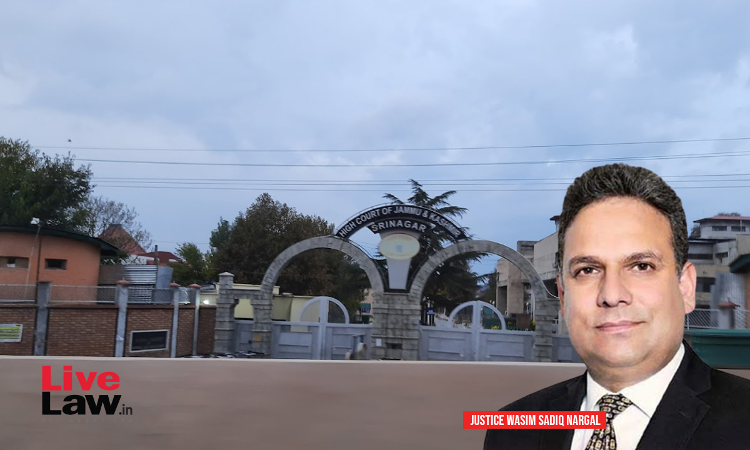
Holding that territorial jurisdiction is a matter of law rooted in the essential facts of a dispute and not a mobile privilege dependent upon a litigant's convenience, the High Court of Jammu & Kashmir and Ladakh has ruled that the expression “cause of action” cannot be interpreted liberally to allow parties to indulge in forum shopping. A bench comprising Justice Wasim Sadiq...
This is a premium content
Available exclusively to
Our subscribers
Subscribe Premium 
INR 1099+GST
Your support helps us to bring you more content at
an affordable subscription scheme !!!
All payment options available
Holding that territorial jurisdiction is a matter of law rooted in the essential facts of a dispute and not a mobile privilege dependent upon a litigant's convenience, the High Court of Jammu & Kashmir and Ladakh has ruled that the expression “cause of action” cannot be interpreted liberally to allow parties to indulge in forum shopping.
A bench comprising Justice Wasim Sadiq Nargal cautioned that permitting jurisdiction to hinge on unilateral acts such as receiving an order at a chosen place would undermine the orderly administration of justice.
Referencing Kusum Ingots & Alloys Ltd. v. Union of India (2004) 6 SCC 25 the court remarked,
“Territorial jurisdiction cannot be allowed to depend upon the unilateral act of a party, such as shifting residence or receiving communication at a chosen location. To permit such interpretation would encourage forum shopping and undermine the orderly administration of justice.”
The ruling was delivered while dismissing a CRPF constable's writ petition solely on the ground of lack of territorial jurisdiction, without entering into the merits of the disciplinary action.
Background:
The petitioner was appointed as a Constable (GD) in the Central Reserve Police Force in June 1996 and served at different locations including Srinagar, Doda, Jalandhar and Delhi. In December 2005, while posted in Delhi, he was alleged to have been involved, along with another constable, in a physical altercation with a senior officer during the intervening night, causing injuries to the latter.
Following a departmental process, the Commandant, 127 Battalion, CRPF, New Delhi, passed an order removing the petitioner from service. His statutory appeal was rejected by the Deputy Inspector General at Jalandhar and the revision petition was dismissed by the Inspector General at Chandigarh. Challenging these orders and the entire enquiry process, the petitioner invoked the writ jurisdiction of the Jammu & Kashmir and Ladakh High Court.
Appearing for the petitioner, Mrs. Surinder Kour, Senior Advocate, assisted by Mr. Michael Singh Dogra, Advocate, argued that the departmental enquiry was conducted in violation of Rule 27 of the CRPF Rules and the principles of natural justice. It was contended that no proper enquiry was conducted, that the proceedings were ex parte, and that the petitioner was denied the opportunity to cross-examine witnesses or produce defence evidence.
On the question of jurisdiction, the petitioner asserted that since the dismissal, appellate and revisional orders were served upon him at his native place in District Poonch, part of the cause of action arose within the territorial jurisdiction of the High Court.
Opposing the petition, Mr. Sumant Sudan, Advocate, appearing for the respondents in place of Mr. Vishal Sharma, DSGI, raised a preliminary objection regarding maintainability. It was contended that the alleged misconduct occurred in New Delhi, the disciplinary enquiry was conducted there, the dismissal order was passed in Delhi, the appeal was rejected at Jalandhar, and the revision dismissed at Chandigarh. As all material events occurred outside Jammu & Kashmir, the High Court, it was urged, lacked territorial jurisdiction.
Court's Observations on Territorial Jurisdiction
Justice Nargal examined the rival submissions and confined the adjudication to the preliminary issue of territorial jurisdiction. The Court noted that it was an admitted position that the incident of misconduct, the disciplinary enquiry, the order of dismissal, and the appellate and revisional orders all originated outside the territorial limits of the High Court.
The Court categorically held that the mere fact that the petitioner was a resident of District Poonch or that the orders were served upon him at his residential address in Jammu & Kashmir did not confer jurisdiction. It observed that no substantial, material or integral part of the cause of action had accrued within the jurisdiction of the Court.
Quoting binding Supreme Court precedents, the Court reiterated that a High Court must satisfy itself that a real and essential part of the cause of action has arisen within its territory before entertaining a writ petition. Trivial or incidental facts, the Court observed, cannot be used to invoke jurisdiction.
In a significant observation, the Court held,
“The expression 'cause of action' cannot be interpreted liberally so as to permit litigants to choose a forum of convenience. Territorial jurisdiction cannot be allowed to depend upon the unilateral act of a party, such as shifting residence or receiving communication at a chosen location. To permit such interpretation would encourage forum shopping and undermine the orderly administration of justice.”
The Court further observed that from the standpoint of the disciplinary authority, there was no alternative but to communicate the dismissal order to the petitioner at his native place. However, the mere service of an order at a particular location does not by itself give rise to a territorial cause of action at that place, the bench maintained.
Justice Nargal underscored that territorial jurisdiction is a matter of law and legislative intent, not a privilege dependent on the convenience or residence of the petitioner. Accepting the petitioner's argument, the Court cautioned, would allow litigants to unilaterally dictate jurisdiction by relocating to a forum of their choice, an outcome wholly impermissible under constitutional jurisprudence.
The Court emphasised that cause of action comprises those facts which the petitioner would be required to prove to establish his entitlement to relief, and such facts must include acts done by the respondents that have a direct nexus with the dispute. Incidental facts like receipt of communication do not constitute even a fraction of cause of action, the court emphasised.
Concluding that none of the acts under challenge were performed within Jammu & Kashmir, the High Court held that it lacked territorial jurisdiction to entertain the writ petition. The defect, the Court observed, went to the very root of the matter and was incurable. Consequently, the writ petition was dismissed without examining the merits of the disciplinary proceedings.
Case Title: Noushad Ahmad Vs Union of India
Citation: 2026 LiveLaw (JKL) 80


