



- Home
- /
- High Courts
- /
- High Court of J & K and Ladakh
- /
- Corrigendum Clarifying Tribunal's...
Corrigendum Clarifying Tribunal's Original Order Cannot Create New Cause Of Action: J&K&L High Court
LIVELAW NEWS NETWORK
16 May 2026 1:25 PM IST
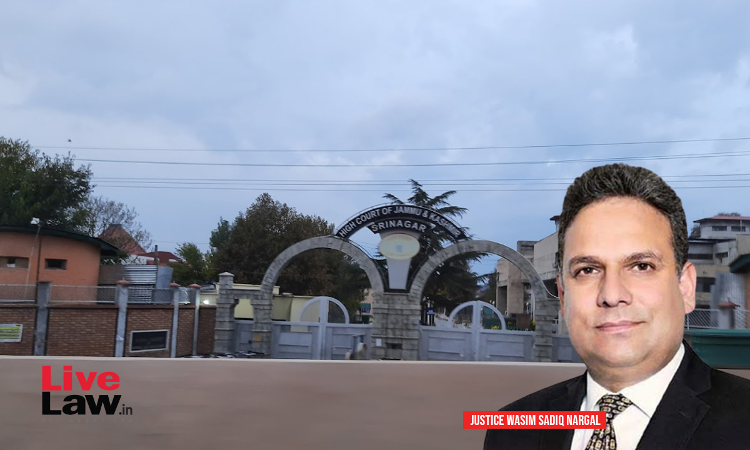
The High Court of Jammu & Kashmir and Ladakh has held that a corrigendum issued by a Tribunal on its own without any formal application, bearing the same date as the main order, does not create a fresh cause of action for a writ petition when it is purely clarificatory in nature and does not effect any substantial modification in the operative portion of the original order.The Court...
This is a premium content
Available exclusively to
Our subscribers
Subscribe Premium 
INR 1099+GST
Your support helps us to bring you more content at
an affordable subscription scheme !!!
All payment options available
The High Court of Jammu & Kashmir and Ladakh has held that a corrigendum issued by a Tribunal on its own without any formal application, bearing the same date as the main order, does not create a fresh cause of action for a writ petition when it is purely clarificatory in nature and does not effect any substantial modification in the operative portion of the original order.
The Court further ruled that once a Tribunal has conclusively held that a person is neither a necessary nor a proper party to the proceedings, and that order has remained unchallenged for a considerable period, such person cannot be permitted to indirectly assail the final order passed in the same proceedings.
The Court was hearing a writ petition filed by one Hajira, who claimed to be a neighbour of respondent No.6. The petitioner sought to quash the order passed by the Jammu & Kashmir Special Tribunal, along with a corrigendum issued thereto, whereby the revision petition filed by respondent No.6 was allowed and directions were issued to regularize additional construction under the “Deemed Permission” clause of the Jammu & Kashmir Municipal Corporation Act, 2000.
The petitioner had also challenged the earlier order dated 26th September 2023 passed by the Tribunal rejecting her application for impleadment in the revision proceedings.
A Bench of Justice Wasim Sadiq Nargal, while examining the nature of the corrigendum and the effect of the unchallenged impleadment order, observed,
“... The corrigendum, therefore, is purely clarificatory in nature and does not effect any substantial modification in the operative portion of the original order so as to independently prejudice the petitioner or furnish a separate cause of action warranting interference by this Court in exercise of its writ jurisdiction.”
The Court further observed that entertaining the present challenge without the foundational impleadment order first being set aside would amount to sitting in appeal over an order that has already attained conclusiveness.
Background:
Respondent No.6 had obtained building permission in respect of land situated at Srinagar. The permission was subsequently revalidated and the petitioner alleged that respondent No.6 had alienated a portion of the land and that the revalidation was granted without proper verification of ownership.
Thereafter Construction activities commenced in 2021, and additional floors were allegedly raised beyond the sanctioned building plan. An application filed by respondent No.6 seeking permission for additional construction was rejected by the competent authority.
Aggrieved, respondent No.6 preferred a revision petition before the J&K Special Tribunal. The petitioner filed an application seeking impleadment as a party respondent. The Tribunal, by a reasoned order dismissed the impleadment application, holding that the petitioner was not a necessary party and that the controversy pertained to questions of ownership and title beyond the Tribunal's competence. This order was not challenged by the petitioner for nearly one and a half years.
Thereafter, the Tribunal passed the impugned order allowing the revision petition and directing regularization of the additional construction subject to payment of regularization fee and compliance with relevant laws, besides issuance of a completion certificate.
A corrigendum was issued on the same date. The petitioner alleged that the corrigendum had been issued without any application and granted additional relief not contained in the original order.
Court's Observation:
The Court first addressed the preliminary objection regarding locus standi. It noted that the Tribunal had already held, by order dated 26th September 2023, that the petitioner was neither a necessary nor a proper party to the proceedings. The Court observed,
“... Once the learned Tribunal, by a reasoned order dated 26.09.2023, conclusively held that the petitioner was neither a necessary nor a proper party to the proceedings and consequently declined impleadment, the said adjudication attained finality upon the petitioner having failed to assail the same before the appropriate forum within a reasonable time.”
The Court held that a judicial determination which has attained finality cannot be permitted to be circumvented by adopting an indirect device.
Examining the doctrine of locus standi, the Court referred to the Supreme Court's decision in Jashbai Motibhai Desai v. Roshan Kumar, Haji Bashir Ahmed (1976) 1 SCC 671, wherein it was held that an applicant should ordinarily have a personal or individual right in the subject-matter of the application to invoke extraordinary jurisdiction under Article 226.
The Court also cited Ravi Yashwant Bhoir v. Collector (2012) 4 SCC 407, where the Supreme Court observed that a person cannot be heard as a party unless he answers the description of an aggrieved party. The Court found that the petitioner had failed to demonstrate any infringement of a legally protected right.
On the nature of the corrigendum, the Court compared the original order with the corrigendum and found that the operative directions remained substantially unchanged.
The Court noted that the original order had directed regularization of construction and issuance of a completion certificate subject to the condition that the construction was not violative of relevant land laws. It explained that the corrigendum merely clarified that such regularization would be subject to payment of the requisite regularization fee and further observed that the construction was covered by the deemed permission clause.
The Court further held that no new right had been created in favour of respondent No.6, nor had any vested right of the petitioner been taken away.
Expounding further on the matter the Court invoked the settled maxim that what cannot be done directly cannot be permitted to be done indirectly, citing NOIDA Entrepreneurs Association v. NOIDA & Others (2011) 6 SCC 508 and State of Tamil Nadu v. K. Shyam Sunder (2011) AIR SC 3470.
The Court observed that permitting a collateral challenge to the final order without setting aside the foundational impleadment order would amount to conferring upon the petitioner, through the backdoor, a status which stood judicially negated by a subsisting and unchallenged order.
Furthermore, the court examined the conduct of the petitioner, noting that the tenor of the pleadings and the repeated attempts to obstruct the proceedings suggested that the litigation was not founded upon protection of any legally enforceable right but appeared to be actuated by personal animosity.
The Court observed,
“.. The present case, viewed in its entirety, bears all the indicia of vexatious litigation. The petitioner has failed to demonstrate any subsisting legal injury, yet has sought to repeatedly question proceedings to which she was already held disentitled to participate.” The Court held that the extraordinary jurisdiction under Article 226 cannot be permitted to be invoked for settling personal scores or pursuing motivated litigation.
In view of these findings the court held that the impugned orders did not suffer from any illegality, arbitrariness, perversity, or jurisdictional infirmity warranting interference under Articles 226 and 227 of the Constitution.
Thus the writ petition was dismissed.
Case Title: Hajira v. J&K Special Tribunal & Ors.
Citation: 2026 LiveLaw (JKL) 207


