



- Home
- /
- High Courts
- /
- High Court of J & K and Ladakh
- /
- Education Not Charity Alone;...
Education Not Charity Alone; Private Unaided Institutions Entitled To Reasonable Returns: J&K&L High Court
LIVELAW NEWS NETWORK
4 Feb 2026 1:35 PM IST
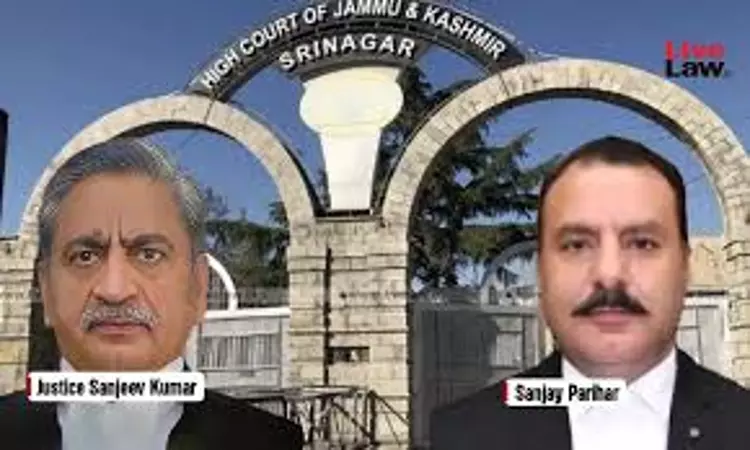
Observing that commercialisation and profiteering do not completely rule out the element of creating surplus for future activities or earning reasonable returns on investments, the Jammu & Kashmir and Ladakh High Court has recently clarified the constitutional position of private unaided educational institutions in the contemporary education system.A Division Bench of Justice Sanjeev...
This is a premium content
Available exclusively to
Our subscribers
Subscribe Premium 
INR 1099+GST
Your support helps us to bring you more content at
an affordable subscription scheme !!!
All payment options available
Observing that commercialisation and profiteering do not completely rule out the element of creating surplus for future activities or earning reasonable returns on investments, the Jammu & Kashmir and Ladakh High Court has recently clarified the constitutional position of private unaided educational institutions in the contemporary education system.
A Division Bench of Justice Sanjeev Kumar and Justice Sanjay Parihar, while adjudicating a batch of writ petitions filed by private unaided schools, undertook an in-depth examination of the nature of education, the role of private institutions, and the permissible limits of State regulation, firmly holding that economic realities cannot be divorced from the functioning of modern educational institutions.
Asking the Government to have a fresh look on the functioning of the Private Schools the court remarked,
“.. It is high time the Government also recognises the right of a person who has made huge investments in terms of money and time to raise a private educational institution without any support from the Government to derive reasonable profits. After all, the establishment of these private educational institutions, particularly in rural areas, has become a source of employment for unemployed educated youth”
Background:
The petitions were instituted by several private unaided schools operating in Jammu & Kashmir. The schools questioned regulatory measures affecting their autonomy, contending that such institutions are established and run without any governmental aid and are sustained entirely through investments made by individuals or educational societies.
Appearing for the petitioners, Senior Advocate Mr. N.A. Beigh, assisted by Mr. Mohd. Murshid Rashid, submitted that the right to establish and administer an educational institution is a protected occupation under Article 19(1)(g) of the Constitution. He argued that private schools today require substantial financial investment in land, buildings, technology, laboratories and human resources, and therefore cannot be expected to operate on a rigid no-profit, no-surplus model.
It was contended that rising operational costs, including salaries, maintenance, utilities and compliance requirements, must be realistically factored in while assessing the financial structure of schools. Any regulatory regime that ignores these realities, according to the petitioners, would directly impact educational standards.
The respondents, while defending regulatory oversight, maintained that education is not a commercial commodity and cannot be converted into a business venture. They submitted that regulation is essential to prevent exploitation of parents and students and to ensure that education remains accessible and fair.
Court's Observations On The Nature Of Private Education:
At the outset, the High Court placed private education in its historical and social context. The Bench noted that private schools were initially conceived as a supplement to public education, but over time have assumed a dominant role due to systemic deficiencies in government schools.
The Court candidly observed that “private education has today virtually supplanted public education, largely because the public school system has failed to live up to the expectations of society.” Taking judicial notice of ground realities, the Bench remarked that parents do not approach private schools out of compulsion created by the institutions themselves, but because of the inadequacies of the public system.
Rejecting the notion that private institutions are driven purely by charity, the Court observed that “it would be like living in a fool's paradise to think that citizens who invest their money, time and labour in establishing educational institutions do so only for philanthropic reasons.”
While reiterating that education cannot be treated as a trade or business in the strict commercial sense, the Court drew a clear distinction between profiteering and permissible surplus. The Bench held that profiteering does not mean earning a surplus, and clarified that what is prohibited is the generation of excessive or unfair profit by exploiting students or parents.
In a crucial observation, the Court held, “commercialisation and profiteering do not completely rule out the element of creating surplus for future activities or earning reasonable returns on the investments made by an individual or educational agency permitted by the State to establish an educational institution.”
The Court further observed that expecting private schools to function on a strict no-profit, no-loss basis would be unrealistic and detached from economic realities, particularly in an era where education demands continuous reinvestment for growth and quality enhancement.
Education As An Occupation Under Article 19:
The Bench reaffirmed that establishing and running a private educational institution is an occupation protected under Article 19(1)(g). While reasonable restrictions may be imposed under Article 19(6), the Court cautioned that such restrictions must not destroy the very viability of the occupation.
It observed, “.. the establishment of a private educational institution involves substantial financial and human investment, and such activity cannot be sustained if economic viability is altogether ignored.” The Court emphasised that regulatory measures must strike a balance between public interest and institutional sustainability.
In conclusion, the Jammu & Kashmir and Ladakh High Court upheld the constitutional validity of regulatory oversight over private unaided schools, but categorically restrained the State from imposing measures that obliterate institutional autonomy or economic viability.
The Court finally ruled that private unaided educational institutions are entitled to fix their own fee structures and manage their affairs, subject only to limited, reasonable and non-intrusive regulation aimed at preventing commercialisation in the sense of exploitation and profiteering.
Case Title: New Convent High School Vs Union of India
Citation: 2026 LiveLaw (JKL) 36


