



- Home
- /
- High Courts
- /
- High Court of J & K and Ladakh
- /
- Contractual Employee Cannot Claim...
Contractual Employee Cannot Claim Protection Under Article 311; J&K&L High Court Upholds Termination Over Unsatisfactory Performance
LIVELAW NEWS NETWORK
8 Jun 2026 6:00 PM IST
The High Court of Jammu & Kashmir and Ladakh has held that a contractual employee engaged under the Ex-Servicemen Contributory Health Scheme (ECHS) cannot claim the constitutional protection available to holders of civil posts under Article 311 of the Constitution.The Court observed that where a contract expressly permits termination on account of unsatisfactory performance or lack...
This is a premium content
Available exclusively to
Our subscribers
Subscribe Premium 
INR 1099+GST
Your support helps us to bring you more content at
an affordable subscription scheme !!!
All payment options available
The High Court of Jammu & Kashmir and Ladakh has held that a contractual employee engaged under the Ex-Servicemen Contributory Health Scheme (ECHS) cannot claim the constitutional protection available to holders of civil posts under Article 311 of the Constitution.
The Court observed that where a contract expressly permits termination on account of unsatisfactory performance or lack of professional competence, termination in accordance with the contractual terms does not amount to punishment and does not require a formal departmental enquiry.
The Court was hearing a Letters Patent Appeal filed by one Manzoor Ahmad Bhat challenging a judgment of the Single Judge whereby his writ petition assailing the termination of his services as Laboratory Assistant under ECHS had been dismissed. The appellant contended that his termination was stigmatic in nature and could not have been ordered without holding a proper enquiry and affording him a reasonable opportunity of hearing.
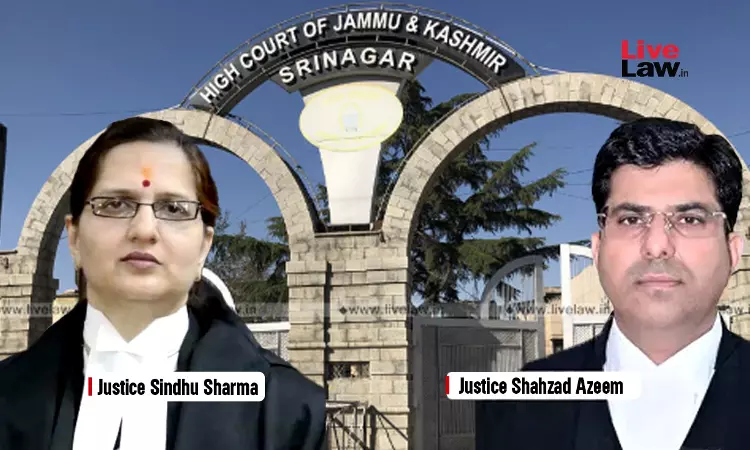
A Division Bench comprising Justice Sindhu Sharma and Justice Shahzad Azeem observed that the appellant's engagement was purely contractual and governed by the terms of the agreement executed between the parties. Distinguishing the Supreme Court's decision in Anoop Jaiswal v. Government of India, the Court held,
“.... the termination of the appellant is not founded on any specific charge of misconduct, but is based on overall unsatisfactory performance and lack of professional competence, as reflected from the record and the communications issued to him from time to time.”
The appellant was appointed as a Laboratory Assistant under the Ex-Servicemen Contributory Health Scheme. His engagement was initially for a fixed term and was subsequently extended through agreements executed in 2005 and 2006.
In May 2007, the appellant was served with a termination notice by the authorities. He submitted a reply to the notice, but the respondents ultimately passed an order terminating his services.
Aggrieved by the termination, the appellant approached the High Court through a writ petition. He contended that the officer issuing the termination notice lacked competence and further argued that the order was stigmatic in nature and therefore could not have been passed without holding a regular enquiry in accordance with the principles of natural justice.
The respondents resisted the claim by asserting that the appellant was merely a contractual employee whose engagement was governed entirely by contractual terms. They submitted that inspections had revealed deficiencies in the functioning of the laboratory and that the appellant had repeatedly been warned regarding his conduct, attitude towards colleagues and unsatisfactory discharge of duties through communications issued in April and May 2007.
After considering the material on record, the Single Judge dismissed the writ petition, holding that the termination was in accordance with the contractual terms. Challenging that decision, the appellant preferred the present Letters Patent Appeal.
Court's Observation:
The Division Bench noted that the appellant's engagement was governed by a written contract of employment and that Clause (11) of the agreement specifically empowered the respondents to terminate the engagement by giving one month's notice or salary in lieu thereof. The clause further contemplated termination on grounds including professional incompetence, misconduct, moral turpitude and unsatisfactory performance of duties.
While examining the legal position, the Court referred extensively to the Supreme Court's judgment in Parshotam Lal Dhingra v. Union of India, AIR 1958 SC 36, wherein it was held that where an employer possesses a contractual or statutory right to terminate employment, exercise of such power ordinarily does not amount to punishment and does not attract Article 311 of the Constitution.
The Court also relied upon State of U.P. v. Ram Chandra Trivedi, AIR 1976 SC 2547, where the Supreme Court held that a temporary employee having no right to the post cannot invoke Article 311 when services are terminated in terms of the contract and the order does not cast any stigma or impose penal consequences.
Applying these principles, the Court observed that the appellant was neither holding a civil post nor was he a member of any civil service. His engagement was purely contractual and renewed from time to time under separate agreements. Consequently, the safeguards available under Article 311 were not available to him.
The Bench noted that the record revealed repeated warnings regarding the appellant's conduct and professional performance. It further observed that inspections conducted by the authorities had disclosed deficiencies in the functioning of the laboratory. The appellant had also responded to the show cause notice, and his explanation had been considered by the competent authority before the termination order was passed.
Rejecting the contention that the order was stigmatic, the Court observed that the termination was not based upon any specific allegation of misconduct requiring a disciplinary enquiry. Instead, it stemmed from the appellant's overall unsatisfactory performance and lack of professional competence.
The Court observed that the decision relied upon by the appellant, namely Anoop Jaiswal v. Government of India, was distinguishable on facts because that case involved a termination founded upon specific allegations of misconduct concealed behind an apparently innocuous order. In contrast, the present case involved termination for unsatisfactory performance under the contractual terms of engagement.
The Bench further held,
“... Further, the material placed on record indicates that the termination was based on overall unsatisfactory performance and failure to adhere to expected standards, rather than any specific charge of misconduct requiring a formal enquiry.”
The Court thus concluded that no stigma was attached to the termination order so as to trigger the requirement of a departmental enquiry.
Finding no infirmity in the judgment of the learned Single Judge, the Division Bench upheld the dismissal of the writ petition and held that no ground for interference was made out in appeal. Accordingly, the Letters Patent Appeal was dismissed.
Case Title: Manzoor Ahmad Bhat v. Union of India & Ors.
Citation: 2026 LiveLaw (JKL) 261


