



- Home
- /
- High Courts
- /
- High Court of J & K and Ladakh
- /
- Daily Wage Employees Cannot Claim...
Daily Wage Employees Cannot Claim Parity With Regular Employees For Deployment After Winding Up Of Company: J&K&L High Court
LIVELAW NEWS NETWORK
12 Jun 2026 1:05 PM IST
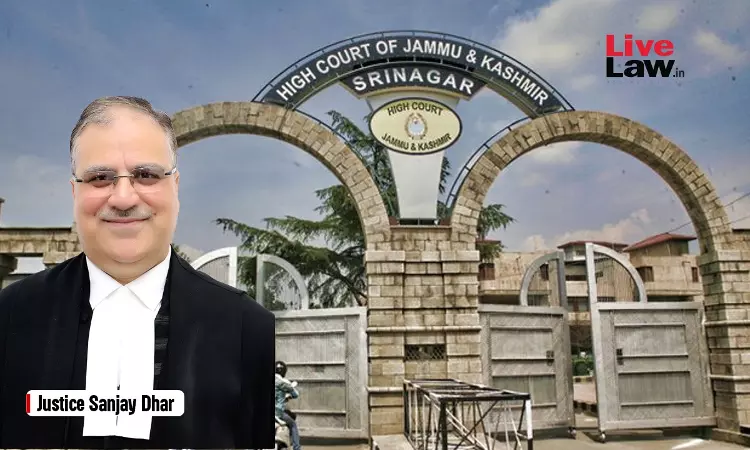
The Jammu and Kashmir and Ladakh High High Court has held that employees engaged on daily wage basis cannot claim parity with those employees who were serving on regular or permanent basis for the purpose of deployment to other government departments after winding up of the company.The Court was hearing a writ petition filed by a person engaged on consolidated basis seeking...
This is a premium content
Available exclusively to
Our subscribers
Subscribe Premium 
INR 1099+GST
Your support helps us to bring you more content at
an affordable subscription scheme !!!
All payment options available
The Jammu and Kashmir and Ladakh High High Court has held that employees engaged on daily wage basis cannot claim parity with those employees who were serving on regular or permanent basis for the purpose of deployment to other government departments after winding up of the company.
The Court was hearing a writ petition filed by a person engaged on consolidated basis seeking regularization, regular pay scale, deployment to another government department after winding up of the Jammu and Kashmir Cement Limited, and clearance of outstanding wages.
A Single Bench of Justice Sanjay Dhar, while observing that “it is only if an employee dies while in service that his legal heirs are eligible to be considered for compassionate appointment,” held that “the respondents may have shown compassion on account of the fact that father of the petitioner has died due to cancer immediately after his retirement and engaged him on consolidated basis but the same does not give him any right to be appointed on regular basis on the pattern of compassionate appointment provided under SRO 43 of 1994.”
Background:
The petitioner's father was working as a Machinery Attendant with the Jammu and Kashmir Cement Limited at its factory for about 26 years. He retired on 31.03.2014 and was diagnosed with Stage-IV lung cancer resulting in his death. The petitioner was engaged on compassionate basis initially for 89 days on consolidated remuneration of Rs.4,500/-. His engagement was extended periodically, and his remuneration was enhanced to Rs.12,000/- by a subsequent order.
The respondent JKCL eventually became a sick unit and the government decided to wind it up. Vide Government Order out of 333 employees, 303 were deployed to different government departments. The remaining 30 workers, including the petitioner, were not deployed. The petitioner claimed that he had not been paid monthly consolidated remuneration with effect from 01.05.2019, and sought deployment and regularization.
The respondents submitted that the petitioner was not eligible for compassionate appointment as his father had attained superannuation prior to his death. They stated that the government considered only employees working in regular pay scales for deployment, leaving out 29 employees engaged on consolidated basis, including the petitioner. The respondents further submitted that outstanding wages could be considered for eligible employees for the period they had actually worked.
Court's Observations:
The High Court noted that certain facts were not in dispute as the petitioner was engaged on consolidated remuneration, his services were never regularized, and after winding up of JKCL, 29 employees including the petitioner were not deployed to any other government department.
On the claim for compassionate appointment and regularization, the Court observed,
“... It is a settled legal position that it is only if an employee dies while in service that his legal heirs are eligible to be considered for compassionate appointment. Thus, even if SRO 43 of 1994 is made applicable to the respondent JKCL, still then the petitioner was not qualified to be appointed on compassionate basis on account of death of his father who had, admittedly, died after his retirement.”
The Court held that the engagement on consolidated basis did not create any right to regular appointment on the pattern of compassionate appointment.
On the claim for deployment to another government department, the Court examined the Government Order and found that only those employees appointed on substantive basis in graded scales were deployed, while workers engaged on daily rated basis or on consolidated basis were not covered.
The Court observed,
“... An employee working on consolidated basis or a casual employee has no right to continue in service and his engagement does not confer upon him any claim for regularization or for continuity in service. Once the respondent JKCL has been wound up, its daily rated workers and workers engaged on consolidated basis have no right to seek a mandamus against the respondent JKCL or against the government to continue their services.”
The Court specifically relied upon the Division Bench judgment of the High Court in Ghulam Nabi Bhat and Ors. v. State of J&K & Ors. and held,
“... The Division Bench rejected the claim of the employees engaged on daily wage basis with regard to their deployment to other government departments by holding that they cannot claim parity with those employees who were serving on regular or permanent basis with the respondent JKCL. In view of the ratio laid down in the said judgment, the contention of the petitioner herein cannot be accepted.”
The Court further observed,
“... The contention of the petitioner that after winding up of the JKCL, he should have been deployed to any other government department or organization as was done in the case of other employees of JKCL, is also without any substance because from a perusal of Government Order No.48-IND of 2021 dated 09.03.2021, it appears that only those employees of the JKCL who were appointed on substantive basis in graded scales, were deployed to other government departments, corporations and organizations.”
On the claim for unpaid wages, the respondents submitted that they were ready to release unpaid wages of all eligible employees for the period they had actually worked.
Accordingly, the respondents were directed to clear all outstanding wages of the petitioner up to the date he actually performed his duties with JKCL, within three months from the date of the order, failing which the amount shall carry interest at 6% per annum from the date of filing of the petition till realization. The writ petition was disposed of accordingly.
Case Title: Shahid Mehraj v. Union Territory of J&K and others
Citation: 2026 LiveLaw (JKL) 271


