



- Home
- /
- High Courts
- /
- High Court of J & K and Ladakh
- /
- Defamation Not Limited To Intent To...
Defamation Not Limited To Intent To Harm Reputation; Knowledge That Imputation May Harm Also Attracts Offence: J&K&L High Court
LIVELAW NEWS NETWORK
13 March 2026 6:40 PM IST
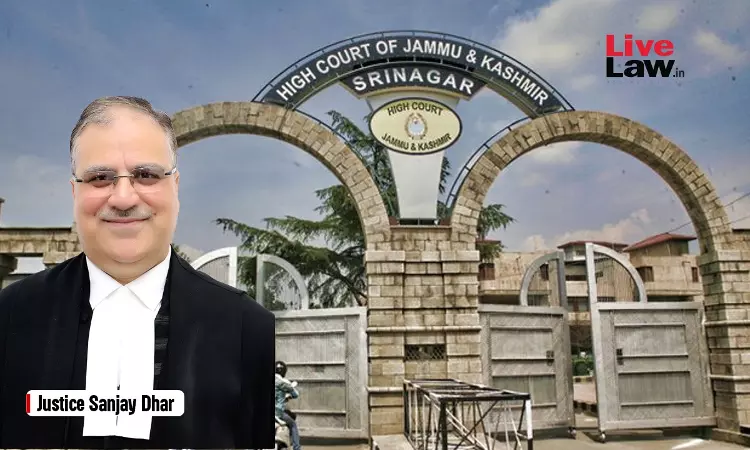
The High Court of Jammu & Kashmir and Ladakh has clarified that the offence of defamation is not confined to cases where a person intends to harm another's reputation. The Court held that Section 499 of the Ranbir Penal Code (RPC) also covers situations where a person publishes an imputation knowing or having reason to believe that such imputation would harm the reputation of...
This is a premium content
Available exclusively to
Our subscribers
Subscribe Premium 
INR 1099+GST
Your support helps us to bring you more content at
an affordable subscription scheme !!!
All payment options available
The High Court of Jammu & Kashmir and Ladakh has clarified that the offence of defamation is not confined to cases where a person intends to harm another's reputation. The Court held that Section 499 of the Ranbir Penal Code (RPC) also covers situations where a person publishes an imputation knowing or having reason to believe that such imputation would harm the reputation of another person.
Justice Sanjay Dhar made this observation while partly allowing a petition seeking quashing of a criminal defamation complaint arising out of a news item published in a newspaper. He explained,
“Section 499 of RPC brings within its purview not only a case where the person making or publishing any imputation intends to harm but it also brings within its purview a case where a person has knowledge or has reason to believe that such imputation will harm the reputation of the person against whom imputation is made.”
Background of the Case:
The case arose from a petition filed by Sanjay Gupta and another challenging a criminal complaint for defamation pending before the Judicial Magistrate 1st Class, Samba. The complaint had been filed by Prem Kumar, a businessman engaged in repairing computers and running a shop at Ramgarh in Samba district.
According to the complainant, a news item published in the newspaper Dainik Jagran falsely portrayed him as an Over Ground Worker (OGW) of militants and alleged that he had links with militant leader Azhar Masood. The report further suggested that he had been taken into custody by security agencies.
Prem Kumar asserted that the allegations were entirely fabricated and had seriously damaged his reputation in society. He claimed that the news item lowered his image in the eyes of his relatives, customers, and the general public. Despite serving a legal notice on the newspaper authorities seeking an apology, no corrective step was taken.
Acting on the complaint and after recording the statements of the complainant and a witness, the trial Magistrate took cognizance of the offence under Section 500 RPC and issued process against the accused. Aggrieved, the petitioners approached the High Court under Sec 482 CrPC.
Court's Observations:
Justice Sanjay Dhar began by examining the legal framework governing defamation under Section 499 RPC, noting that the provision covers not only intentional defamation but also imputations made with knowledge that they are likely to harm someone's reputation.
He explained that Section 499 of RPC brings within its purview not only a case where the person making or publishing any imputation intends to harm him but it also brings within its purview a case where a person has knowledge or has reason to believe that such imputation will harm the reputation of the person against whom imputation is made.
The Court observed that the law recognizes the importance of protecting an individual's reputation and therefore places responsibility on those who publish or circulate allegations concerning others.
“… So even if it is assumed that there was no intention on the part of the petitioners to harm the reputation of the respondents while publishing the offending news item still then having regard to the nature of the news item, it can prima facie be stated that they had the knowledge that the said news item would harm the reputation of respondent/complainant”, the court opined.
At the same time, the Court examined the scope of the High Court's powers under Section 482 of the Code of Criminal Procedure to interfere with criminal proceedings pending before a Magistrate. Referring to settled Supreme Court precedents, including State of Haryana v. Bhajan Lal, the Court reiterated that such powers must be exercised sparingly and only in cases where continuation of proceedings would amount to abuse of the process of law.
Applying these principles to the facts of the case, the Court carefully scrutinized the role attributed to each of the petitioners in the complaint. With regard to petitioner No.2, Abhimanyu Sharma, who was shown to be associated with the editorial management of the newspaper, the Court noted that he was responsible for the publication affairs of the Jammu edition of the newspaper. Consequently, the Court held that he could not escape liability at the threshold stage and the proceedings against him deserved to continue.
However, the Court found that no specific allegations had been made against petitioner No.1, Sanjay Gupta, regarding his involvement in selecting or publishing the offending news item.
“There are no specific allegations with regard to his role in selecting the offending news item… In the absence of any such allegations, prosecution against petitioner No.1 cannot be sustained.”
The Court emphasized that criminal liability in defamation cases cannot be imposed merely on the basis of a person's designation unless the complaint specifically discloses his role in the publication of the defamatory material.
In view of the absence of specific allegations against Sanjay Gupta, the High Court quashed the complaint and criminal proceedings against him. However, the Court held that the case against Abhimanyu Sharma, who was responsible for the editorial affairs of the newspaper, disclosed sufficient grounds to proceed. Consequently, the proceedings before the trial Magistrate shall continue against petitioner No.2.
The petition was therefore partly allowed, with the High Court directing that the criminal defamation case proceed only against the remaining accused.
Case Title: Sanjay Gupta & Anr. v. Prem Kumar


