



- Home
- /
- High Courts
- /
- High Court of J & K and Ladakh
- /
- Determination Of Possession Rights...
Determination Of Possession Rights In Plaintiff's Injunction Suit Satisfies Due Process, Separate Eviction Suit Not Needed: J&K High Court
LIVELAW NEWS NETWORK
5 Dec 2025 2:25 PM IST
Observing that due process of law is satisfied the moment a competent court adjudicates rights of the parties, the High Court of Jammu & Kashmir and Ladakh has held that “once a person in possession brings a suit for injunction against a person who interferes in his possession and his rights are determined in the said suit, it is not necessary for the defendants to bring a fresh suit...
This is a premium content
Available exclusively to
Our subscribers
Subscribe Premium 
INR 1099+GST
Your support helps us to bring you more content at
an affordable subscription scheme !!!
All payment options available
Observing that due process of law is satisfied the moment a competent court adjudicates rights of the parties, the High Court of Jammu & Kashmir and Ladakh has held that “once a person in possession brings a suit for injunction against a person who interferes in his possession and his rights are determined in the said suit, it is not necessary for the defendants to bring a fresh suit for eviction”.
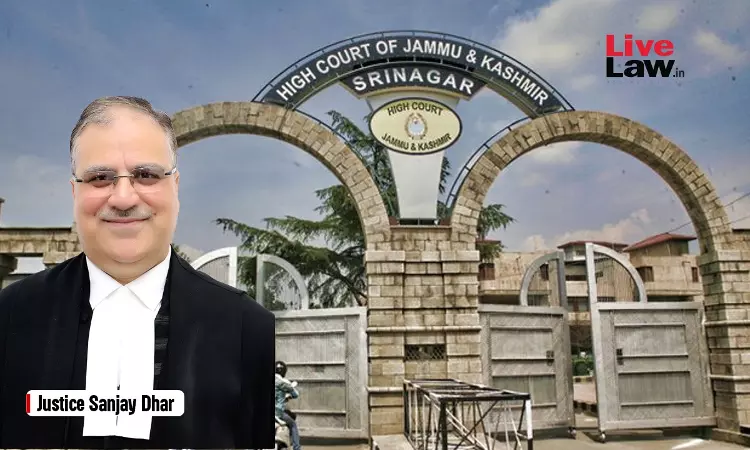
Justice Sanjay Dhar made this observation while dismissing a petition filed by a shop-occupant seeking protection of his possession despite his claim of ownership being prima facie rejected by the courts below.
Background of the Case
The litigation arose from a suit filed by the petitioner (plaintiff) Abdul Khaliq Sofi before the Sub Judge, seeking a permanent prohibitory injunction against respondents Mohammad Shafi Mir and another (defendants). The plaintiff asserted that he had purchased a small plot from defendants on which basis he claimed to have constructed two-storied shops where he ran a bakery business .
The defendants, however, completely denied any sale, asserting instead that the plaintiff was merely a tenant who was let two shops against payment of rent, with the amount already paid constituting advance rent paid in installments. They alleged rental arrears and asserted absolute ownership over the shopping complex comprising three shops on the ground floor with a first floor also constructed by them. They accused the plaintiff of filing a false suit to evade paying market rent from January 2024 onwards .
The trial court vacated an interim injunction earlier granted in favour of the plaintiff, holding that he failed to make out a prima facie case. His appeal before the District Judge was also dismissed. Aggrieved, he invoked the High Court's supervisory jurisdiction challenging both orders.
Court's Observations:
Justice Dhar began by addressing the plaintiff's principal contention that if even assuming him to be a tenant he could not be dispossessed without following due course of law. The Court noted that although the plaintiff sought injunction in his capacity as owner, his ownership claim was prima facie untenable given the nature of the document relied upon ie a mere receipt acknowledging payment, containing no covenant regarding transfer of immovable property.
The Court explained that Section 49 of the Registration Act clearly bars reliance on such an unregistered document for proving a sale. While an unregistered agreement to sell may be admissible for collateral purposes or in a suit for specific performance, the present document, the court pointed, “does not contain any covenant with regard to transaction of sale relating to the suit property” and the plaintiff had not even filed a suit for specific performance. Therefore, the receipt of money cannot be taken as evidence with regard to agreement to sell the suit property and hence the contention of the plaintiff is misconceived, the bench underscored.
The Court then held that since the plaintiff sought injunction based on his claim as owner, and that claim had been found prima facie false, he was disentitled to equitable relief. Justice Dhar observed,
“The relief of injunction is an equitable relief and a litigant, whose right to such relief has been found to be prima facie based upon falsehood, cannot be granted such relief. A litigant who seeks equitable relief has to do equity.”
However, even assuming the plaintiff to be a tenant or a tenant holding over, the Court proceeded to analyse whether he was entitled to retain possession until the defendants instituted a separate eviction action.
The bench conducted an extensive review of precedents, like Madan Lal v. Shri Mata Vaishno Devi Shrine Board (2023), G.M. Modi Hospital v. Shankar Singh Bhandari (Delhi HC),
& Thomas Cook (India) Ltd. v. Hotel Imperial (Delhi HC) in order to answer the question fairly.
Relying on these authorities, the Court elaborated the principle that due process of law or due course of law means that a person in settled possession cannot be evicted without a court adjudicating the rights of the parties. Crucially, the Court underscored that it is immaterial as to which party brings the action to court and what is material is that rights must be adjudicated by a competent court .
Citing with approval the Delhi High Court's exposition in Thomas Cook, the Court emphasised,
“'Due process' is satisfied the moment the rights of the parties are adjudicated upon by a court, irrespective of who approached the court. When a party seeking injunction fails to make out a case and the court rejects the claim, the person in possession cannot insist that the opposite party must now file a fresh suit for eviction before acting upon such determination.”
Applying the above principles to the case, Justice Dhar held,
“It is clear that the requirement of due process of law gets fulfilled once a person in possession brings a suit for injunction against a person who interferes in his possession and his rights are determined in the said suit. It is not necessary for the defendants to bring a fresh suit for eviction against the plaintiff once in a suit for injunction filed by the plaintiffs the Court determines that the plaintiff does not have a prima facie case in his favour.”
Since both the trial court and appellate court had conclusively found that the plaintiff failed to establish a prima facie case, the High Court held that he could not insist on retaining possession pending a fresh eviction suit.
Justice Dhar went even further and clarified,
“Even if the plaintiff is in possession of the suit property… he cannot retain his possession and his possession cannot be protected till such time the defendants obtain a decree of eviction. The defendants are entitled to use reasonable force to evict the plaintiff, as he has failed to prima facie establish his right to remain in possession.”
Finding no merit in the petition, the Court dismissed it in entirety, upholding the concurrent findings of the courts below and reiterating that the plaintiff could not claim protection once his own suit had resulted in a judicial determination against him.
Case Title: Abdul Khaliq Sofi Vs Mohammad Shafi Mir
Citation: 2-25 LiveLaw (JKL) 299


