



- Home
- /
- High Courts
- /
- High Court of J & K and Ladakh
- /
- Disability Developed After 14 Years...
Disability Developed After 14 Years Of Army Service Presumed Attributable To Service Absent Cogent Rebuttal: J&K&L High Court
LIVELAW NEWS NETWORK
4 Jun 2026 3:10 PM IST
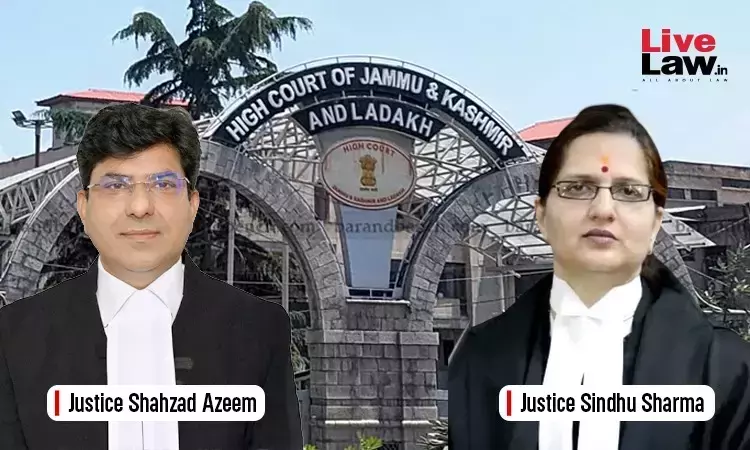
The Jammu & Kashmir and Ladakh High Court upheld an order of the Armed Forces Tribunal granting disability element of pension to Army personnel after observing that the disability had developed during service after more than fourteen years of enrolment and that the subsequent denial of attributability lacked adequate reasoning.The Court was hearing a writ petition filed by the Union of...
This is a premium content
Available exclusively to
Our subscribers
Subscribe Premium 
INR 1099+GST
Your support helps us to bring you more content at
an affordable subscription scheme !!!
All payment options available
The Jammu & Kashmir and Ladakh High Court upheld an order of the Armed Forces Tribunal granting disability element of pension to Army personnel after observing that the disability had developed during service after more than fourteen years of enrolment and that the subsequent denial of attributability lacked adequate reasoning.
The Court was hearing a writ petition filed by the Union of India challenging an order passed by the Armed Forces Tribunal, Srinagar Bench at Jammu, in an Original Application whereby the Tribunal had directed the petitioners to grant disability element to the respondent at 20% from 01.01.1994 to 31.12.1995 and thereafter rounding off to 50% from 01.01.1996 for life. The Tribunal had also restricted arrears to three years before the filing of the Original Application.
A Division Bench of Justice Sindhu Sharma and Justice Shahzad Azeem observed, “In the present case, it is not in dispute that the respondent developed the disability during service after more than 14 years of enrolment. On the contrary, the initial medical board had recorded that the disability was contracted during service and was not within the control of the respondent. The subsequent denial of attributability lacks adequate reasoning and does not inspire confidence.”
The respondent was enrolled in the Indian Army in July 1977. During service, he developed an eye disease, namely Hypermetropic Amblyopia of the right eye, which was detected while he was posted at Namkum. He was initially placed in low medical category 'CEE' (Temporary) and was subsequently downgraded to permanent low medical category 'CEE'.
The initial medical board recorded that the disability had been contracted during service and was not within the control of the respondent. Owing to his permanent low medical category, the respondent was discharged from service under Rule 13(3)(iii)(v) of the Army Rules, 1954 and was granted service pension with effect from 01.01.1994.
However, the Release Medical Board assessed the disability at 15–19% for two years and opined that it was neither attributable to nor aggravated by military service. Consequently, the claim for disability pension came to be rejected by PCDA (P), Allahabad, and the first appeal was also dismissed.
Subsequently, after obtaining relevant documents through the Right to Information Act, the respondent issued a demand notice, which was rejected. The respondent thereafter approached the Armed Forces Tribunal in an earlier Original Application, pursuant to which directions were issued for the conduct of a Review Medical Board.
The Review Medical Board conducted in February 2020 assessed the disability at 20% for life. However, the claim was again rejected on the ground that the disability was not attributable to or aggravated by military service. Aggrieved thereof, the respondent filed the Original Application before the Armed Forces Tribunal, which was allowed by the impugned order challenged before the High Court.
The High Court noted that the Tribunal had framed two issues, namely whether the Principal Controller of Defence Accounts (Pensions), Allahabad, could overrule the opinion of the Review Medical Board and whether the respondent was entitled to the benefit of rounding off of disability pension.
The Court observed that the Tribunal had relied upon Ex. Sapper Mohinder Singh v. Union of India, while holding that the decision of PCDA (P), Allahabad, overruling the opinion of the Review Medical Board was unsustainable in law.
On the issue of rounding off, the High Court agreed with the reliance placed by the Tribunal on Union of India v. Ram Avtar & Ors. (2014). The Court noted that the Supreme Court had disapproved the policy of granting the benefit of rounding off only to those personnel who were invalided out of service, while denying the same to personnel retiring on superannuation or completion of tenure.
Referring to the observations in Ram Avtar (2014), the Court reproduced the Supreme Court's finding that, “We do not see any error in the impugned judgment(s) and order(s) and therefore, all the appeals which pertain to the concept of rounding off of the disability pension are dismissed.”
The Court further noted that the Tribunal had relied upon Dharamvir Singh v. Union of India (2013) while considering the issue of attributability. The Tribunal had observed that though the Review Medical Board assessed the disability at 20% for life, the denial of attributability was based merely on an endorsement that the intervening period was covered under the previous medical board.
The High Court observed that the Tribunal had rightly held such reasoning to be cryptic and unconvincing, particularly when the disability had arisen after more than fourteen years of Army service. Referring to Dharamvir Singh (2013), the Court observed that where no disease or disability is recorded at the time of enrolment, and the medical authorities fail to provide reasons as to why the disease could not be detected at that stage, the disability would be presumed to have arisen during service.
The Court also relied upon Sukhvinder Singh v. Union of India (2014), wherein the Supreme Court held, “any disability not recorded at the time of recruitment must be presumed to have been caused subsequently and unless proved to the contrary to be a consequence of military service.”
The High Court further reproduced the Supreme Court's observations that, “wherever a member of the Armed Forces is invalided out of service, it perforce has to be assumed that his disability was found to be above twenty per cent.”
After examining the material on record, the Court held that the findings recorded by the Tribunal regarding the attributability of disability did not suffer from any infirmity.
The High Court held that the respondent had developed the disability during service after more than fourteen years of enrolment and that the subsequent denial of attributability was unsupported by adequate reasoning.
Accordingly, the Court dismissed the writ petition filed by the Union of India and upheld the order passed by the Armed Forces Tribunal directing the grant of disability element of pension to the respondent along with rounding off benefits.
Case Title: Union of India & Ors. v. Ex NK Roshan Lal
Citation: 2026 LiveLaw (JKL) 247
Appearances
For Appellants: CGSC Rohan Nanda
For Respondent: Advocates B. S. Sarmal, Amit Singh


