



- Home
- /
- High Courts
- /
- High Court of J & K and Ladakh
- /
- Disengagement Of Daily Wagers By...
Disengagement Of Daily Wagers By PSU Due To Closure Or Financial Constraints Not Arbitrary Under Article 14: J&K&L High Court
LIVELAW NEWS NETWORK
31 March 2026 5:20 PM IST
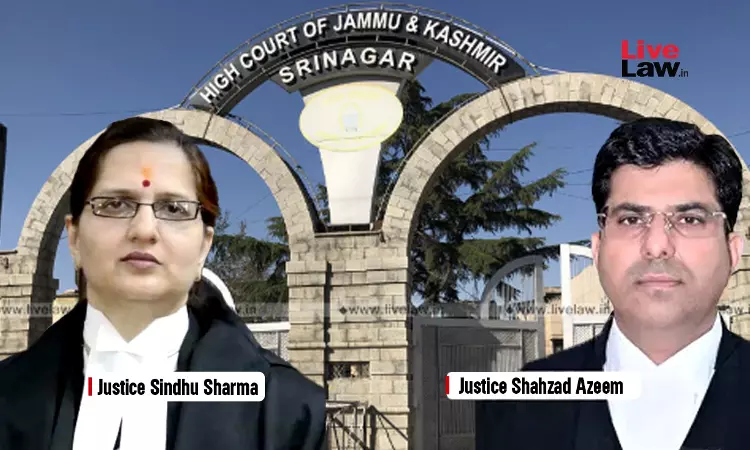
The High Court of Jammu & Kashmir and Ladakh at Srinagar has held that the disengagement of daily rated workers by a public sector undertaking, compelled by the closure of its operations and acute financial constraints, does not violate Article 14 of the Constitution.The Court was hearing a Letters Patent Appeal challenging the judgment of the learned Single Judge dismissing a writ...
This is a premium content
Available exclusively to
Our subscribers
Subscribe Premium 
INR 1099+GST
Your support helps us to bring you more content at
an affordable subscription scheme !!!
All payment options available
The High Court of Jammu & Kashmir and Ladakh at Srinagar has held that the disengagement of daily rated workers by a public sector undertaking, compelled by the closure of its operations and acute financial constraints, does not violate Article 14 of the Constitution.
The Court was hearing a Letters Patent Appeal challenging the judgment of the learned Single Judge dismissing a writ petition filed by daily rated workers seeking continuation in service and release of wages after their disengagement from J&K Cements Limited.
A Division Bench comprising Justice Sindhu Sharma and Justice Shahzad Azeem observed: “In the present case, the appellants were engaged only on a daily wage basis, without any regular recruitment process, and their engagement was explicitly conditional and temporary, subject to approval by the Board. The Company, being a public sector undertaking functioning on its own financial resources, was facing acute fiscal constraints and was compelled to close its operations following the directions of the Pollution Control Board. In such circumstances, the action of the Company in discontinuing the services of the appellants cannot be said to be arbitrary or violative of Article 14 of the Constitution”.
The appellants, numbering 51, claimed that they had been working as daily rated workers in the J&K Cement Factory at Khrew since 2005 and had subsequently been brought on muster rolls in 2013. They were later engaged as daily rated workers for a fixed period of five years by order dated 14.06.2018.
Their engagement was terminated by order dated 07.03.2019, following which they approached the writ court contending that their disengagement was arbitrary, particularly as other employees of the Company had been adjusted in various Government departments.
The respondents contended that the appellants' engagement was purely temporary and subject to approval by the Board of Directors. It was further submitted that the Khrew Plant had been ordered to be closed by the Pollution Control Board on 29.12.2018 for non-compliance with environmental norms, and that the Company was facing severe financial distress.
The Court examined the nature of engagement of the appellants and reiterated the settled principle that daily wagers or casual employees do not acquire any vested right to continue in service. It was observed that “any engagement not made in accordance with the recruitment rules or a regular selection process does not confer any legal right to claim continuance or absorption.”
Relying on the Secretary, State of Karnataka v. Umadevi (2006) 4 SCC 1, the Court held that temporary or contractual employees cannot invoke the doctrine of legitimate expectation to claim continuation or regularisation in service.
In Umadevi (2006), the Apex Court had held: “When a person enters temporary employment or gets engagement as a contractual or casual worker, and the engagement is not based on a proper selection as recognised by the relevant rules or procedure, he is aware of the consequences of the appointment being temporary, casual or contractual in nature. Such a person cannot invoke the theory of legitimate expectation for being confirmed in the post when an appointment to the post could be made only by following a proper procedure for selection and, in concerned cases, in consultation with the Public Service Commission. Therefore, the theory of legitimate expectation cannot be successfully advanced by temporary, contractual or casual employees. It cannot also be held that the State has held out any promise while engaging these persons either to continue them where they are or to make them permanent. The State cannot constitutionally make such a promise. It is also obvious that the theory cannot be invoked to seek a positive relief of being made permanent in the post.”
The Court further examined the circumstances leading to disengagement and noted that the closure of the Khrew Plant was pursuant to directions of the Pollution Control Board, and not a voluntary administrative decision. It was observed that restoration of the plant would require substantial financial investment beyond the means of the Company.
The Court also took note of the financial position of the Company, observing that it was unable to meet even its basic obligations, including payment of salaries to permanent employees and retirement dues. In such circumstances, discontinuation of services of daily rated workers was held to be a necessary administrative consequence.
Addressing the plea of discrimination, the Court held that the appellants could not claim parity with regular or permanent employees who had been redeployed under specific Government orders, as they stood on a different footing in law and fact.
“The contention of the appellants that similarly situated employees were deployed in Government departments does not hold merit. The Government Order No. 48-IND of 2021 dated 09.03.2021 was issued in respect of certain categories of regular or permanent staff of the Company, and not for daily wagers or muster roll workers. The appellants, therefore, cannot claim parity with those employees who stood on a different legal and factual footing”, the Bench remarked.
The Court further observed that the learned Single Judge had already safeguarded the limited equitable interest of the appellants by directing that they be given preference in case the plant is revived in future.
The High Court concluded that the disengagement of the appellants was justified in the facts and circumstances of the case and did not suffer from arbitrariness or illegality under Article 14 of the Constitution.
Accordingly, the Court dismissed the appeal and upheld the judgment of the learned Single Judge.
Case Title: Ghulam Nabi Bhat & Ors. v. State of J&K & Ors.
Citation: 2026 LiveLaw (JKL) 128
Appearances
Advocate Areeb Javed Kawoosa appeared for the appellants, while Government Advocate Wasim Gul represented the respondents.


