



- Home
- /
- High Courts
- /
- High Court of J & K and Ladakh
- /
- Courts Cannot Direct Regularisation...
Courts Cannot Direct Regularisation Of Seasonal Labourers Amid Govt's Blanket Ban On Such Engagements: J&K&L High Court
LIVELAW NEWS NETWORK
14 May 2026 2:00 PM IST
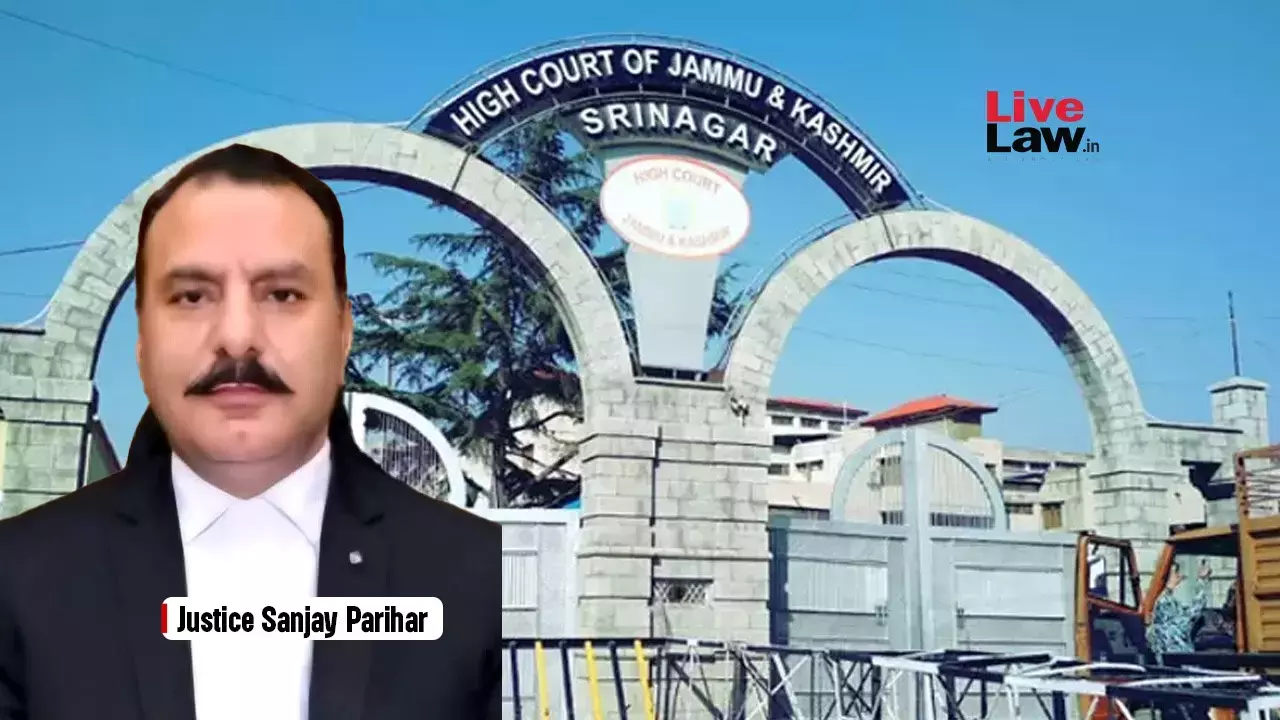
The High Court of Jammu & Kashmir and Ladakh has held that judicial review under Article 226 of the Constitution is confined to examining the decision-making process and not the decision itself.The Court emphasised that courts must refrain from issuing directions for permanent absorption or regularization when there exists a blanket ban on engagements imposed by the Government and over...
This is a premium content
Available exclusively to
Our subscribers
Subscribe Premium 
INR 1099+GST
Your support helps us to bring you more content at
an affordable subscription scheme !!!
All payment options available
The High Court of Jammu & Kashmir and Ladakh has held that judicial review under Article 226 of the Constitution is confined to examining the decision-making process and not the decision itself.
The Court emphasised that courts must refrain from issuing directions for permanent absorption or regularization when there exists a blanket ban on engagements imposed by the Government and over 3,000 seasonal labourers are working under similar conditions, as such a direction would amount to transgressing into the domain of executive policy.
The Court made these observations while hearing a writ petition filed by seasonal labourers seeking quashing of Order whereby their claim for being brought at par with certain other casual labourers was rejected, and seeking a mandamus commanding the respondents to accord them the same treatment and benefits extended to those labourers.
A Single Bench of Justice Sanjay Parihar, while dismissing the petition, observed,
“... The respondents have further placed on record that there exists a blanket ban imposed by the Government on all forms of engagements and that more than 3,000 seasonal labourers are working in various districts of Kashmir under similar conditions. In such circumstances, issuance of a direction by this Court for extending permanent casual labour status to the petitioners would amount to transgressing into the domain of executive policy.”
The petitioners claimed to have been working as seasonal labourers in the respondent department since 1998 and contended that they were similarly situated to respondents 6 to 9. According to the petitioners, despite rendering long years of service, they were not considered for adjustment or regular engagement, whereas respondents 6 to 9, who were identically placed, were brought within the cadre of permanent casual labourers.
The petitioners argued that the impugned action was violative of Articles 14 and 16 of the Constitution, as the respondents had created an artificial classification amongst similarly situated employees without any rational basis.
The respondents contended that the petitioners were merely seasonal labourers engaged on need basis during the irrigation season and did not fulfil the eligibility criteria prescribed under SRO 520 of 2017. It was argued that there exists a blanket ban on engagements, and that the cases of respondents 6 to 9 stood on a different footing as they were adjusted against watch and ward duties on the basis of seniority and administrative exigencies.
Court's Observations:
The Court noted that the moot question was whether the respondents could legally deny parity to the petitioners despite the admitted position that they were engaged under the same scheme. The Court found from the material that the petitioners and respondents 6 to 9 were all engaged as seasonal labourers, but the respondents had not denied that respondents 6 to 9 were subsequently retained on a year-to-year basis and brought within the fold of permanent casual labourers.
The sole justification offered was that respondents 6 to 9 were adjusted against watch and ward duties on account of administrative exigencies and seniority.
The Court observed that the petitioners figured much lower in the seniority list and continued to remain seasonal labourers engaged purely during the irrigation season. The Court reiterated the principle that equality under Article 14 postulates positive equality and not negative equality, and that merely because some benefit was extended to another set of employees does not confer an enforceable right upon the petitioners to claim identical relief contrary to the governing statutory framework.
Citing State of Bihar v. Kameshwar Prasad Singh, (2000) 9 SCC 94, the Court held that Article 14 does not envisage perpetuation of illegality or irregularity.
The Court also relied upon the Constitution Bench judgment in Secretary, State of Karnataka v. Umadevi (3), (2006) 4 SCC 1, wherein it was authoritatively held that regularization or permanent absorption cannot be claimed as a matter of right de hors the constitutional scheme governing public employment. The Court observed that courts must refrain from issuing directions for absorption, regularization, or permanent continuance unless the appointment itself is made in accordance with law.
The Court further noted that the respondents had placed on record that there exists a blanket ban imposed by the Government on all forms of engagements, and that more than 3,000 seasonal labourers are working in various districts of Kashmir under similar conditions.
In such circumstances, the Court held that issuing a direction for extending permanent casual labour status to the petitioners would amount to transgressing into the domain of executive policy. The Court opined that judicial review under Article 226 is confined to examining the decision-making process and not the decision itself unless the same is shown to be patently arbitrary, mala fide, or violative of statutory provisions, and no such case was established.
Finding no merit in the petition the bench dismissed the petition.
Case Title: Mohammad Amin Rather And Others v. UT of J&K And Others
Citation: 2026 LiveLaw (JKL) 203


