



- Home
- /
- High Courts
- /
- High Court of J & K and Ladakh
- /
- Dying Declaration Recorded Minutes...
Dying Declaration Recorded Minutes Before Death Is Substantial Evidence; Minor Contradictions Cannot Be Scrutinised At Bail Stage: J&K&L HC
LIVELAW NEWS NETWORK
13 May 2026 8:20 PM IST
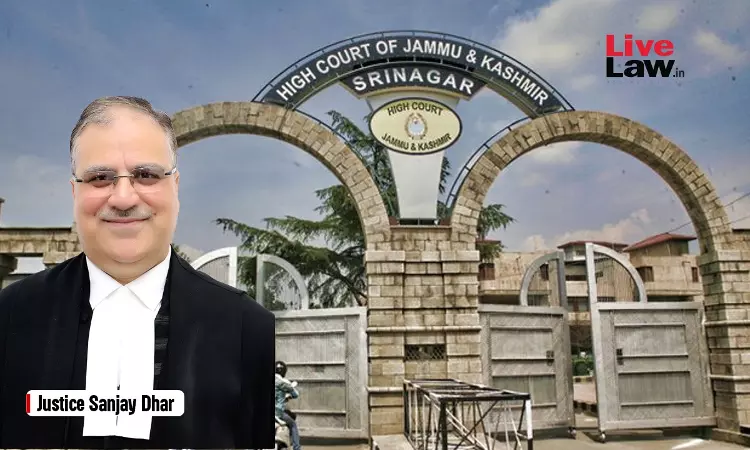
The High Court of Jammu & Kashmir and Ladakh has held that a dying declaration recorded on a mobile phone minutes before the death of the deceased, which has been forensically certified as unedited, constitutes substantial admissible evidence under Section 32(1) of the Evidence Act, and minor contradictions in such a statement cannot be critically analyzed at the stage of considering a...
This is a premium content
Available exclusively to
Our subscribers
Subscribe Premium 
INR 1099+GST
Your support helps us to bring you more content at
an affordable subscription scheme !!!
All payment options available
The High Court of Jammu & Kashmir and Ladakh has held that a dying declaration recorded on a mobile phone minutes before the death of the deceased, which has been forensically certified as unedited, constitutes substantial admissible evidence under Section 32(1) of the Evidence Act, and minor contradictions in such a statement cannot be critically analyzed at the stage of considering a bail application.
The Court was hearing a bail application filed by petitioners facing trial for offences under Sections 302 and 120-B IPC before the Court of Additional Sessions Judge, Baramulla. The petitioners contended that they were in custody for more than five years and that the forensic evidence completely demolished the prosecution case, as the poison recovered from the kitchen was Zinc Phosphide while the viscera detected Organo Phosphorus Insecticide.
A Single Bench of Justice Sanjay Dhar, while dismissing the bail application, observed,
“... The statement made by the deceased immediately before his death which relates to the circumstances pertaining to his death becomes admissible in evidence and, therefore, the contention of learned counsel for the petitioners that there is no material on record of the trial court that would connect the petitioners with the alleged crime, is misconceived.”
On 24.01.2020, Police Station Bijhama received information that an unknown person was found in unconscious condition. The person was taken to hospital at Uri but was declared brought dead. The deceased was identified as Mohammad Syed Abasi. Upon completion of inquest proceedings, it was revealed that the cause of death was poisoning, following which FIR for offences under Sections 302 and 120-B IPC was registered.
Investigation revealed that the deceased had a love affair with one Zahida Bano, sister of accused Shahida Begum. The family members were unhappy with this relation. Accused Shahida Begum and Hilal Ahmad Malik, along with the petitioners, hatched a conspiracy. The accused procured rodent killer poison, mixed it with tea and offered it to the deceased after assuring him that his marriage would be contracted with Zahida Bano.
The deceased, before his death at 7.00 p.m., called PW Altaf Hussain and asked him to record the conversation. During the conversation, the deceased named the petitioners as persons responsible for his death. PW Altaf Hussain produced his mobile phone, which was seized.
The CFSL report confirmed no editing in the conversation. Charges were framed and female accused were enlarged on bail on 28.04.2023, but the petitioners' bail applications were dismissed. The petitioners moved the present application after the trial court dismissed their previous application.
Court's Observations:
The Court first noted the legal position that in a case involving an offence punishable with death sentence or imprisonment for life, the accused cannot be released on bail if there appear reasonable grounds for believing that he has been guilty of such an offence.
Examining the statements of PW-20 Altaf Hussain and PW-21 Mohammad Rafiq, the Court found that both witnesses had, prima facie, supported the prosecution version. Both stated that the deceased contacted PW Altaf Hussain on his cellphone and asked him to record the conversation, during which the deceased clearly stated that he had been tricked by the petitioners and poisoned.
“… The investigating agency has collected the call data record and has also seized the cellphone of PW Altaf Hussain, in which the conversation was recorded. The said cellphone has been sent to CFSL and as per the report submitted by CFSL, there is no editing in the conversation”,the court remarked.
The Court held that the statement of the deceased made immediately before his death relating to the circumstances of his death is admissible under Section 32(1) of the Evidence Act. “There may be minor contradictions here and there in the statements of PWs Altaf Hussain and Mohammad Rafiq but at the stage of considering the bail application, it is not open to this Court to critically analyze their statements,” the Court observed.
Regarding the forensic evidence, the Court noted that the postmortem report clearly opined that death resulted from poisoning. “The issue as to whether the poison detected in the viscera of the deceased was the same kind of poison which was recovered by the police from the kitchen of the two accused, may not be of much relevance at this stage for the purposes of considering the prayer of the petitioners for grant of bail,” the Court held.
On the ground of long incarceration, the Court noted that the challan was filed during the peak of the Covid pandemic, physical functioning of courts was not taking place, and proceedings were conducted through WhatsApp video calls. Formal charges could be framed only on 06.07.2021, more than one year after the presentation of challan.
The Court found that for about two years from the date of filing of the challan, there was hardly any progress. However, after the pandemic was over, the trial progressed at a reasonable pace, and most prosecution witnesses had already been examined.
“In the face of this material on record, it cannot be stated that there has been any delay in progress of the trial which can be attributed either to the court below or to the prosecution,” the Court held, concluding that the right to speedy trial was not violated.
The High Court thus found no merit in the petition and dismissed the same. However, the Court directed the trial court to expedite the trial so that the challan is finally disposed of at the earliest.
Case Title: Basharat Ahmad Abbasi Alias Bashir And Another v. UT of J&K And Others
Citation: 2026 LiveLaw (JKL) 201


