



- Home
- /
- High Courts
- /
- High Court of J & K and Ladakh
- /
- Enemy Infiltrated Govt Through...
Enemy Infiltrated Govt Through Employees To Advance Terror Agenda: J&K&L High Court Upholds Constable's Dismissal For Sheltering Militant
LIVELAW NEWS NETWORK
2 Jun 2026 3:35 PM IST
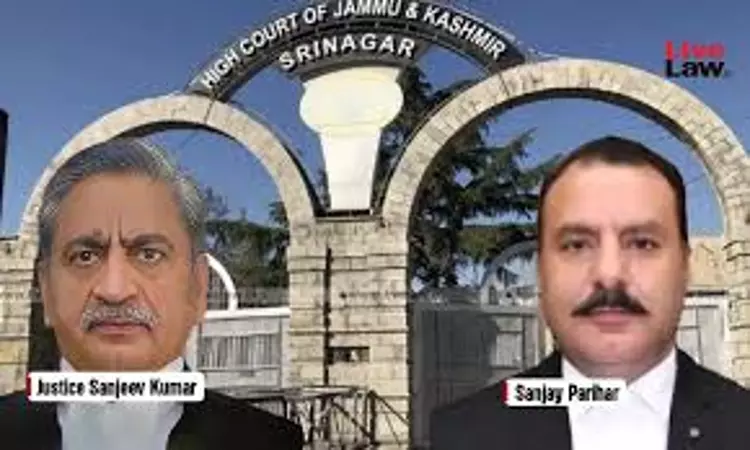
The High Court of Jammu & Kashmir and Ladakh has upheld the dismissal of a police constable who was found involved in anti-national activities, observing that the enemy had been using multiple tools and strategies to disintegrate the nation by infiltrating the Government through its employees and members of the security forces.The Court held that the respondent was one such pawn in the...
This is a premium content
Available exclusively to
Our subscribers
Subscribe Premium 
INR 1099+GST
Your support helps us to bring you more content at
an affordable subscription scheme !!!
All payment options available
The High Court of Jammu & Kashmir and Ladakh has upheld the dismissal of a police constable who was found involved in anti-national activities, observing that the enemy had been using multiple tools and strategies to disintegrate the nation by infiltrating the Government through its employees and members of the security forces.
The Court held that the respondent was one such pawn in the hands of the enemy who had been persuaded to act against his employer and his country.
The Court was hearing an intra-Court appeal filed by the then State of Jammu and Kashmir (now Union Territory) against a judgment passed by a Single Judge, whereby the writ Court had set aside the dismissal order of the respondent issued in 2007.
A Division Bench of Justice Sanjeev Kumar and Justice Sanjay Parihar, while observing that “in a bid to disintegrate our nation by creating terror and promoting dissatisfaction amongst the people of the Valley against the Government of India, the enemy has been using multiple tools and strategies. One such strategy in those days was to infiltrate in the Government through Government employees and members of the security forces,” held that the writ Court had dealt with the matter in a slipshod manner and ignored the contemporaneous record.
Mr. Mohsin Qadri, Senior AAG appeared for the appellants-State, while Mr. Syed Faisal Qadiri, Senior Advocate with Mr. Mir Adhan Zahoor, Advocate and Mr. Salih Pirzada, Advocate appeared for the respondent.
The respondent had been enrolled in the Department of Police in the year 1991. In the year 2004, he was found involved in anti-national activities and was arrested by the police of Police Station Zadibal, Srinagar for offences under Section 120-B RPC and Sections 7/24 of the Indian Arms Act. Simultaneously, he was placed under suspension and a departmental enquiry was initiated.
While the enquiry was yet to proceed formally, the appellants invoked the provisions of Section 126(2)(c) of the Constitution of Jammu and Kashmir (corresponding to Article 311(2)(c) of the Constitution of India) and, having found the activities of the respondent detrimental and prejudicial to the security of the State, dismissed him from service.
The respondent challenged the dismissal order before the writ Court on the ground that the services could not have been terminated without conducting a departmental enquiry and providing an adequate opportunity to defend himself. The writ Court allowed the petition, observing that there was nothing indicated by the appellants as to why the departmental enquiry, which had been initiated, was dispensed with.
Senior AAG Mohsin Qadri argued that the respondent's involvement in militant and anti-national activities posed a serious threat to State security, warranting his dismissal under Section 126(2)(c) of the J&K Constitution. He contended that the decision was taken after due consideration of the material by the Government, Cabinet and Governor, and was therefore neither arbitrary nor unsupported by evidence.
He further submitted that a regular departmental inquiry was rightly dispensed with as it would have exposed sensitive security information and endangered witnesses, making such an inquiry inexpedient in the interest of State security.
Court's Observation
The Division Bench first examined the legal position governing the dispensation of a regular departmental enquiry under Section 126(2)(c) of the Constitution of Jammu and Kashmir.
Relying on the Constitution Bench judgment in Union of India v. Tulsiram Patel (1985) and A.K. Kaul v. Union of India (1995) 4 SCC 73, the Court held that the satisfaction of the Governor under clause (c) is not personal satisfaction but the satisfaction of the Head of the State acting on the aid and advice of the Council of Ministers, and that the Governor is not supposed to disclose the facts on which it is based either to the civil servant concerned or to any authority.
The Court then examined the record produced by the appellants, including the detailed memorandum prepared by the Department of Home for submission to the Cabinet. The record revealed that the respondent, a Driver Constable, was involved in subversive activities.
The Court also noted that as per the interrogation report in FIR, the respondent was in contact with a Pakistani mercenary and had arranged a permanent hideout for him in the house of one one Haji Mushtaq Gaji. Upon a tip-off, the house of Haji Mushtaq was raided, from where a large quantity of arms and ammunition was recovered. Haji Mushtaq's arrest led to the role of the respondent. The respondent's rented accommodation was also searched, wherein two hand grenades were recovered.
The Court made a significant observation on the larger conspiracy against the nation,
“... The enemy succeeded to some extent and made considerable inroads into the Government machinery at one point of time. Several Government employees at different levels, including those working in security and intelligence agencies, were roped in by the enemy country to achieve its nefarious design of disintegrating this country. The respondent was one such pawn in the hands of the enemy who had been persuaded to act not only against his employer but also against his country for extraneous reasons and considerations. Not only had he established contacts with a Pakistani militant, but he had also arranged a hideout for him. During interrogation, which was followed by searches, two hand grenades were also recovered from the possession of the respondent.”
The Court noted that the memorandum which was approved by the Cabinet took note of the findings of fact returned by a Committee headed by the Chief Secretary. The memorandum clearly indicated the reasons as to why holding a regular enquiry in the case of the respondent was required to be dispensed with. The Court found that the writ Court had ignored all this material available on record and had also failed to take note of the specific pleadings of the appellants.
The Court further observed that holding a departmental enquiry would have been inexpedient and an exercise in futility, as in the atmosphere then prevailing, nobody would have come forward to depose against the respondent without exposing themselves to threat to life and property.
Accordingly, the High Court held that the writ Court had erred in setting aside the dismissal order on the ground that no material was available justifying the dispensation of the departmental enquiry, when such material was available in abundance in the contemporaneous record.
The Division Bench thus set aside the impugned judgment of the writ Court and dismissed the writ petition, thereby upholding the dismissal order passed against the respondent under Section 126(2)(c) of the Constitution of Jammu and Kashmir.
Case Title: State of Jammu and Kashmir & Ors. v. Ghulam Mohd. Tantray
Citation: 2026 LiveLaw (JKL) 237
Appearances
For Appellants: Mr. Mohsin Qadri, Senior AAG
For Respondent: Mr. Syed Faisal Qadiri, Senior Advocate with Mr. Mir Adhan Zahoor, Advocate and Mr. Salih Pirzada, Advocate


