



- Home
- /
- High Courts
- /
- High Court of J & K and Ladakh
- /
- Equal Pay For Equal Work Applies...
Equal Pay For Equal Work Applies Irrespective Of Funding Source: J&K&L High Court Upholds Enhanced Remuneration For Vocational Instructors
LIVELAW NEWS NETWORK
3 Jun 2026 11:35 AM IST
Reiterating that employees performing identical duties cannot be paid differently merely because their remuneration originates from different sources, the High Court of Jammu & Kashmir and Ladakh has upheld the entitlement of Vocational Instructors engaged under the Self-Finance Scheme in Industrial Training Institutes (ITIs) to enhanced remuneration under an Government Order.The Court...
This is a premium content
Available exclusively to
Our subscribers
Subscribe Premium 
INR 1099+GST
Your support helps us to bring you more content at
an affordable subscription scheme !!!
All payment options available
Reiterating that employees performing identical duties cannot be paid differently merely because their remuneration originates from different sources, the High Court of Jammu & Kashmir and Ladakh has upheld the entitlement of Vocational Instructors engaged under the Self-Finance Scheme in Industrial Training Institutes (ITIs) to enhanced remuneration under an Government Order.
The Court held that the doctrine of “equal pay for equal work” squarely applies where the nature of duties discharged by employees is the same, regardless of the source from which their wages are paid.
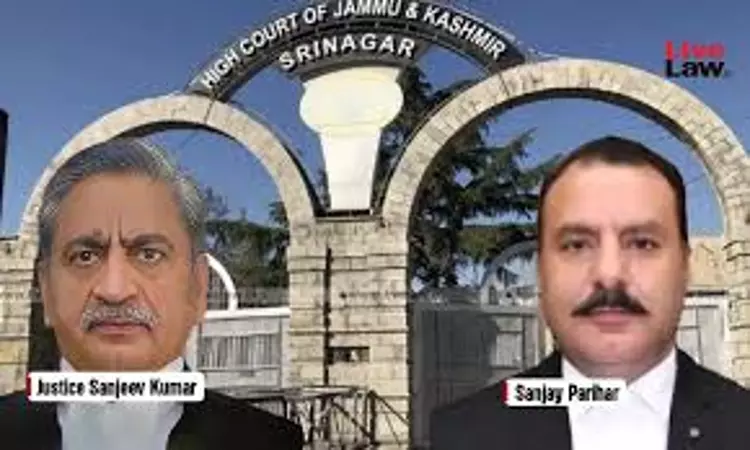
Dismissing an intra-court appeal filed by the Union Territory administration and the Skill Development Department, a Division Bench of Justice Sanjeev Kumar and Justice Sanjay Parihar affirmed the judgment of the writ Court directing extension of enhanced remuneration benefits to Vocational Instructors engaged on academic arrangement basis under the Self-Finance Scheme.
The Bench observed,
“... It cannot be said that those who are engaged as Lecturers or Vocational Instructors on academic arrangement basis and paid under the 'Self Finance Scheme' perform the duties different from those engaged against gazetted or non-gazetted posts and are paid from a different source. The doctrine of 'equal pay for equal work' is fully attracted.”
The Court further remarked,
“We cannot approve the action of the petitioners giving different wages to the persons for the similar duties merely on the ground that the sources of payment of their wages/remuneration differ.”
The respondents were engaged as Vocational Instructors on academic arrangement basis in various Industrial Training Institutes across Jammu and Kashmir between 2009 and 2011 under the Self-Finance Scheme. Initially, they were paid an honorarium of Rs. 4,000 per month.
Subsequently, the Government revised the honorarium payable to Lecturers and Vocational Instructors engaged on academic arrangement basis through Government Order of 2012. Under the revised structure, Vocational Instructors possessing degree qualifications became entitled to Rs. 6,000 per month, while those holding ITI/CTI qualifications were granted Rs. 5,500 per month. The honorarium was further enhanced through another Government Order issued in 2017. The respondents received the benefit of both these revisions without distinction.
The dispute arose after the issuance of Government Order No. 34 of 2020 whereby remuneration of candidates engaged on academic arrangement basis in ITIs and Polytechnics was enhanced to Rs. 15,000 for gazetted posts and Rs. 12,000 for non-gazetted posts. However, the respondents were denied the benefit of this enhancement on the ground that they had been engaged under the Self-Finance Scheme and not against regular gazetted or non-gazetted vacant posts.
Aggrieved by the denial, the respondents approached the High Court through a writ petition seeking implementation of the 2020 Government Order in their favour.
The Government argued that the enhanced remuneration contemplated by Government Order was confined only to candidates engaged on academic arrangement basis against available gazetted and non-gazetted posts in ITIs and Polytechnics.
According to the appellants, persons engaged under the Self-Finance Scheme constituted a separate category and were therefore outside the ambit of the Government Order.
The respondents, on the other hand, contended that the Government Order drew no distinction between employees engaged under the Self-Finance Scheme and those engaged against vacant posts and that all academic arrangement employees performing identical duties were entitled to equal treatment.
Court's Observations:
The Division Bench noted that the writ Court had carefully examined the language of the Government Order and correctly concluded that no distinction had been created between employees engaged under the Self-Finance Scheme and those appointed against gazetted or non-gazetted vacancies.
The Court observed that a plain reading of the Government Order revealed that the benefit of enhanced remuneration had been granted to all candidates engaged on academic arrangement basis in ITIs and Polytechnics.
Addressing the Government's interpretation, the Bench explained that the references to gazetted and non-gazetted posts in the Government Order were made only to determine the applicable rate of remuneration depending upon the nature of duties performed.
According to the Court, employees discharging duties corresponding to gazetted posts were entitled to remuneration of Rs. 15,000, whereas those performing duties relatable to non-gazetted posts were entitled to Rs. 12,000.
The Court clarified that these references were never intended to exclude employees engaged under the Self-Finance Scheme from the benefit of enhanced remuneration.
The Bench held that the source from which remuneration is paid cannot be a valid basis for discrimination when employees perform the same functions and discharge identical responsibilities.
The Court emphasized that Vocational Instructors engaged under the Self-Finance Scheme perform the very same teaching and instructional duties as their counterparts engaged against sanctioned vacancies and, therefore, cannot be treated differently for purposes of remuneration.
Invoking the constitutional principle of equal pay for equal work, the Court held that differential wages for identical work would amount to impermissible discrimination.
Finding no infirmity in the judgment rendered by the writ Court, the Division Bench held that the respondents were rightly declared entitled to the benefit of enhanced remuneration envisaged under Government Order.
Accordingly, the Letters Patent Appeal filed by the Union Territory and its authorities was dismissed, and the judgment directing payment of enhanced remuneration to the respondents was affirmed.
Case Title: Union Territory of J&K & Ors. v. Fayaz Ahmad Bhat & Ors.
Citation: 2026 LiveLaw (JKL) 241


