



- Home
- /
- High Courts
- /
- High Court of J & K and Ladakh
- /
- EWS Claim Cannot Be Rejected For...
EWS Claim Cannot Be Rejected For Mere Format Defect If Eligibility Exists On Cut-Off Date: J&K High Court
LIVELAW NEWS NETWORK
18 Feb 2026 12:45 PM IST
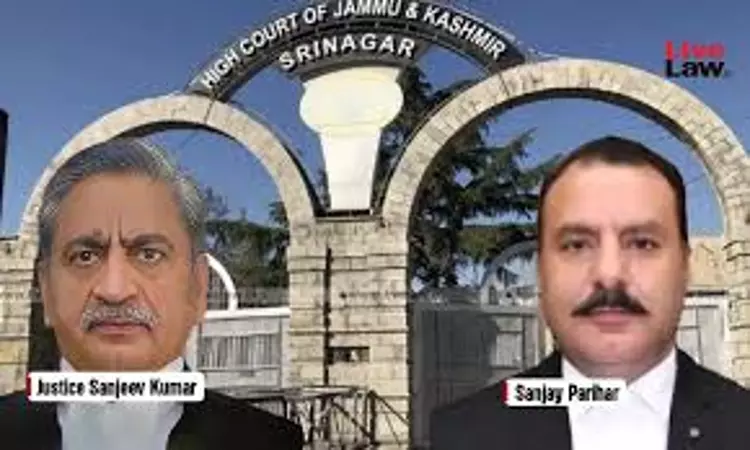
The Jammu and Kashmir and Ladakh High Court has ruled that a reservation certificate that substantively satisfies statutory eligibility conditions on the cut-off date cannot be invalidated solely due to a defect in format, especially when the defect is clarified by the issuing authority and the candidate's eligibility itself is not in dispute.Reiterating this crucial principle, a Division...
This is a premium content
Available exclusively to
Our subscribers
Subscribe Premium 
INR 1099+GST
Your support helps us to bring you more content at
an affordable subscription scheme !!!
All payment options available
The Jammu and Kashmir and Ladakh High Court has ruled that a reservation certificate that substantively satisfies statutory eligibility conditions on the cut-off date cannot be invalidated solely due to a defect in format, especially when the defect is clarified by the issuing authority and the candidate's eligibility itself is not in dispute.
Reiterating this crucial principle, a Division Bench of Justice Sanjeev Kumar and Justice Sanjay Parihar, dismissed a writ petition challenging the selection of a higher-merit EWS candidate for the post of Assistant Professor (Botany) and remarked,
“… A candidate claiming the benefit of a reserved category must ensure that he or she possesses a valid requisite category certificate on the cut-off date and that the candidature of such candidate would be provisional till the genuineness of the reserved category certificate is verified by the competent authority”
Background:
The controversy arose from the selection process initiated by the Higher Education Department for the post of Assistant Professor (Botany). Initially, four posts were referred to the Jammu and Kashmir Public Service Commission (JKPSC), followed by a subsequent reference of nineteen additional posts, including two posts reserved for Economically Weaker Sections (EWS). Both sets of posts were notified through separate advertisements, and a common written examination was conducted.
The petitioner, Priyanka Rakwal, and the private respondent, Arun Kumar Khajuria, applied under the EWS category. While the private respondent secured 64.08 merit points, the petitioner secured 49.10 points. Despite the private respondent being the most meritorious EWS candidate, he was initially excluded from the provisional select list because the EWS certificate submitted by him before the cut-off date was not in the prescribed UT format, though it had been issued by a competent authority.
Aggrieved by his exclusion, the private respondent submitted a representation along with a clarification issued by the Tehsildar, Kathua, and after granting a hearing to the petitioner, the JKPSC recommended the private respondent for appointment. The petitioner approached the Central Administrative Tribunal (CAT), which dismissed her Original Application, leading to the present writ petition before the High Court.
Appearing for the petitioner, Mr. D.S. Chauhan, Advocate, assisted by Ms. Damini Singh Chauhan, contended that the private respondent did not possess a valid EWS certificate as on the cut-off date since the certificate produced was not in the prescribed format under the J&K Reservation Rules, 2005. It was argued that any clarification or fresh certificate issued after the cut-off date could not cure this defect, and therefore, the petitioner's provisional selection ought to have been finalized.
Observations and Reasoning of the Court:
The Division Bench undertook a detailed examination of the statutory framework governing EWS reservation under the J&K Reservation Act, 2004, and the Reservation Rules, 2005, as amended after the J&K Reorganisation Act, 2019. The Court noted that for claiming EWS reservation, a candidate must not belong to SC/ST/OBC categories, must have family income below the prescribed threshold, and must not possess disqualifying assets.
The Court found that the certificate dated 31.05.2023, submitted by the private respondent before the cut-off date, clearly certified that his family income was below ₹8 lakh and that he did not possess the prohibited assets. Although the certificate did not strictly conform to the UT format and made reference to the Central format, it was nonetheless issued by a competent authority, it noted.
Crucially, the Tehsildar, Kathua, later issued a clarification stating that the private respondent did not fall within any excluded categories under the J&K Reservation Act. The Court held that this clarification did not confer a new eligibility, but merely explained and cured an omission in the earlier certificate.
“It is the substance and not the form that should determine the validity of a particular certificate in contention.”, the court stated.
The Bench further observed that the recruitment advertisement only required possession of a valid category certificate on the cut-off date and did not mandate adherence to a particular format or prescribe consequences for deviation. Therefore, the strict approach adopted in certain Supreme Court precedents, where advertisements explicitly barred acceptance of non-conforming certificates, was held to be inapplicable.
The Court also reiterated that inclusion in a provisional select list does not confer an indefeasible right to appointment. Since the petitioner's selection was expressly provisional and subject to objections, the JKPSC was well within its jurisdiction to consider the grievance of a more meritorious candidate.
“It would not be just and fair to knock out a candidate who has secured the highest merit only on the ground that the certificate of income and assets was issued on a wrong format.”, the court reasoned.
Finding no illegality or infirmity in the selection process, the writ petition was dismissed. “Viewed from any angle, merit cannot be defeated by a mere technical defect in form when eligibility in substance stands satisfied on the cut-off date.”, the court concluded.
Case Title: Priyanka Rakwal Vs UT Of J&K
Citation: 2026 LiveLaw (JKL) 49


