



- Home
- /
- High Courts
- /
- High Court of J & K and Ladakh
- /
- FCI Can Recover Amounts For Delay...
FCI Can Recover Amounts For Delay In Completing Black-Topping Of PEG Godown Roads: J&K&L High Court
LIVELAW NEWS NETWORK
12 Jun 2026 4:30 PM IST
The High Court of Jammu & Kashmir and Ladakh has held that black-topping of internal roads forms an essential component of the infrastructure required under the Private Entrepreneur Guarantee (PEG) Scheme and that recoveries effected by the Food Corporation of India (FCI) for failure to complete such work within the stipulated period cannot be faulted merely because the godown continued...
This is a premium content
Available exclusively to
Our subscribers
Subscribe Premium 
INR 1099+GST
Your support helps us to bring you more content at
an affordable subscription scheme !!!
All payment options available
The High Court of Jammu & Kashmir and Ladakh has held that black-topping of internal roads forms an essential component of the infrastructure required under the Private Entrepreneur Guarantee (PEG) Scheme and that recoveries effected by the Food Corporation of India (FCI) for failure to complete such work within the stipulated period cannot be faulted merely because the godown continued to remain operational.
The Court held that where a private entrepreneur fails to fulfil contractual obligations despite extensions of time and specific undertakings, recoveries effected in terms of policy decisions governing the scheme are legally sustainable.
The Court was hearing a writ petition filed by M/s Alpine Agro Services challenging communications issued by the Food Corporation of India whereby recoveries were ordered from rentals payable to the petitioner under a Lease and Service Agreement on account of delayed completion of black-topping of internal roads in a godown established under the PEG Scheme. The petitioner sought quashment of the impugned recoveries and contended that the action was arbitrary, contrary to the contract and unsupported by proof of actual loss.
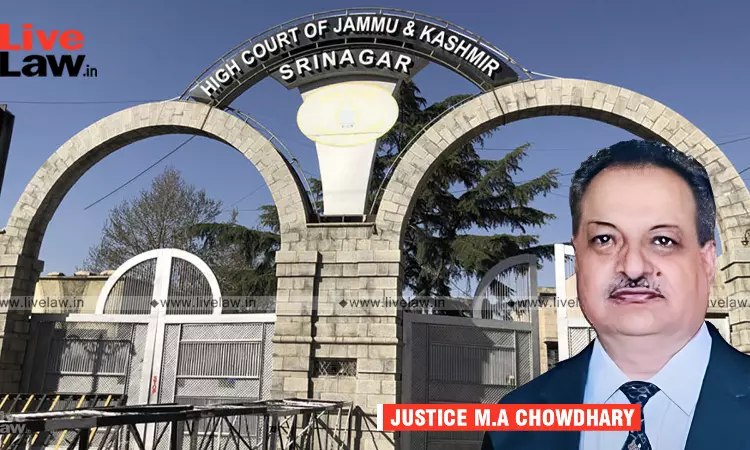
A Bench of Justice M. A. Chowdhary observed that “Black-topping of the internal roads of the godown premises constituted an essential component of the infrastructure envisaged under the Model Tender Form and the failure to provide the same amounted to breach of contractual obligations.”
Background:
The petitioner participated in the tender process floated by the Food Corporation of India for construction of godowns under the PEG Scheme and was awarded the work for establishing a storage facility with a capacity of 17,500 MT on a Build, Own and Operate basis. A Lease and Service Agreement was executed between the parties and the facility was taken over by FCI on Guaranteed Hiring Basis for a fixed period.
According to the petitioner, the godown had been functioning continuously and had been accepted by FCI as suitable and operationally fit for storage purposes. It was contended that the only work remaining was black-topping of the internal roads, which could not be completed within time due to circumstances beyond the petitioner's control, including the demise of one of its partners and the prevailing law and order situation in the Valley. The petitioner further asserted that an earlier recovery had already been made and that subsequent recoveries amounted to unjustified penal action.
The respondents contended that black-topping of internal roads was an essential contractual requirement. They submitted that the petitioner had furnished an undertaking to complete the work within the stipulated period and had even been granted an extension up to one year from the date of takeover. Despite this, the petitioner failed to complete the work within the extended period.
The respondents further asserted that the recoveries were based on decisions of the High Level Committee applicable to PEG godowns across the country and were calculated in accordance with the approved Cost Saving Amount formula.
Court's Observations:
The Court observed that the principal controversy related to the legality of recoveries effected on account of delayed completion of black-topping of internal roads in the godown established by the petitioner under the PEG Scheme.
It noted that the material facts were largely undisputed as the petitioner had admittedly not completed black-topping at the time the facility was taken over and had furnished an undertaking promising completion of the work within the prescribed period. Even after an extension was granted, the work remained incomplete, the court found.
Examining the contractual framework, the Court noted that the respondents had consistently maintained that black-topping formed an essential element of the infrastructure contemplated under the Model Tender Form. The Court accepted this position and observed,
“... the petitioner-firm, despite the terms and conditions of the agreement, had failed to provide the required infrastructure in full as it failed to complete the drainage as well as the black-topping of the internal roads within the stipulated period.”
The Court further examined the recoveries imposed by the respondents. It noted that the recoveries were not isolated actions but had their genesis in decisions taken by the High Level Committee in relation to PEG godowns across the country. The respondents had explained the methodology adopted for computation of the recoverable amount and had linked the recovery to the financial advantage allegedly derived by the petitioner through delayed execution of the black-topping work.
Addressing the petitioner's challenge based on arbitrariness and absence of actual loss, the Court found that the petitioner had failed to establish any legal infirmity in the impugned action. The Court observed,
“... the respondent-Corporation had taken a lenient view and recoveries were ordered in terms of the decisions taken by the High Level Committee.” It noted that the contractual arrangement empowered the respondents even to terminate the agreement for failure to fulfil contractual obligations, but instead recoveries alone were effected.
The Court also rejected the petitioner's reliance on the law and order situation prevailing in the Valley. It observed that the petitioner was required to complete the work before expiry of the extended deadline, whereas the disturbances relied upon commenced subsequently. The Court held that the petitioner, having furnished a specific undertaking regarding completion of the work, could not avoid the consequences flowing from non-compliance.
The Court further noted that the petitioner had challenged only the consequential communications through which recoveries were effected and had not challenged the foundational decisions taken by the High Level Committee pursuant to which the recoveries had been ordered. This aspect also weighed with the Court while examining the validity of the impugned action.
Finding no merit in the challenge mounted by the petitioner, the Court upheld the recoveries effected by the respondents and declined to interfere with the impugned communications. Consequently, the writ petition was dismissed.
Case Title: M/S Alpine Agro Services v. Union of India & Ors.
Citation: 2026 LiveLaw (JKL) 273


