



- Home
- /
- High Courts
- /
- High Court of J & K and Ladakh
- /
- “Statutory Authority Cannot Act As...
“Statutory Authority Cannot Act As Rubber Stamp”: J&K&L High Court Grants Relief To Homeowner, Stays Eviction
LIVELAW NEWS NETWORK
21 Feb 2026 9:20 PM IST
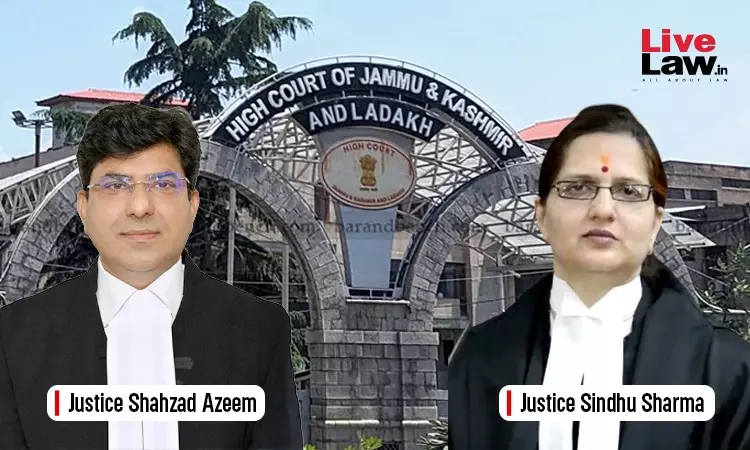
The High Court of Jammu and Kashmir and Ladakh has underscored that while practical assistance from subordinate officers is permissible and often necessary in large administrations, a statutory authority cannot abdicate its core decision-making function or act merely as a rubber stamp.The Division Bench of Justice Sindhu Sharma and Justice Shahzad Azeem underlined that final decisions...
This is a premium content
Available exclusively to
Our subscribers
Subscribe Premium 
INR 1099+GST
Your support helps us to bring you more content at
an affordable subscription scheme !!!
All payment options available
The High Court of Jammu and Kashmir and Ladakh has underscored that while practical assistance from subordinate officers is permissible and often necessary in large administrations, a statutory authority cannot abdicate its core decision-making function or act merely as a rubber stamp.
The Division Bench of Justice Sindhu Sharma and Justice Shahzad Azeem underlined that final decisions must reflect an independent application of mind, disclose reasons with reference to material considered, and withstand judicial scrutiny.
It added,
“… A statutory duty cast on a Statutory Authority cannot be fully got done through a subordinate in the sense of delegating the core decision-making power and full reliance cannot be placed on a subordinate officer's report without independent application of mind by the Authority”
The court made these observations while allowing a Letters Patent Appeal and granting interim protection to a Srinagar resident whose residential house had been locked and sealed during eviction proceedings.
Background:
The appellant claimed to be a bona fide purchaser of land at Srinagar, having purchased the same in 1996 through a registered sale deed and constructed a residential house after obtaining due permission in 2004. He asserted continuous residence with his family for over two decades.
Eviction proceedings were initiated against him following earlier directions passed in a writ petition filed by a private respondent, a migrant, seeking protection of his immovable property under the Jammu and Kashmir Migrant Immovable Property (Preservation, Protection and Restraint on Distress Sales) Act, 1997. Although the appellant was not a party to that petition, administrative orders were passed directing the taking over of possession of land alleged to belong to the migrant.
In an earlier round of litigation, the High Court had directed the District Magistrate to grant the appellant a post-decisional hearing, while expressly refraining from adjudicating the merits of the rival claims. After the hearing, the District Magistrate again rejected the appellant's claim, relying largely on reports of subordinate revenue officials.
The appellant challenged this order and sought interim protection, which was declined by the Writ Court on the ground of estoppel and on the premise that eviction had already been carried out.
Court's Observations:
Allowing the appeal, the Division Bench noted that the impugned order of the District Magistrate was founded almost entirely on vague and cryptic reports of field officials, with no independent assessment of crucial questions such as whether the land in question was migrant property, whether the appellant's possession was unauthorised, and how the survey numbers stood altered during settlement operations.
In a key observation, the Court held,
“Practical assistance from subordinates is allowed and is also necessary in large administrations, but the Statutory Authority cannot abdicate its duty or act as a rubber stamp. The final decision must reflect the Authority's own mind and the Order must ordinarily disclose reasons in reference to the material considered by it to withstand judicial scrutiny.”
The Bench emphasised that core decision-making power, the Court said, cannot be delegated, nor can the authority mechanically adopt subordinate reports without critical scrutiny.
The High Court also took note of glaring inconsistencies in the recording of survey numbers across different stages, observing that earlier records indicated one set of new survey numbers after settlement, while the impugned order referred to entirely different numbers without any explanation. This, the Court observed, prima facie indicated non-application of mind.
The Bench was further critical of the mechanical rejection of the appellant's documentary material, including his registered sale deed, site plans and building permission, as well as the summary dismissal of his request for demarcation under the Jammu and Kashmir Abadideh Survey and Record Operations Regulations, 2022, based on an erroneous understanding of their scope and purpose.
On the issue of interim relief, the Court held that the Writ Court had exceeded the permissible limits of interlocutory adjudication. It observed that the appellant had raised several arguable issues requiring full adjudication, including improper delegation of statutory power, conflicting revenue records, and denial of meaningful consideration to his plea for demarcation. It further noted that denial of interim relief had resulted in grave and irreversible consequences.
Expressing concern over the manner in which the eviction was carried out, the High Court recorded,
“… Here is a case which shocks the conscience of the Court when indisputably it is shown to the Court that the authorities have locked the house along with all household items, including study books belonging to the school- going children, during the eviction process, especially when the High Court was hearing the case on the same very day.”
Such action, the Bench observed, resulted in deprivation of shelter and severe disruption of family life, implicating the right to life under Article 21 of the Constitution.
Holding that the appellant had made out a strong prima facie case, the Court allowed the appeal. It thus set aside the Writ Court's order, stayed the operation of the District Magistrate's order and the eviction notice, and directed restoration of status quo ante by handing over the keys of the house to the appellant after preparing an inventory of household items.
Case Title: Noor Illahi Faktoo Vs UT Of J&K
Citation: 2026 LiveLaw (JKL) 61


