



- Home
- /
- High Courts
- /
- High Court of J & K and Ladakh
- /
- 'Purpose Of Investigation Is To...
'Purpose Of Investigation Is To Find Truth, Not Implicate': J&K&L High Court Quashes Charges Over 'Half-Baked' Report In Graft Probe
LIVELAW NEWS NETWORK
9 April 2026 2:01 PM IST
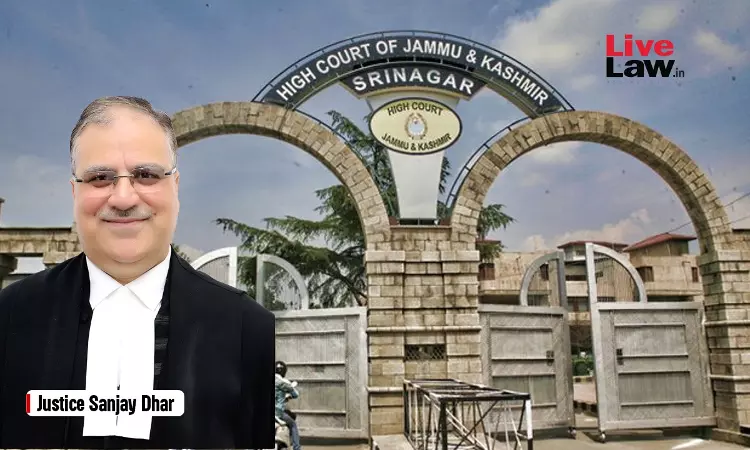
The Jammu & Kashmir and Ladakh High Court has held that the purpose of investigation is not to somehow implicate a person but to unearth the truth, and it is the duty of the investigating agency to ascertain the veracity of the defence projected by a suspect. The Court observed that when an accused provides an explanation in answer to a questionnaire, the agency must verify the same...
This is a premium content
Available exclusively to
Our subscribers
Subscribe Premium 
INR 1099+GST
Your support helps us to bring you more content at
an affordable subscription scheme !!!
All payment options available
The Jammu & Kashmir and Ladakh High Court has held that the purpose of investigation is not to somehow implicate a person but to unearth the truth, and it is the duty of the investigating agency to ascertain the veracity of the defence projected by a suspect. The Court observed that when an accused provides an explanation in answer to a questionnaire, the agency must verify the same before seeking to rely upon evidence that may be tainted by self-interest.
The Court was hearing a petition filed by a former Naib Tehsildar challenging orders passed by the learned Special Judge (Anti-Corruption), Jammu, including an order framing charges against him for offences under the J&K PC Act and the RPC in connection with an alleged conspiracy to tamper with revenue records.
The bench of Justice Sanjay Dhar observed,
“The purpose of undertaking investigation is not somehow to implicate a person but its purpose is to unearth the truth. In that direction, it is duty of the investigating agency to ascertain the veracity of the defence projected by a suspect. Otherwise, there was no purpose for the investigating agency to seek answers from the petitioner/accused to the questions formulated by the investigating officer.”
Background:
An FIR was registered against the petitioner and others for offences under the J&K PC Act and the RPC. The allegation was that the petitioner, while posted as Naib Tehsildar, General Record Room, Jammu conspired with a Patwari to manipulate revenue records to confer undue benefit upon a beneficiary.
The trial court directed the investigating agency to conduct further investigation regarding the petitioner's actual role. Pursuant to this, the agency recorded statements of two witnesses, including the Junior Assistant who was the immediate custodian of the record. The trial court thereafter framed charges against the petitioner.
Court's Observation:
The Court noted that the petitioner had projected a specific defence in answer to the questionnaire given to him by the investigating officer. The petitioner stated that the settlement record was under the lock and key of the Junior Assistant, and that the tampering seemed to have been done by the Patwari before depositing the record in the record room and before the petitioner's joining as Incharge Naib Tehsildar and the record was deposited in the record room on October 17, 1997.
The Court held that it was the duty of the investigating officer to ascertain the veracity of this defence. The Court observed that the Junior Assistant, whose statement was recorded, was the immediate custodian of the record. Before placing reliance upon his statement, the court opined that it was incumbent upon the investigating agency to ascertain the approximate period when the insertions or corrections in the revenue record had taken place.
The Court remarked,
“Having regard to the nature of technology that is presently available with the FSL laboratories, it is quite possible to determine the approximate age of the insertion/tampering that has taken place in the revenue record in the present case. On that basis, the investigating agency could have taken a cue for undertaking further investigation of the case. Instead of doing so, the investigating agency has taken a short cut and recorded statements of two witnesses, one of whom might be interested in saving his own skin to lay blame on others”
The Court further observed that the assertion of the Junior Assistant that the record was tampered with the connivance of the petitioner may or may not be correct. However, having regard to the fact that he was the immediate custodian, if the tampering had taken place during a period when the petitioner was not incharge of the record room, the assertions could not have been relied upon and the defence put up by the petitioner would get vindicated.
The Court criticized the investigating agency for taking a shortcut by merely recording statements of two witnesses, one of whom might be interested in saving his own skin to lay blame on others. The Court held that the investigating agency had submitted a half baked report without undertaking a proper investigation regarding the approximate period of tampering or verifying the defence projected by the petitioner.
The Court also noted that the trial court had observed that there were five Naib Tehsildars during the relevant period, including a distant cousin of the accused Patwari, yet it remained satisfied with the nature of further investigation. The Court held that the trial court should have asked the investigating agency to conduct a proper investigation instead of proceeding to frame charges.
The Court thus disposed of the petition by upholding the order directing further investigation, but quashing the order framing charges and the memo of charges against the petitioner. The Court directed the investigating agency to undertake further investigation in the light of the observations made by the trial court and the High Court, and to file a final report in the prescribed form under Section 173(2) of the CrPC.
The trial court shall thereafter consider the question of framing of charges afresh on the basis of the entire material brought on record, the court concluded.
Case Title: Subash Chander Sharma v. SHO P/S Anti Corruption Bureau Jammu & Ors.
Citation: 2026 LiveLaw (JKL) 141


