



- Home
- /
- High Courts
- /
- High Court of J & K and Ladakh
- /
- Justice May Be Tempered With Mercy...
Justice May Be Tempered With Mercy In Exceptional Cases: J&K&L High Court Allows Symbolic Possession In Migrant Property Eviction Dispute
LIVELAW NEWS NETWORK
15 Jan 2026 7:05 PM IST
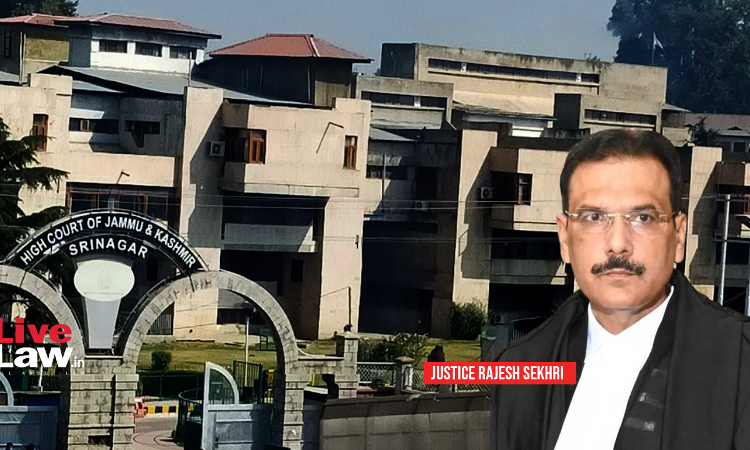
While reaffirming that justice must ordinarily be administered strictly in the manner prescribed by law, the Jammu and Kashmir and Ladakh High Court has underscored that in exceptional factual situations, courts cannot remain indifferent to human consequences.Observing that rigid statutory compliance may, in rare cases, require to be balanced with compassion, the Court held that justice...
This is a premium content
Available exclusively to
Our subscribers
Subscribe Premium 
INR 1099+GST
Your support helps us to bring you more content at
an affordable subscription scheme !!!
All payment options available
While reaffirming that justice must ordinarily be administered strictly in the manner prescribed by law, the Jammu and Kashmir and Ladakh High Court has underscored that in exceptional factual situations, courts cannot remain indifferent to human consequences.
Observing that rigid statutory compliance may, in rare cases, require to be balanced with compassion, the Court held that justice may legitimately be “tempered with mercy” where extraordinary circumstances so demand. These observations were made by Justice Rajesh Sekhri while dealing with a dispute involving eviction from a residential house raised over migrant property in Pulwama.
Factual Background:
The writ petition was filed by Farooq Ahmad Dar, challenging an order passed by the District Magistrate, Pulwama, whereby a Mutation was set aside and the Tehsildar was directed to take over possession of the subject land and hand it over to the private respondents, who claimed ownership as migrant landholders. The District Magistrate had exercised powers under the Jammu and Kashmir Immoveable Property (Preservation, Protection and Restraint on Distress Sales) Act, 1997.
Aggrieved, the petitioner directly approached the High Court seeking quashment of the order, contending that he had been in settled possession of the land for over two decades and had constructed a residential house thereon. According to the petitioner, the land had been alienated in his favour in the year 2000 by the mother of the private respondents through an irrevocable General Power of Attorney and a supporting affidavit.
Advocate Nissar Ahmad Bhat, appearing for the petitioner, argued that the writ petition was maintainable despite the availability of a statutory appeal under Section 7 of the 1997 Act. He submitted that the appellate remedy was illusory and inefficacious, as the statute mandates surrender of possession as a precondition for filing an appeal. Given that the petitioner and his family were residing in the house constructed on the land, compelling physical surrender would result in grave hardship. Reliance was placed on the Supreme Court judgment in Godrej Sara Lee Ltd. v. Excise and Taxation Officer to contend that alternative remedies do not bar writ jurisdiction in all cases.
Opposing the petition, Ms. Maha Majeed, AAG, assisting Senior AAG Mohsin S. Qadri for the official respondents, along with Advocate Zaffar Qadri for the private respondents, raised a preliminary objection to maintainability. They argued that the petitioner had bypassed the statutory remedy of appeal provided under the 1997 Act and had approached the High Court directly. Several precedents of the High Court were cited to reinforce the settled principle that writ jurisdiction should not be invoked when an efficacious statutory remedy is available.
Court on Statutory Remedy and Jurisdiction
Justice Sekhri noted that the impugned order had been passed by a competent authority under the Act and after affording an opportunity of hearing to all parties. The Court observed that none of the recognised exceptions to the rule of alternative remedy such as lack of jurisdiction, violation of natural justice, enforcement of fundamental rights, or challenge to legislative vires were attracted in the present case.
Placing reliance on the Supreme Court decision in Radha Krishan Industries v. State of Himachal Pradesh, the Court reiterated that where a statute creates a right of appeal, parties must ordinarily exhaust that remedy before invoking the writ jurisdiction under Article 226.
“.. Since petitioner has neither sought enforcement of any fundamental right nor challenged the vires of any legislation, the present case is not covered under any of the four exceptions carved out by the Supreme Court in Radha Krishan Industries. As such, when a right of appeal is created under the Act, resort must be had to the statutory remedy, before invoking discretionary writ jurisdiction of the High Court, under Article 226 of the Constitution”, the court maintained.
The Court also adverted to the legislative intent behind the 1997 Act, noting that it was enacted in the backdrop of the mass exodus of a minority community from the Kashmir Valley in 1989. The requirement of surrendering possession before filing an appeal, the Court observed, was a conscious legislative safeguard to protect migrant properties and could not be diluted as a matter of routine.
At the same time, the Court recognised the peculiar factual situation presented in the case. Emphasising a humane dimension, Justice Sekhri observed,
“True it is that justice has to be administered as per the mandate of law, and when a Statutory Authority is required to do a thing in a particular manner, the same has to be done in that manner or not at all. However, in peculiar facts and circumstances of a case to address an extraordinary situation presented in a case, the justice at times is required to be tampered with mercy.”
The Court noted that the petitioner claimed to be in long, undisturbed possession and had raised a residential house on the land. It reiterated that a person in settled possession cannot be evicted except by due process of law, and that “settled possession” implies effective and undisturbed possession for a considerable period to the knowledge of the owner.
Symbolic Handing Over Of Possession:
Confronted with the question of whether the petitioner could be compelled to surrender physical possession of his house merely to avail the statutory appeal, the Court relied on the Division Bench judgment in Shabir Ahmad Rufai v. UT of J&K. In that case, the Court had permitted filing of an appeal after handing over symbolic possession of the property.
Justice Sekhri endorsed this approach, observing that symbolic delivery of possession amounts to actual delivery in the eyes of law, even though the occupant is not physically removed. He remarked,
“.. In my opinion, the arrangement devised by the Division Bench in “Shabir Ahmed Rufai” shall be in the fitness of justice, and it shall be expedient if the petitioner is allowed to handover the symbolic possession of the subject property before availing the statutory remedy of appeal”
Accordingly, the High Court dismissed the writ petition on the ground of availability of an alternative statutory remedy, but granted liberty to the petitioner to file an appeal under Section 7 of the 1997 Act by surrendering symbolic possession of the property within one week.
The Appellate Authority was directed to decide the appeal expeditiously, preferably within three months, after hearing both sides. The petitioner was also directed to file an undertaking to hand over vacant possession in the event of failure in appeal.
Case Title: Farooq Ahmad Dar Vs UT Of J&K
Citation: 2026 LiveLaw (JKL) 17


